Stopping violence against women
Psyche

Violence at home: "It happens in all social classes"

We talk to Jutta Dreyer, family therapist and counselor at the pme's life situation hotline Familienservice. The Lebenslagen-Hotline offers its contractual partners' employees anonymous and free initial and crisis counseling for women, children and other people affected by domestic violence.

Ms. Dreyer, where does domestic violence begin?

Jutta Dreyer: Domestic violence refers to violence that occurs within a couple or marriage. However, it can also be committed between siblings, against children by their parents or against parents by adolescent children. In our counseling sessions, we also often encounter cases where older people experience violence at the hands of their family caregivers. In most cases, domestic violence happens in the home.

Domestic violence ranges from insults, prohibitions, threats and humiliation to physical, psychological, sexual and economic violence if the victims are financially dependent on the perpetrator. In most cases, those affected experience several of these forms of violence at the same time.

Domestic violence increasingly includes digital violence . In a growing number of cases, victims are confronted with partners or ex-partners who publish intimate images or use them in so-called deepfakes to discredit them. Or surveillance software is secretly installed on their cell phone to digitally stalk and control them. The goal here is to make the person feel unsafe everywhere.

Digital violence

We’ve put together a summary of the steps you can take if you’re a victim of cyberbullying,which you’ll find below the interview.

Who is affected by domestic violence?

Domestic violence exists in all social classes and anyone can be affected by it. As a rule, it is women who experience physical, psychological and sexual violence at the hands of their partners. There are also men who are victims of domestic violence. However, in four out of five cases, women are the victims.

You said that children are also victims of domestic violence.

If children live in the household, they are often victims of physical abuse themselves or are extremely affected because they have to witness the violence and the climate of fear and intimidation. The children often try to protect their mother and are exposed to conflicts of loyalty towards their father. The children usually suffer psychological consequences for a very long time and show behavioral abnormalities as well as anxiety and developmental disorders.

What are the most common forms of domestic violence you encounter in your counseling practice?

In the case of domestic violence, a distinction must be made between spontaneous conflict behavior and systematic controlling behavior. In the case of systematic violence, the perpetrator is concerned with dominating the relationship and exercising power. The victims here are almost exclusively women. Violence as spontaneous conflict behavior arises from affect when an argument or conflict escalates. Incidentally, women and men are equally affected by this.

This YouTube content can only be loaded if you accept the privacy policy of Google LLC.

To the data protection settings "


Why do many women stay in relationships?

Many women are afraid that the situation could escalate at the moment of separation. This is why it is important in counseling to be very careful at this point, to develop an emergency plan and to put everything in place to protect the women and their children. On the other hand, many women have financial fears, are worried about taking their children out of their familiar environment and do not know whether they will be able to cope with the changes after a separation. Most men are also very loving again at times. The perpetrators often apologize after they have been violent and promise never to do it again. As a result, many women hope that things will get better again.

How can you help women to decide?

For many women, it is important that they are met where they are and that someone listens to them without exerting pressure or forcing them to make a decision. We inform them about their rights and the options for help and support so that they can decide for or against a separation. It is important that we draw a "picture" together with the women that includes a future that can work from their point of view. We want to encourage the women to recognize their strengths and resources and to see what they have already achieved.


Violence in the home: Children suffer particularly badly. Child protection experts can help.


If a woman decides to separate, how do you help?

Of course, this depends very much on the situation the woman is in. If the situation threatens to escalate, we do everything we can to protect her: we call the police for support or a cab if things have to move quickly. If the women want to leave their homes, we research women's shelters, look for other safe places such as boarding houses or think about which friends or relatives they could find a safe place with.

For many women, however, counseling is a first step towards finding out what the way out of violence could look like, what their options are and where financial help is available.

What to do if children are affected by domestic violence? How can they be protected?

If children are affected by domestic violence and we have the impression that they are in acute danger, then we are also obliged to act. I also advise mothers to inform the youth welfare office if their children are affected by violence. In my experience, the youth welfare offices are very well thought out and professional and try to support the families very well. We also have child protection experts in our counseling service who we can call in if we wish.

What many women don't know: There is a right to physical integrity. This means that the moment a person is threatened in their own home, it is decided through the courts that the home is awarded to the victim and the partner must leave.

What services are available for men who no longer want to be perpetrators?

There are programs for perpetrators, and they are very successful if the men are willing to get involved and want to change their behaviour. Anyone who would like to find out more can contact the men's counseling centers.

Thank you very much for the interview!

Digital Violence: Protective Measures and Legal Action

Digital violence is a serious threat. If you are a victim, there are concrete steps you can take to protect yourself and fight back.

General Immediate Measures & Key Principles

  • Preserve evidence: Take screenshots of all relevant interactions. Save messages, images, and profiles. Always note the date, time, and platform where the incident occurred. This documentation is crucial for any potential legal action.
  • Block the perpetrator: Block the person in question on all platforms. If necessary, change your username so that they can no longer find you directly.
  • Secure your accounts: Change your passwords immediately and enable two-factor authentication (2FA) wherever possible. This applies to all your accounts, especially email, social media, and cloud services.
  • Seek help: You don’t have to deal with this situation on your own. Talk to people you trust and reach out to professional counseling services.

Resources for those affected:

  • "Violence Against Women" Helpline: Call 116 016 for free, anonymous, 24/7 support.
  • myprotectify.org: A platform by and for people experiencing domestic violence.
  • HateAid: Provides specialized counseling and legal support for victims of online abuse.
  • Weisser Ring: Supports victims of crime, including cases of cyberstalking.

Forms of Digital Violence and Targeted Countermeasures

1. Cyberstalking

This refers to persistent stalking and harassment through unwanted messages or the monitoring of online activities.

Countermeasures: 

  • Ignore & Block: Do not respond to attempts to contact you. Any response could be misinterpreted by the stalker as "encouragement." Be sure to block the person on all platforms.
  • Check your privacy settings: Set your social media profiles to "private." Check who can see your posts, and remove that person from your followers or friends list.
  • Inform those around you: Let your friends and family know so they don’t unwittingly pass on information to the stalker.
  • Protect your location data: Turn off the GPS feature for your social media apps and avoid posting your live location.

Legal action:

  • File a police report: Cyberstalking is a criminal offense classified as "harassment" (Section 238 of the German Criminal Code). Filing a report is the most important step toward putting an end to the stalking. Bring all the evidence you have gathered with you to the police.
  • Apply for a protection order: You can obtain a temporary restraining order from the court that prohibits the abuser from contacting you or approaching you. This also applies to digital communication.

2. Image-based violence (e.g., "revenge porn")

The unauthorized creation, sharing, or threat of distribution of intimate images.

Countermeasures:

  • Notify the platforms: Immediately report the content to the operators of the websites or social media platforms and request that it be removed. Use the designated "Report" buttons to do so.
  • Use the "StopNCII.org" tool: This tool helps proactively prevent the distribution of intimate images. You can use it to generate a digital fingerprint (hash) of your images. Participating platforms will then automatically block the upload of these images without you having to hand over the originals.
  • Do not give in to blackmail: If you are threatened with disclosure, do not pay any money. This usually does not solve the problem and can make the situation worse.

Legal action:

  • Reporting a crime to the police: Creating and distributing such recordings without consent is a criminal offense (Section 201a of the German Criminal Code (StGB), Section 184g of the German Criminal Code (StGB), Sections 22 and 33 of the German Artistic Copyright Act (KUG)).
  • Legal assistance: A lawyer can help you enforce claims for injunctive relief and damages and expedite the removal of the content.

3. Deepfakes

Realistic-looking fake images, videos, or audio recordings designed to portray you in a false light.

Countermeasures:

  • Report and Have It Removed: Report the fake content to the platform operators immediately.
  • Clarification: Depending on the situation and after consulting with an advisory service, it may be advisable to make the forgery public in order to regain control over the narrative.
  • Reverse image search: Tools like Google Images or TinEye can sometimes help you find the original material used to create the fake. This can serve as evidence of manipulation.

Legal action:

  • Criminal Complaint: Even though there is no specific "deepfake law," such acts are punishable by law. Depending on the content, they may constitute offenses such as insult (§ 185 StGB), defamation (§ 186 StGB), slander (§ 187 StGB), or a violation of the right to one's own image.

4. Digital Surveillance & Stalkerware

The misuse of tracking apps to monitor your smartphone activity.

Countermeasures:

  • Check your smartphone: Go through the list of your installed apps. Look for apps you don't recognize or that have suspicious names (e.g., "System Service").
  • Anti-stalkerware apps: Programs like Malwarebytes or specialized tools from antivirus vendors can detect and remove such surveillance apps.
  • Factory reset (last resort): If you’re certain you’re being monitored but can’t find the app, resetting your device to factory settings is the safest option. Warning: Be sure to back up your important data first, but don’t restore an old backup, as it may contain spyware.
  • Change your passwords: Immediately after uninstalling the software, change all your passwords, especially those for your email and cloud accounts (Apple ID, Google Account).

Legal action:

  • Reporting a crime to the police: The unauthorized installation of surveillance software is a criminal offense (Section 202a of the German Criminal Code: Interception of data; Section 202b of the German Criminal Code: Interception of data).
  • Important: Ideally, have your device backed up by IT forensic experts or the police before the software is removed, so that the incident can be documented in a way that preserves the evidence.

The following apps can help you find such software:

  • Malwarebytes: This app is known for its ability to detect and remove malware and spyware from mobile devices. It also offers protection against stalkerware.
  • Avira: Avira offers mobile security solutions that are also effective at detecting stalkerware.
  • Avast: Avast also offers mobile security solutions to protect against unwanted spyware.
  • Clario Anti Spy: This tool automatically scans your device for hidden spyware, suspicious apps, and system-level tampering—issues commonly found in lists of stalkerware apps.
  • Protectstar Anti Spy: This app scans for suspicious profiles, excessive permissions, or known stalkerware remnants and provides clear recommendations for action.

zero 8 alternatives to a salary increase: benefits for employee retention

Benefits for employees - a group of people standing smiling under an umbrella
Leadership & HR

8 alternatives to a salary increase: benefits for employee retention

Benefits in kind, recreational allowances, social funds: employerscan support their employees financially with benefits without increasing their salary. This has advantages for both sides.

From employee retention to employer branding: employers can only benefit if they offer their employees benefits. Employees feel appreciated, save on bus tickets, for example, and thus also save themselves from having to reach into their own wallets. Young professionals in particular attach great importance to an attractive benefits package when looking for a job.

Study: The most important employee benefits

In view of drastically rising energy prices and the cost of living, benefits are becoming even more important and form an important building block for retaining and supporting employees - especially those on low incomes.


"People on low incomes generally don't have economical electrical appliances either, often have draughty windows, old gas boilers and poorly insulated homes, which exacerbates the whole problem."

Caritas spokesperson, report by RedaktionsNetzwerk Deutschland (rnd)


Note

The content of our information and service materials is compiled with the greatest care and checked regularly. However, no liability can be accepted for the completeness and topicality of the information. Any legal notices, recommendations or information contained herein are non-binding. The pme Familienservice accepts no liability for this.


1. social fund in financial emergencies

The company's own social fund is a financial subsidy in emergency situations or acute emergencies that can be paid out to employees who find themselves in financial difficulties through no fault of their own, e.g. due to serious illness, death of a partner, accident, imminent loss of housing, etc.

The amount paid out from the fund does not have to be repaid by the employee. The amount available each year is determined by the company itself.

Important: The company must conclude a company agreement and define the criteria according to which the social fund is paid out to the applicant(s).

In addition, an autonomous and trustworthy body is needed to manage the social fund, check the applications and pay out the amount to the employee - such as the works council or, alternatively, the employee representative body.

You should clarify the details in advance with your own legal and tax department.

When is the social fund paid out?

Approval and payment usually take place in 3 steps:

  1. Employees in an emergency situation submit an application in which they describe their emergency situation and state what the money from the fund is needed for.
  2. The application is reviewed by an independent body (works council, employee representative body), taking into account income and family circumstances.
  3. If the application meets the internally defined criteria and the legal requirements, the amount is transferred once, in addition to the salary.

The employer is not informed of any of this: neither the amount, nor who the applicant is, nor the reasons given.


"If someone obviously gets into an emergency situation through their own fault, which could have been avoided, for example, by taking personal precautions, then we are not allowed to pay out anything. However, if there is a sudden threat of losing your home due to flooding, death or serious illness, for example, then this is an acute emergency situation that the person has got into through no fault of their own. With the social fund, we can help quickly, discreetly and unbureaucratically in serious emergencies."

Peter Fischer, employee representative, pme Familienservice

Would you like to find out more about the Social Fund?

If you are interested in setting up a social fund in your company, please contact Peter Fischer for further information.

2. employer loan

The employer loan can also be an alternative to the usual bank loan and help employees in financial difficulties out of trouble.

A loan can be granted in emergencies or crisis situations, but not as regular financial support.

The loan is a voluntary benefit provided by the employer. If the company is prepared to grant loans, this can be agreed in a loan agreement .

In justified emergencies, a loan must be distinguished from remuneration, advances and deductions from remuneration and is not directly related to the employee's work and employment contract. It therefore does not constitute consideration for the work performed.

When is the employer loan paid out?

Three steps to an employer loan:

  1. Employees submit an application, which is then submitted to the HR department together with the manager.
  2. The HR department will review the application together with the applicant and the manager.
  3. If the loan is approved, payment is made via the accounting department. The amount is paid out independently of the salary.
Please note:

A loan should not be granted if wages have already been garnished, if there are long-term financial problems or if consumer insolvency is to be expected.

The loan can generally be granted interest-free up to an amount of € 2,600. In addition, the prescribed calculation of interest is required.


If employers wish to grant a loan with interest , this must be expressly agreed in the contract. If no interest is agreed in the contract, the loan must be repaid without interest.

"The company must of course check whether it has the means to offer its employees an interest-free loan. The main effort involved is talking to the HR department and the manager to check the application."
- Nils Hofert, Head of Human Resources, pme Familienservice

Further information: Hasselbach law firm

3. tax-free recreation allowance

Recreation allowances are voluntary financial benefits that employees can receive from their employer.

The maximum amount and frequency of payment of this benefit is defined by law.

A company is free to decide whether to pay out the maximum amount of currently 156 euros for the employee and 104 euros for partners and 52 euros for each child - or less.

How the employee in question spends their vacation is irrelevant. The employer can also subsidize a vacation stay at home for its employees.

How is the recovery allowance paid out?

Whether working student, mini-jobber or permanent employee: all employees are entitled to a recreational allowance.

  • The recovery allowance is tied to a calendar year and cannot be transferred.
  • The allowance may only be paid within three months before or after the start of the leave.
  • The money from the recreation allowance may only be spent for the purpose of recreation.

Further links:

www.impulse.de/recht-steuern/rechtsratgeber/erholungsbeihilfe

www.haufe.de/erholungsbeihilfen

4. non-cash benefit value of 50 euros per month

Another alternative to a taxable salary increase are benefits in kind.

Every company can give employees up to 50 euros a month free of tax and social security contributions . If the amount is exceeded, income tax and social security contributions are payable.

The benefit in kind may only be granted once per employee per month.

Benefits in kind are, for example:

  • Employer's contribution to accommodation costs
  • Meals
  • Work clothes
  • Petrol or other vouchers (no marketplace vouchers, e.g. from Amazon and Kaufland)
  • Admission tickets

Gifts for personal occasions

Gifts for birthdays, anniversaries or a personal occasion can be given by an employer in addition to benefits in kind . The maximum tax-free amount for gifts is €60 per personal occasion.

Further information:

www.edenred.de/sachbezug-2022

www.smartsteuer.de/online/lexikon/s/sachbezuege

5. job tickets & monthly passes

In view of the current very high gasoline and diesel prices, this topic is likely to be of particular interest to many employees.

The job ticket category includes monthly or annual tickets that companies purchase from public transport companies and then pass on to their employees free of charge or for an additional payment.

The job ticket must be provided in addition to the salary already owed.

The tax exemption has applied to both the job ticket and the employer subsidy for journeys on public transport since 01.01.2019.

6. leasing bike

There are now many providers of leasing company bikes. Employers can lease bicycles from them for a predefined period of time.

Such contracts usually run for 36 months. At the end of the contract, the leased bike must be returned - or can be purchased by the employee. It is also possible to extend the contract, return the old leased bike and get a new model.

This also pays off for the employer: According to a study, employees who cycle to work all year round are sick around 1.4 days less per year and also feel better.

How does the employee receive the leased bike?

The employer leases the bike. The employee rides it whenever he or she wants, whether for work or leisure. The employee pays the monthly leasing rate by converting his or her salary.

This means that the employee's gross salary is reduced by the leasing installment. This benefits both sides: Both employees and employers pay less social security contributions thanks to the employee's lower gross salary. Journeys between home and work must be accounted for in the same way as a company car.

"Administrative work arises above all when the leasing contract is interrupted by employees, for example due to a long illness, pregnancy or if the team member leaves before the 36-month leasing period expires."

Anke Bechler, Human Resources, pme Familienservice

Further links:

www.impulse.de/recht-steuern/dienstfahrrad

7. private insurance at special conditions

The company pension scheme is great, but having the additional opportunity as an employee to take out further discounted insurance makes this offer even more attractive.

At pme Familienservice , team members can use an insurance service to take out the most important private insurance policies, such as liability, accident, residential buildings, household contents, motor vehicle and more.

On request, employees can receive individual offers for additional insurance (e.g. Riester pension, supplementary health or long-term care insurance).

How does the employee get the insurance?

Employees can access all the relevant documents for concluding a contract via a dedicated insurance website for your company. A special bonus: spouses or life partners can also benefit from the special conditions.

Please note:

The employer does not receive any cash benefits or commission from the insurer, but also assumes no liability for the benefits and contracts.


"We pre-selected the insurance companies. And then the biggest effort was to inform our team members about it - via flyers, the intranet and the employee magazine, for example."
- Nils Hofert, Head of Human Resources, pme Familienservice

8. lunch and drinks

To help employees with their living expenses, employers can provide their employees with lunch and drinks free of charge.

The company can tax the non-cash benefit at a flat rate of 25 percent. The big advantage of this is that no social security contributions are due for flat-rate taxation.


"At the Berlin headquarters, we get lunch delivered by a caterer and the team members also eat here in the office. The work consists of accepting the food, preparing it, clearing and washing the dishes and keeping the kitchen clean. The team members also get fresh salad, which I chop and prepare every day. I spend 4 to 5 hours a day doing this."

Anke Brennecke, housekeeper, pme Familienservice


Further information:

Meal allowance tax-free - All information 2024


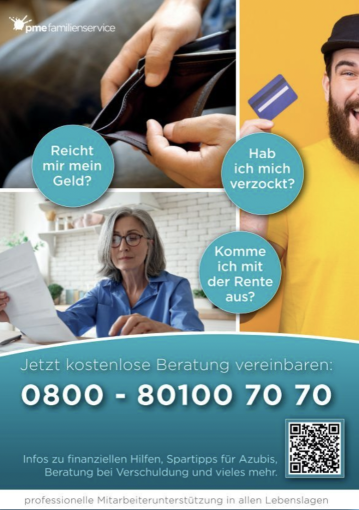
Ordering posters: Advice on financial difficulties

Are you an employer and already a client of our income and budget advice service? Inform your employees about your offer.


​​​​​​​

Download and print (A4)

To the free poster order (A2)