29.10.2024
  Christin Müller
  38021
38021
Actor Samuel Koch: "I wish for several lives"
The name Samuel Koch is inevitably associated with December 4, 2010. On that day, the former artistic gymnast fell so badly on the TV show "Wetten, dass...?" that he has been paraplegic ever since. Millions of people shared in his fate and were inspired by his fighting spirit and courage. We met the 37-year-old at Health Day 2024 and spoke to him about shattered dreams, new perspectives, his club work and tree house parties in Nicaragua.
Bestselling author, actor, club founder, speaker and former professional gymnast. Quite a lot for one life ...
Gymnastics has always been my purpose in life, I've been doing it for as long as I can remember and practiced it intensively until I couldn't do it anymore. In my best days, I trained at least twice a day and competed in the second national league in Germany, but mainly in the French league.
After graduating from high school, I wanted to do something with the body I'd been growing for almost 17 years and somehow fly. On a physical, sporting level, there is no better school than artistic gymnastics.
Various ideas and opportunities opened up: I passed my officer's aptitude test in the German army and wanted to become a jet pilot, I had a scholarship offer from the State University of Illinois as a gymnastics coach. And because I had done gymnastics in France, I also considered joining Cirque du Soleil as an acrobat.
In the end, I applied to drama school because I could do a bit of everything there. It's a course where you tap dance, ride, dance and have acrobatics lessons.
At the audition at drama school, they said: "How is it possible that you have such a full CV at 21?". Even after leaving school, I thought: "I need seven or eight lives with all there is to discover here". In the meantime, however, I no longer had a plan because my life and my plans were so focused on my body.
But now I'm back to the point where I wish I had more than one life.
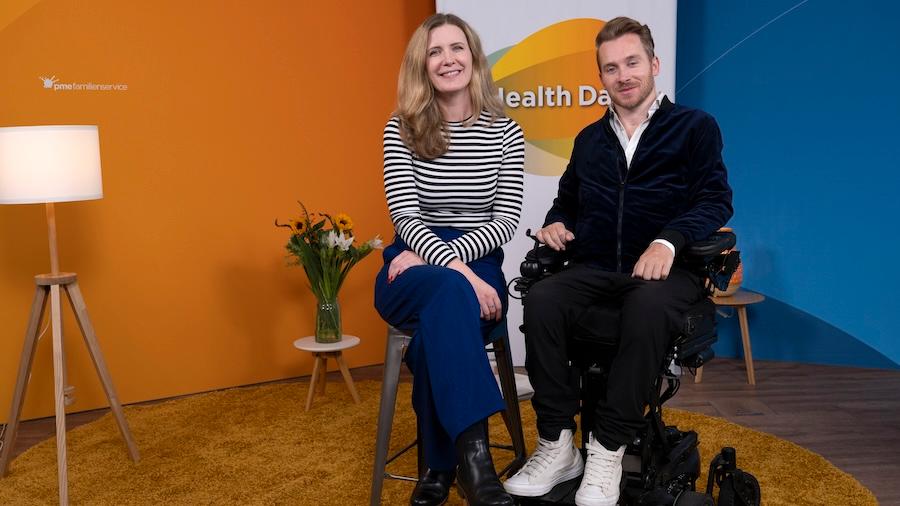
Samuel Koch in conversation with pme editor Christin Müller.
You were so active before your accident. After day X, did you ask yourself whether you could still be who you were before?
Everything I wanted to do was suddenly gone - Cirque du Soleil, gymnastics coach, pilot - and I would have needed my body for everything else.
For as long as I could remember, I was always defined and identified as an athlete and gymnast and was often away at school for competitions. And then suddenly I wasn't anymore and was just lying around. It made me wonder who I actually was.
And then you became a bestselling author after the accident ...
When I was still in hospital, many publishers approached me and wanted to do a book with me. At first, I turned everything down. Then, through a friend, I met the publishing director of Adeo Buchverlag, who convinced me in conversation. We agreed on an exit clause, which I could make use of the day before publication and cancel without giving a reason. That sounded fair. The publishing director in turn introduced me to Prof. Dr. Christoph Fasel, with whom I am still friends today. I told him everything and he wrote it down. It was nice to talk to him - perhaps also a form of therapy.
When I saw the text for the book, I pulled the exit clause and said "We're breaking off. We're leaving it now". I thought it was all strange and stupid. Then the head of publishing introduced me to the editor Karoline Kuhn - who is still a good friend of mine today. He put her at my side and she wrote every sentence the way I wanted it.
That's how the book "Two Lives" came about. My main motivation behind it was the fact that I had - and this is no exaggeration - received boxes of letters from people. There was a touching collective sympathy. By telling my story, I found a way to respond to all these people.
Have you developed dreams in recent years that you hadn't thought of before because they weren't relevant yet?
Yes, this is our association work with Samuel Koch und Freunde e.V., which would never have occurred to me before. It was only during my time in rehab that I realized what an incredible treasure it is to have so many friends and family members at my bedside that I had to set up a schedule for the visits. The colleague in the bed opposite me screamed all night in pain and because he was alone and full of grief. When you lie there for nine months, fewer and fewer people come over time. That was such an eye-opening experience for me.
In addition, over the months I received (and still receive) a lot of mail from mostly overburdened, overwhelmed, desperate people who have suffered a stroke of fate in their family and identify with my situation.
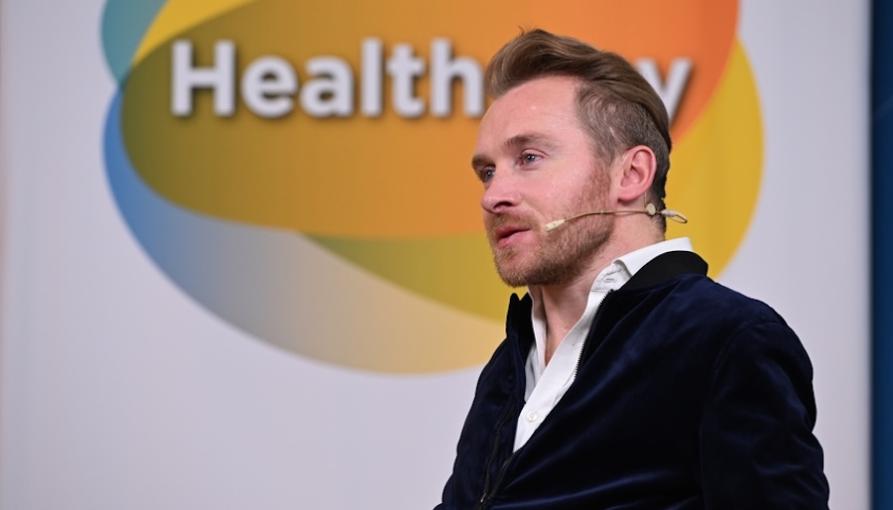
Samuel Koch was a speaker at the pme Health Day 2024.
Are people hoping for concrete help?
They see me in public and perhaps think to themselves: "He's done it, despite all the crap he's been through." I know that about myself too. I was completely disoriented and no longer had a plan for my life. Not being able to walk and being in a wheelchair is only what you can see.
But all of this entails a rat's tail of imponderables that I still have to deal with today. Every month you have to reapply for someone to keep you alive. My father has given up his pension so that he can help pay for his son's care - that's my everyday life. I still have the chance to work as a speaker to earn some extra money. It's hard to imagine what it's like for others.
How do you support people with your association?
Our work supports the group of family caregivers - the mothers, fathers, siblings and partners of injured or seriously ill people who don't know what to do next.
On the one hand, there are many offers, on the other hand, there are many people who need help. I wanted to bring supply and demand together. That's how the association came about. For example, we always realize how valuable it is to hold regular family times, which are a time-out for body, soul and spirit for the family or siblings who are sometimes overshadowed. People draw on our family times, sometimes for years.
What does family time look like?
The families who come to us have a relative with limitations or severe limitations, disabilities or a severe disability.
No matter how much you love your father, mother or child, at some point you reach your limit. After all, caring for people with severe disabilities is a 24/7, 365-day-a-year job. People whose child is in a wheelchair, for example, can't simply go on vacation because it's often not financially feasible.
During family time, you don't have to look after them for a week because we take over the care and supervision. The family carers can take some time off. And this looks very colorful in detail: Manicures for mothers, massages, canoe trips, singing with music therapists, arts and crafts, counseling sessions, exchanges with other families - there's something for everyone.
We are currently renting space in existing buildings. Sometimes in the Berlin City Mission, sometimes in a Tabaluga House run by the Peter Maffay Foundation, sometimes in a monastery in central Germany, sometimes in a farmhouse. The aim is to eventually have our own institute of hope, an oasis of well-being for body, soul and spirit, where everything is barrier-free - from the playground and jacuzzi to the theater room and workshop.
What are you doing for your mental health?
I consciously start each day in silence, with a listening heart - without a cell phone or other things that keep me busy and distracted. As soon as you turn on your cell phone, everything is urgent, you still have to do this, that and the other. I don't think that's good for your mental health.
I can spend an hour or two just reading and being quiet and thinking before I start my business. I have to be careful not to get bogged down. But sometimes my quiet time only lasts three minutes.
Quiet times are very important to me. Once or twice a year, I consciously try to spend several days doing nothing other than what is now known as detoxing. I then like to go to a monastery - in the traditional way. And I try to end my day the way I started it.
It sounds like you have developed a good plan to keep your life in balance ...
Yes, apart from that I'm not so good at work-life balance. My wife always says I have a work-work balance. I think within my work-work balance, my work-life balance or my mental health, it's beneficial that my work is also my life and my life is also my work.
There are coaches who say "I can't do that" is a self-imposed limitation. How do you see that?
I'm very ambivalent about it. On the one hand, I can say very factually: "I can't run." Then when I hear sayings like "You just have to believe in yourself", "You just have to want it", "Live your dream", I have to say: "Sometimes it just doesn't work". There are things that we can't deny or sugarcoat, no matter how strong our psyche is. Then it is perhaps the higher art of accepting something, letting go or finding alternatives.
On the other hand, I have an allergic reaction to phrases like "That's not possible", "It's too complicated", "It's not insured", "We've never done it that way before". I think it's extremely important for my life not just to look at what I can't do, but above all to check: What can I do and what is still possible? Even if others say I can't.
And if they say: "There's never been a wheelchair user up there in that tree house in Nicaragua who's partied at a house rave," then I'm instantly suspicious and make an extra effort.
You are seen as an encourager or even a role model who gives people confidence in hopeless situations. Do you also see yourself as a role model, or is the pressure sometimes too much for you?
I think that everyone has a responsibility. We were born in a democratic country and should behave as such. In my understanding of being a democrat, this means that we have to leave social spaces, cultural spaces, public spaces and actually everyone better than we found them.
And then, I believe, this responsibility grows with the appearance in public space. Everyone who is there on Instagram, as a politician or wherever, has a responsibility.
That's why I can't say it annoys me. Of course, there were moments when I had no plan, no desire, no perspective. And when I'm asked: "What do you want with your business, with your life now?", I have to say: "My life is a long way from what I actually want anyway".
And then there are those sweet kindergarten children and school classes who have recorded songs and sent them to me. The school performances and musicals that we have staged with children, or the children's book that we have written - the children look up to you. They are a beautiful, interactive reminder of this responsibility, and I want to live up to it, and that helps me again.
Are you happy?
I am a bit strict with the word "happy" because I have the feeling that this vehement search for happiness misses its original target.
Happiness in the sense of enjoyment is - even in my life - relatively easy to reproduce, but in the long term it tends to be harmful.
The second, much more desirable category of happiness is contentment, with the emphasis on "being", i.e. the state of being. Then you can also be unhappy for a moment. But in essence, you are content with a form of inner peace. I would say that I am content and feel a deep sense of peace, but at the same time I am not content.