

AI in Healthcare: Opportunities, Risks, and Safe Use
Chest tightness, dizziness, unusual weakness: What should you do? Many people turn to an AI chatbot first when they experience these symptoms. The response comes quickly, sounds reasonable, and can be reassuring—perhaps by suggesting stress, lack of sleep, or too much caffeine.
But that is precisely where the risk lies: The same symptoms can indicate a medical emergency. A chatbot can neither measure a person’s pulse or blood pressure nor perform an EKG. It cannot tell if someone is having difficulty breathing, appears confused, or looks visibly ill.
Text: Patrizia Lehmkuhl (healthcare manager), Edited by: Christin Müller
This post is for general informational purposes only and is not a substitute for medical advice, diagnosis, or treatment. If you have acute symptoms or are experiencing a medical emergency: Do not continue researching or chatting; seek professional help immediately.
Read the article:
Why AI Is So Attractive in the Field of Healthcare
AI-powered health assistants are available around the clock. They explain complicated terms in simple language, summarize long texts, and help people formulate questions for their next doctor’s or therapist’s appointment. This can be especially helpful when a practice is closed or when people are still unsure which healthcare provider is right for them.
Some people find it easier to first put a sensitive question into words without speaking to someone in person. AI can then serve as a bridge: It can help organize concerns and prepare for the next step.
What AI Does Well in the Healthcare Sector
AI is particularly helpful when it comes to explaining, organizing, and preparing . 1
For example, it can:
- translate medical terminology into plain language,
- Organize your questions for a doctor's or therapist's appointment,
- help you set up a symptom diary in a way that makes sense,
- Summarize information from reliable sources,
- Explain information about prevention, exercise, sleep, or nutrition in an easy-to-understand way,
- make multilingual information more accessible.
In a representative survey conducted by the Bertelsmann Foundation in 20252 , many people reported using digital services such as search engines, AI chatbots, and health portals to address health-related questions. At the same time, users of AI chatbots reported relatively frequently that they had received incorrect or misleading information.
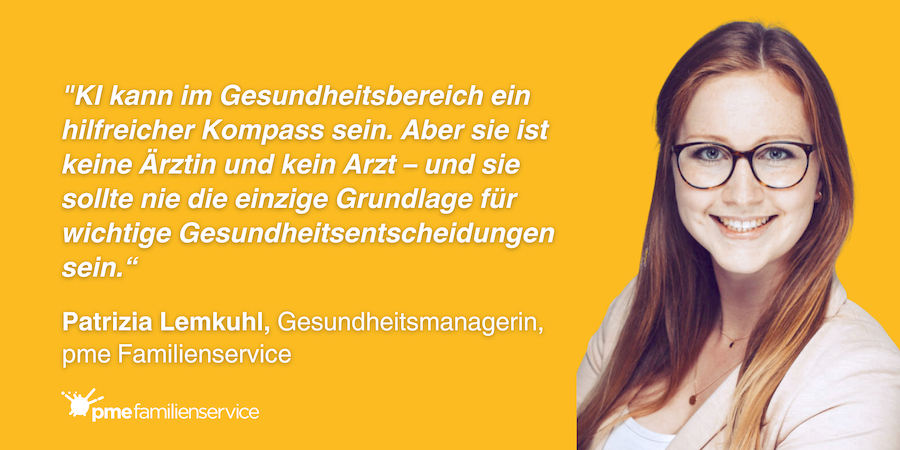
Where AI Reaches Its Limits
AI generates answers based on patterns in data. It can summarize medical knowledge, but it cannot examine a person. It understands a situation only as well as it is described—and even then, it may misinterpret or overlook important connections.
Four points are particularly problematic:
1. Even plausible answers can still be wrong
Chatbots often express themselves fluently and confidently. This does not mean that what they say is medically accurate. The information may be outdated, incomplete, or fabricated3. Therefore, source citations should also be verified.
2. Acute warning signs cannot be reliably assessed via chat
When symptoms are serious, time is of the essence. AI cannot measure vital signs or perform a physical examination. It should therefore not be allowed to decide whether it is safe to wait and see.
Seek immediate help instead of continuing to chat, for example in the following situations:
- severe or new chest pain,
- Shortness of breath,
- Symptoms of paralysis, speech or vision problems,
- Altered consciousness or severe confusion,
- severe allergic reactions,
- heavy bleeding or sudden, severe pain,
- acute self-harm or suicidal thoughts.
In Germany , the number to call for life-threatening emergencies is 112. For urgent, non-life-threatening medical issues outside of office hours, the on-call medical service can be reached at 116 117 .
3. AI can cause unnecessary anxiety
The opposite can also happen: When symptoms are relatively minor, a chatbot might suggest rare, serious illnesses. This can cause anxiety. A long list of possible causes doesn’t necessarily indicate what’s most likely.
4. Health data requires special protection
Health data is among the most sensitive types of personal data. Before using a tool, check the following: Who operates it? What data is stored? Is the information you enter used to improve the system? Is there clear and understandable privacy information available?
Do not enter any unnecessary identifying information—such as your full name, address, insurance numbers, or complete medical reports. If you share information to help contextualize a question, limit yourself to what is truly relevant from a professional standpoint.
How to Use AI More Safely for Health-Related Questions – 5 Tips
1. Use AI as a guide, not as a diagnosis
AI can help clarify a question. It cannot definitively determine what condition a person has or whether a situation is safe.
2. Ask specific questions
Instead of asking, “What’s wrong with me?” it’s more helpful to ask, “What information should I write down for my doctor’s appointment if I have recurring headaches?” This keeps the focus on preparation rather than self-diagnosis.
3. Ask for sources—and verify them
Ask the AI to list the sources it used. Then check whether they come from recognized institutions, professional associations, government agencies, or scientific publications. A list of sources alone is not proof of quality.
4. Question both reassuring and dramatic answers alike
If something feels serious, new, or threatening, seek medical advice—even if an AI advises you to wait and see. And if a chatbot suggests serious diagnoses for mild symptoms, don’t automatically assume that possibility is likely.4
5. Prepare for your doctor's appointment
For example, write down:
- How long have you been experiencing these symptoms?
- How strong are they, and how are they changing?
- What triggers it or makes it worse?
- What accompanying symptoms occur?
- What pre-existing conditions, medications, or allergies are relevant?
This information helps professionals make an assessment and often makes the appointment more efficient.
Conclusion: AI can be helpful, but professional help remains essential
AI as a health advisor can be helpful in everyday life when it comes to providing clear information, good preparation, and guidance. However, it can make mistakes, overlook important warning signs, or cause unnecessary anxiety.
Those who use AI wisely are best served by adopting a simple mindset: Chatbots are tools for asking questions and preparing; they are not a substitute for diagnosis or emergency decisions. When it comes to serious, new, or unclear symptoms, it’s better to seek medical help once too soon than to wait too long.
FAQ
Can AI make a diagnosis for medical issues?
No. General AI chatbots can explain information and help you organize potential questions for a doctor's appointment. However, they are not a substitute for a medical examination, diagnosis, or treatment.
When should I stop chatting with an AI if I'm experiencing discomfort?
If you experience, among other things, severe or new chest pain, shortness of breath, signs of paralysis, speech or vision problems, altered consciousness, severe allergic reactions, heavy bleeding, sudden, severe pain, or an acute risk of self-harm, you should seek medical help immediately. In life-threatening emergencies, call 112.
Can AI chatbots provide incorrect health information?
Yes. AI-generated answers may be incorrect, incomplete, or outdated—even if they sound convincing. Therefore, verify important information and also consult reliable sources, such as public health agencies, professional associations, or medical experts.
What health information should I avoid entering into an AI chatbot?
Share only the information that is truly necessary for your question. If possible, avoid providing your full name, address, insurance numbers, login credentials, or complete medical records. Also, check how the tool in question processes and stores data.
How can AI help you prepare for a doctor's appointment?
AI can help you organize your symptoms and formulate questions. For example, it’s helpful to make notes about when the symptoms began, how severe they are, what triggers or worsens them, and which medications or pre-existing conditions might be relevant.
Does it make sense to provide an AI with medical guidelines as a source?
This can help you make sense of the information. Ask the AI to cite specific sources or guidelines, and then check whether they are up to date and come from a recognized institution. However, an AI response should not replace individual advice from medical professionals.