

How to Successfully Implement AI in Your Business
The strategic use of AI in businesses improves business processes, boosts productivity, and fosters innovative business models. However, sustainable success requires a responsible approach that involves employees and ensures data protection. Read best practices and expert tips for HR professionals and leaders.
Read more in this article:
Why is artificial intelligence essential for businesses?
AI is here to stay. Only those who understand where AI truly helps and where its limitations lie can use it effectively and responsibly. That is why it is important for companies and their employees to actively engage with the topic.
At pme Familienservice , we Familienservice a wide range of applications and constantly examine the potential and limitations of artificial intelligence.
To this end, we ask ourselves the following questions:
- Where can AI help us?
- Where do we need to use them to stay on top of things?
- In what areas are we holding back because AI isn't good enough yet or isn't suited to the task?
Our goal is not to replace people, but to improve our services. We encourage all team members to use AI and provide them with “Nova,” a privacy-compliant AI platform, to help them do so.
In a study conducted by the digital industry association Bitkom, working people were asked about the pros and cons of a smart assistant
56 percent of respondents would generally like AI to assist them in their work. 43 percent answered this question with “no” or “rather no.” 39 percent believe that AI could take over tasks in their current job, 27 percent think this is possible in the future, and 30 percent do not believe this is possible either now or in the future.
Opportunities and Challenges: How to Successfully Implement AI in Your Business
The discussion about AI in the workplace is marked by uncertainty and differing viewpoints. While some view AI as an infallible technology, others fear that it will render them obsolete.
Common patterns include:
- Highlighting one's own unique skills
- Focus on the flaws and weaknesses of AI
- Covert or excessive use of AI
- Humanizing AI (AI as a colleague or friend)
The study “AI and the Future of Work” by the rheingold Institute for the Randstad Foundation shows that many companies underestimate the psychological dimension when implementing AI.
“Right now, companies need to understand that it’s not just about technology and efficiency gains, but also about identity, self-worth, and a culture of collaboration,”
says Johannes Dorn, managing director of the rheingold Institute.
In our "AI and Learning" event series, we team up with our experts and top speakers to provide practical answers and valuable insights on how to use AI—both at work and in everyday life!
View all "AI and Learning" events
The Role of Leaders in AI Adoption
“Managers have a responsibility to bring their team along for the ride and foster a culture of trust,”
says Meike Bukowski, Head of Human Resources Development at pme Familienservice.
These include the following questions:
- How do we take everyone with us?
- How do we deal with uncertainties and fears?
- What types of training and exchange programs are needed?
In addition, it is important to show employees where AI is helpful and where it is not (yet), and how to use it safely and in compliance with data protection regulations.
“Another responsibility of managers is to encourage the use of AI,” says Victoria Domke, HR Development at pme Familienservice. This involves creating opportunities for learning and experimenting with AI and providing examples of how it can be used.
“Many executives are caught in a vicious cycle,” adds Katharina Opper of Prompt Engineering’s AI Unit: “They don’t have enough time to focus on AI, even though AI would actually save them time.” To break this cycle, executives need to raise awareness of how AI can make their work easier. Last but not least, they need to lead by example and demonstrate how AI can be used as a practical tool.
The Role of Human Resources Development
For human resources development, AI is not just a trend, but a fundamental shift.
The following aspects are of primary importance:
- Developing skills for team members
- A positive attitude toward AI: AI as a tool
- AI as a Tool to Support Learning Processes
- Addressing Privacy Concerns
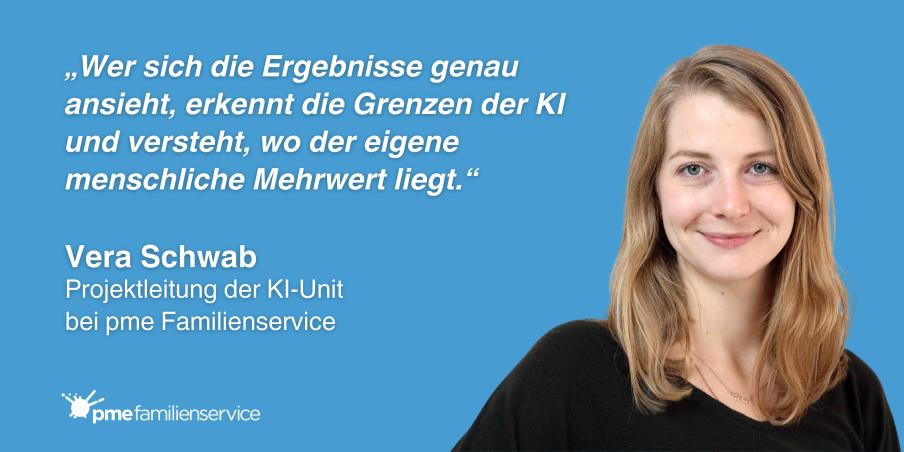
“With the Nova AI platform, all pme team members have a ‘safe playground’ where they can experiment without worry.”Vera Schwab, Project Manager of the AI Unit at pme Familienservice
The members of pme-Personalentwicklung see themselves as both learners and active contributors. The goal is to engage all employees in such a way that they feel motivated and encouraged to try new things, while breaking down resistance.
Through various formats, Human Resources promotes AI skills among employees:
- Exchange formats
- Group coaching sessions
- AI advocates
- Study buddies to support team members
Strategies for Knowledge Transfer
“When it comes to AI, traditional training has only limited effectiveness. It’s important to closely support employees and encourage them,” says Vera Schwab of the AI Unit at pme Familienservice.
Her tips:
- Don't look for the perfect prompt—just give it a try
- Talking to AI as if it were a person
- Ask questions, such as “Who are you?” or “What can you do?”
- Integrating AI into Team Meetings (Update on Agents, Use Cases, Best Practices)
- Knowledge transfer, e.g., through AI multipliers and learning buddies
- Provide a guide and step-by-step instructions
Responsible Use of AI and Guidelines
While AI offers many opportunities, its use also entails numerous risks. That is why the European Parliament adopted the Artificial Intelligence Act in March 2024, thereby establishing the world’s first legal framework for the use of artificial intelligence.
pme Familienservice AI Code of Conduct
pme Familienservice these risks and concerns very seriously and therefore began as early as 2022 to systematically build up internal AI expertise and actively involve team members in discussions about the use of AI. We are convinced that we can only successfully harness the potential of AI if we make our goals and the application of AI transparent and decide together with our team members and our clients when to use AI and for what purpose: pme Familienservice AI Code of Conduct
- Use only verified AI platforms from trusted providers.
- Do not enter sensitive or personal information into open AI services.
- Systematic prompting: The more precise the input, the better the results.
- AI makes mistakes, so be sure to check all results.
- If you have any questions, please contact your IT department or data protection officer.
Strategy and Approach to Responsible Use
At pme Familienservice , we Familienservice AI where it helps the company grow, offers customers new options, automates processes, and enhances our services—for example, with chatbots like Luca or ELKI, which are available to our customers around the clock. In doing so, we take a "blended approach": people are at the center of everything we do.
Katharina Opper from the AI Unit emphasizes: “We always consider how to use AI in line with our company philosophy. We don’t want to replace human service with bots just because it’s technically possible.” AI offers a low-threshold entry point, especially for complex or personal issues, with humans stepping in to provide support when necessary.
AI Unit as a driver
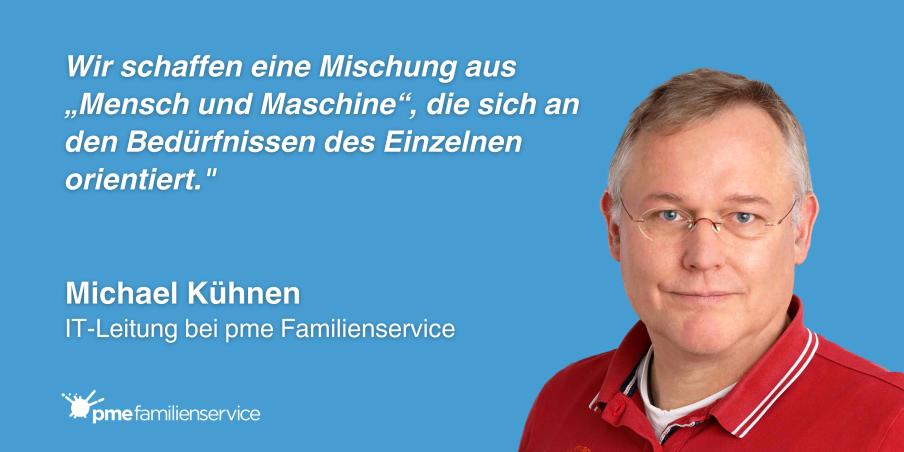
Since the release of OpenAI’s first major GPT model in November 2022, the IT department at pme Familienservice actively Familienservice with AI. While the initiative was initially driven by a few “early adopters,” it is now firmly established with a four-person AI unit. “Topics like prompting and model selection require a high level of expertise, as they have a major impact on the entire company,” says Michael Kühnen.
The AI Unit at pme Familienservice both internally and externally:
- She serves as a point of contact for all team members and promotes skill development in line with the principle of "helping people help themselves."
- It establishes technical interfaces with pme's own systems.
- Together with product managers, she develops solutions for how AI can be used to benefit customers, for example in the form of advisory assistants
It is important to make employees aware that they must review all AI-generated results. After all, employees are liable for any content they publish on behalf of the company.
As a first and most important step, companies need a central AI strategy that takes data protection into account. At a minimum, this should include guidelines for employees and training opportunities to ensure data protection and safeguard trade secrets or personal data. If team members experiment on their own, this carries the risk of "shadow AI" and data protection risks.
FAQ – Artificial Intelligence in Business
Why is artificial intelligence (AI) indispensable in businesses today?
AI boosts efficiency, supports teams, and helps companies stay competitive in the digital age.
How do employees benefit from AI in the workplace?
You can automate routine tasks, receive personalized learning support, and have the burden of complex tasks lifted from your shoulders.
What should executives keep in mind when implementing AI?
Managers should address employees' fears and uncertainties, foster transparency, and actively promote knowledge-building.
What challenges are associated with the use of AI?
Among the biggest hurdles are data protection issues, feeling overwhelmed by new tools, and resistance within the team.
Is the use of AI regulated by law?
Yes, with the AI Act, clear rules for the safe and responsible use of AI will apply across Europe.
How can employees be prepared for AI?
Through training, learning buddies, practical exchange programs, and an open, learning-oriented corporate culture.
Further links and information
pme Familienservice AI Code of Conduct
Study: "AI and the Future of Work"