


It's the quiet tones that count
Children's songwriter and author Fredrik Vahle has been delighting audiences for more than 45 years. As soon as the 77-year-old performs his own children's songs, the auditorium falls silent and several hundred children listen spellbound to his words and sounds. In his latest CD "Lilo Lausch liebt leise Lieder" (Lilo Lausch loves quiet songs), he devotes himself to listening and eavesdropping and shows the wonders of sounds, languages and cultural influences in everyday life.
They say "You don't have to teach children to hear, listen and eavesdrop, they can do it on their own. But it's worth making them aware of it again and again." How can children be inspired to listen?
Fredrik Vahle: That's a big question. Hearing and listening already begin in the prenatal phase. The child is not even born yet when it begins to hear and listen. This is always associated with very elementary touch processes and also plays a role in later hearing experiences.
This means that when the child starts to listen actively later on, it will always be touched by these sounds and songs. That is something very important. That's why hearing gets under our skin in a certain way. This image of "getting under the skin" already contains the special nature of hearing and listening. These are always very deep and intimate processes, but if they are misguided, they can also be terribly annoying.
Not only can we sing the praises of hearing, but it must also be said that it can be exploited so that we lose sight and hearing if we simply listen too much. And especially when listening intensively to the silence - and we now have a special opportunity to do so - hearing and listening to certain sounds plays a role again, for example the singing of birds.
An endless amount of discussions, opinions and news - at the moment, we are getting too much and too loud. How do you deal with it when your ears are full?
I have a few listening rituals. For example, I go into the forest for several hours in the morning and just listen. I listen to the birds, I listen to the sounds in the air, I also listen to the people I meet. This often leads to conversations and other forms of listening begin again. But at first it's more or less listening that I expose myself to. During the day, I also listen to what the newspapers say, but I listen to very little news, for example, and I don't have a television. I choose what I listen to very carefully.
Has children's attention and your ability to listen changed since you started out as a children's songwriter 45 years ago?
That's a question I'm often asked, but I don't check the children's behavior while I'm singing. I always try to reach the children and I think I do that quite well. And I'm happy with that, although of course I know that the children's media environment has changed a lot and that certain obstacles to their own attention have increased as a result. The children think they have less time to be bored, to do nothing, to just listen and hear what else is going on and not always have to listen and hear what they are told.
We hear well-known poems and spoken verses spoken as rap or accompanied by new swing melodies. How did "Lilo Lausch liebt leise Lieder" come about?
What helped me a lot was my biographical work on my book "Schräge Lieder schöne Töne". For the second "Lilo Lausch" CD in particular, I discovered my own childhood as a great source of inspiration. There were certain musical experiences that I had as a child and which then suddenly manifested themselves in an unexpected creativity with regard to these songs. That's why I'm really happy that this has now become a well-rounded thing. My inner child was very much involved musically. I think you can perhaps hear that in the liveliness of the songs.
What musical experience has particularly inspired you?
These are partly my listening memories, which come together with ancient children's verses or old poems. "Heini Hupfer", for example, is originally a poem that has been around for 20 years, and I came up with the swing melody with finger snaps. Some of these are things that came about very quickly, I didn't tinker with them for long.
Sometimes a song can suddenly be made from very simple semantic insights, like the "cockcrow song". I simply noticed that the cockcrow is expressed quite differently in different languages and I turned this semantic fact into a song. Of course, this expresses the individual character of the language better than if I were to present it linguistically, semantically and objectively. Kokiriko" or "Kirikiri" is simply easier to sing than to define and explain.
First, "Lilo Lausch läuft leise" was published, now "Lilo Lausch liebt leise Lieder" follows. Why is it important to you to emphasize the quiet element?
That's almost a bit of a double entendre, but in this case double means that it's a particularly important thing. The loud tones, the loud slogans and the things that are written in large print in the newspapers and what politicians say in large print and what is written in large print at demonstrations always jump out at us.
I believe it is very important that we always listen to the softer sounds. These can also be softer sounds of sadness, of protest, of our own difficulties in life, but also sounds of contentment or of special experiences that we can have at this time. There really is a lot to tell. I believe that music as a connecting medium can be rediscovered in this way, in that it is not the loud, clamorous sounds of music that are important, but the quiet tones.
And the fact that something can also be dissonant and shouted is also very important, so that no one is lulled to sleep by the music or slogans or the like, but is also repeatedly led to wake up. Music can create harmony, but it can also make people wake up!

Fredrik Vahle, born in 1942, is an author, lecturer, associate professor for language and movement at the University of Giessen and has been one of the most successful children's songwriters in the German-speaking world for over forty years. The "father of the new children's song" inspires children and adults alike and has been awarded the Federal Cross of Merit for his music.
Vahle has accompanied the Zuhören Foundation with its nationwide educational program "Lilo Lausch" for years and shows the wonders of sounds, languages and cultural influences in everyday life. In his latest CD "Lilo Lausch liebt leise Lieder" (Lilo Lausch loves quiet songs), he devotes himself to listening and eavesdropping and shows the wonders of sounds, languages and cultural influences in everyday life. www.lilolausch.de
Karl Klecks and Lilo Lausch - pme Familienservice cooperates with the Listening Foundation
In our daily work at Lernwelten-childcare centers , we aim to live and teach values such as listening, silence, friendship, tolerance and democracy. We want to encourage a new culture of listening that is characterized by mindfulness and appreciation.
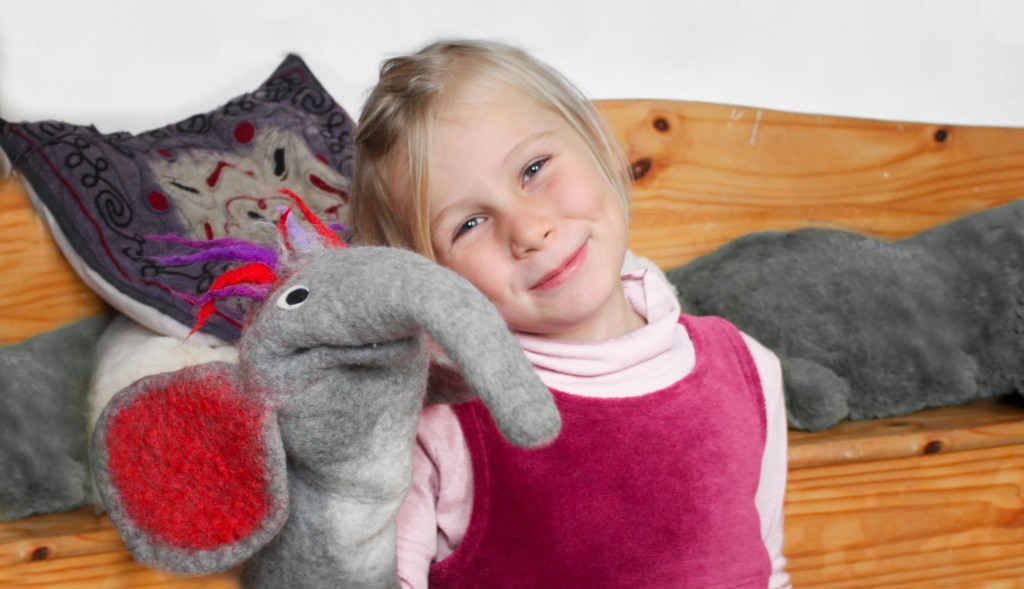
We are supported in this by the "Lilo Lausch & Karl Klecks" listening and language concept, which was created by combining the educational concept of the Listening Foundation with the Karl Klecks language and values concept developed by pme Familienservice . The hand puppets Lilo Lausch and Karl Klecks promote children's social, cultural and linguistic skills in a variety of ways and incorporate the children's native languages as well as German and English.