


Strengthening Team Resilience as a Leader
As a leader, you lay the foundation for a more resilient team: with psychological safety, clear roles, and brief learning routines, you’ll remain capable of taking action together.
How do leaders strengthen team resilience?
Team resilience does not come from more pressure, but rather from trust, clarity, and a culture of learning that is put into practice. According to research , psychological safety is the most important single factor for team success and can be actively fostered. Resilient teams remain capable of taking action even in crises because they maintain shared structures, clear roles , and a culture of learning. Leaders are the most important lever: They create the conditions under which resilience either flourishes or is hindered.
Read more in this article:
What is a resilient team?
Resilience is not an innate trait of individuals, but rather the result of a deliberate team and leadership culture. A resilient team is built primarily on a foundation of security, clarity, and autonomy.
In practice, this means: an open culture of accountability, clear roles, regular reflection, and enough autonomy so that the team can continue to work together to find solutions even under pressure. The key difference from a group of resilient individuals lies in collective learning and shared effectiveness—that is, the feeling that, as a team, they can make a difference.
"Team resilience is the result of clear roles, psychological safety, and a culture of learning—especially from mistakes. Or, to put it more vividly: Team resilience doesn’t mean avoiding storms. It means learning together how to dance—even when the wind is howling."
Derya Bobrik, resilience and leadership expert at pme Familienservice
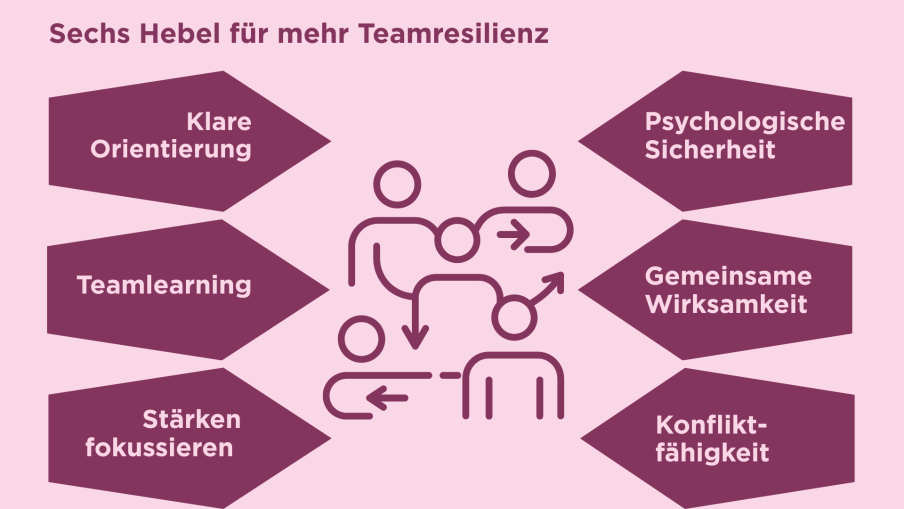
The Six Key Factors for Building Team Resilience
1. Creating Psychological Safety
Psychological safety describes an environment in which every team member knows that questions, doubts, and mistakes can be openly discussed without fear of negative consequences.
This concept was popularized by the research of Amy Edmondson, a professor at Harvard Business School. Her findings are clear:
"‘Psychological safety is not about comfort. Rather, it is a platform for productive discomfort: the kind of discomfort that fuels innovation, learning, and growth. And leaders are the architects and engineers of this climate.’
Amy C. Edmondson, Harvard Business School"
Google's Project Aristotle reached the same conclusion: psychological safety is the most important driver of team success—even more so than the team members' competence, personality, or experience.
2. Provide clear guidance
Teams need clarity, especially during stressful times: shared goals, aligned priorities, and clearly defined responsibilities. Without this guidance, friction, mistrust, and exhaustion set in. Clarity is not micromanagement—it is the prerequisite for true autonomy.
This also means accepting change as part of the job and communicating openly about it, rather than downplaying or delaying it.
3. Promote self-efficacy and shared efficacy
Resilient teams are aware of the impact they have. Leaders make this impact visible—by recognizing small steps of progress, by documenting results, and by assigning tasks that offer genuine creative freedom.
The difference between a group of resilient individuals and a truly resilient team lies in their shared effectiveness: the collective belief that they can overcome challenges together.
4. Developing Conflict Resolution Skills
Tensions that go unaddressed drain energy and erode trust. Resilient teams address conflicts early on, provide constructive feedback, and solve problems objectively— focusing on the issue at hand, not on personal relationships. This is a skill that can and must be developed.
5. Strengthen Team Cohesion and Team Learning
Regular team routines, mutual support, and genuine dialogue about meaningful collaboration form the foundation of collective resilience. Team learning—the process of reflecting, learning, and adapting together—is what distinguishes a resilient team from a group of resilient individuals.
6. Make Conscious Use of Your Strengths
Resilient teams know their collective strengths and use them strategically. Developing an awareness of what the team does particularly well—and consciously drawing on those strengths during difficult times—is an often-underestimated factor in resilience.
What Leaders Can Do in Practice
Building team resilience is not a matter of chance, but rather the result of deliberate leadership efforts. The following five measures help leaders foster resilience within their teams in a sustainable way:
1. Stay Calm in Stressful Situations
Stability starts at the leadership level. Leaders who handle their own emotions calmly and mindfully provide direction— especially during hectic times. Mistakes and uncertainties are addressed openly, and responsibility is taken.
Instead of looking for someone to blame, the focus is shifted to constructive solutions.
2. Communicate information openly and early on
Uncertainty grows where information is lacking. Clear lines of communication, regular updates, and carefully documented agreements create transparency and a sense of security. Important changes and decisions are supported by clear, understandable reasoning—to prevent rumors and fears.
3. Create room for decision-making
Resilience grows through autonomy. Situational leadership means delegating tasks and responsibilities in a way that’s tailored to the situation, assigning clear roles, and allowing room for independent decision-making. Clearly defined processes and escalation procedures ensure that the team remains capable of taking action even under pressure.
Do you enable situational leadership, promote autonomy, and ensure that roles and escalation procedures are clearly defined?
4. Model a culture of learning: Use mistakes as a resource
Resilient teams are characterized by a positive culture of error and learning. Mistakes are not viewed as flaws, but as learning experiences that help the entire team grow.
Sharing learning experiences creates a safe environment—and helps others avoid repeating the same mistakes. “Thank you for sharing that mistake—now I don’t have to make it myself!”
Regular feedback, a focus on learning progress rather than assigning blame, and joint reflection on successes and failures firmly integrate learning into the daily work routine.
5. Actively Shaping Change
Change is a constant in the modern workplace. Targeted training in key skills such as problem-solving, prioritization, and time management makes teams more resilient.
Flexible work models (hybrid, flex time) provide greater flexibility and support a healthy work-life balance. Unnecessary meetings are reduced, and decision-making processes are standardized.
In addition, it is worth proactively establishing contingency plans: business continuity plans for critical processes, identified single points of failure, and secure backups help ensure the ability to respond quickly in times of crisis.
Leadership fosters team resilience not through theoretical appeals, but through leading by example, clear communication, a drive to shape the future, and appreciation. When these factors come together, a team culture emerges that can withstand stress and capitalize on opportunities for growth.
Measuring Team Resilience: How to Stay on Top of Things
What isn't measured can't be improved. The following metrics help highlight a team's resilience:
- Pulse Survey Score: Regular brief surveys on morale, stress, and teamwork
- Sickness rates and absenteeism are indicators of burnout and engagement (Gallup: Emotionally engaged employees are absent 41% less often)
- Time to Recover: How quickly does the team recover from disruptions or crises?
- Turnover: High turnover indicates low employee retention and a lack of resilience
- Error Rate & Learning Cycles: Are errors openly communicated and used as learning opportunities?
- Employee Satisfaction: Regular , Structured Surveys (e.g., eNPS)
Tip: Use pulse surveys and burnout indicators as an early warning system before stress escalates into a crisis.
A simple routine to get started
Team resilience isn't built through one-time workshops, but through continuous, embedded practice. Three approaches have proven effective:
Weekly: Pulse Check (15 minutes)
- What went well this week?
- What was particularly challenging?
- What can we learn from this?
Monthly Retrospective:
- Review roles, responsibilities, and priorities
- What can the team handle on its own?
- When is external support (supervision, EAP) appropriate?
In Times of Crisis: The Three Steps
- Stabilize – Ensure Safety, Prevent Panic
- Making Decisions—With Clear Processes and Defined Roles
- Reflection – Systematically Applying "Lessons Learned"
This sequence helps us not only to react, but also to remain capable of taking action together.
FAQ: Building Team Resilience
What is psychological safety—and how can I foster it within my team?
Psychological safety arises when team members can openly express questions, doubts, and mistakes—without fear of negative consequences. Leaders foster it by acknowledging their own mistakes, actively seeking feedback, and not only tolerating but also valuing other perspectives. The concept gained prominence through Amy Edmondson’s research at Harvard Business School and was confirmed by Google’s Project Aristotle as the most important factor in team success.
How can I tell if my team is resilient?
A resilient team remains capable of taking action even in times of crisis, discusses mistakes openly, supports one another, and works constructively to find solutions. It does not experience above-average turnover or absenteeism, and conflicts are addressed early on and objectively—rather than being allowed to simmer.
Which routines are most helpful?
Weekly brief check-ins (pulse checks), monthly retrospectives, and structured decision-making processes ensure ongoing communication, reflection, and better collaboration. What matters is consistency—not the length of the meetings.
What should you do when team members are facing personal crises?
Respond flexibly, communicate openly, and work together to adjust priorities. Offer targeted support when stress persists: for example, Employee Assistance Programs Familienservice EAP) from pme Familienservice or supervision
How long does it take to build a resilient team?
Team resilience is not a project with an end date, but rather an ongoing process. The first noticeable changes—greater openness, less finger-pointing—often become apparent after three to six months of consistent leadership efforts. A stable culture of resilience develops over a period of 12 to 24 months.
What distinguishes a resilient team from a resilient individual?
Individual resilience helps a person cope with stress. Team resilience arises from the interplay of shared goals, mutual trust, collective learning, and shared effectiveness. A team can be more resilient than its individual members—or more fragile, if trust and structure are lacking.
The Work:Life Academy at pme Familienservice offers a wide range of seminars and training programs for companies focused on leadership development and employee development.
Whether in-person, online, or as blended learning or blended coaching—we flexibly tailor our seminars and training sessions to the needs of your teams and leaders.
Systemic, solution-oriented, and practical:Work:Life Academy

 Cropped.jpg/d58eff96-6d5b-0ebf-538a-ff3b569f3dc5/d58eff96-6d5b-0ebf-538a-ff3b569f3dc5?imageThumbnail=2)


.jpg/499b32b2-7da0-c8dd-12d3-208b04766e58/499b32b2-7da0-c8dd-12d3-208b04766e58?imageThumbnail=2)