


At what UV index should I stop going out in the sun?
Wouldn't it be nice to just enjoy the sun without having to worry about protection? The UV Index is here to help: a handy number that tells you just how intense the current sunlight really is.
Expert: Patrizia Lehmkuhl, Health Manager | Editor: Christin Müller
Summary: The Most Important Facts About the UV Index
The UV Index is your free, daily-updated early warning system for sunburn, acute skin damage, and long-term risks such as skin cancer.
You should consistently use sunscreen whenever the UV index reaches 3 or higher. If you know when protection is necessary, you can plan your outdoor activities wisely and avoid unnecessary risks.
Read more in this article:
- What is the UV index?
- What factors influence the UV index?
- How do you use the UV index in practice?
- Sunscreen SPF: What You Need to Know
- Myths About the Sun and Sun Protection
- Practical tips for sun protection in your daily life
- Conclusion
- FAQ: Frequently Asked Questions About the UV Index & Sun Protection
- Sources & Recommended Reading
What is the UV index?
UV stands for ultraviolet radiation. The UV Index (UVI) summarizes the intensity of UV radiation at a given location in an easy-to-understand number and indicates how quickly you are at risk of getting sunburned. The higher the number, the greater the risk of sunburn, skin aging, eye damage, and skin cancer.
Would you like to know what the daily UV index is in your area? The nationwide solar UV monitoring network measures the amount of UV radiation reaching the ground at over 40 locations across the country. You can find the latest measurement data on the BfS website.
What factors influence the UV index?
Various factors determine the current UV index:
- Sun's altitude: The higher the sun is in the sky, the stronger the UV radiation.
- Ozone and airborne particles: Higher levels of ozone and aerosols reduce radiation; lower levels result in higher readings.
- Note: Water , sand, snow, or light-colored facades can increase the strain.
- Cloud cover: Clouds reduce UV radiation but do not provide complete protection—UV rays can still penetrate clouds.
Tip: You can find out the exact value by checking many weather services or using a UV index card.
How do you use the UV index in practice?
The UV index is not just an abstract number; it helps people take specific protective measures. The WHO has clearly defined this:
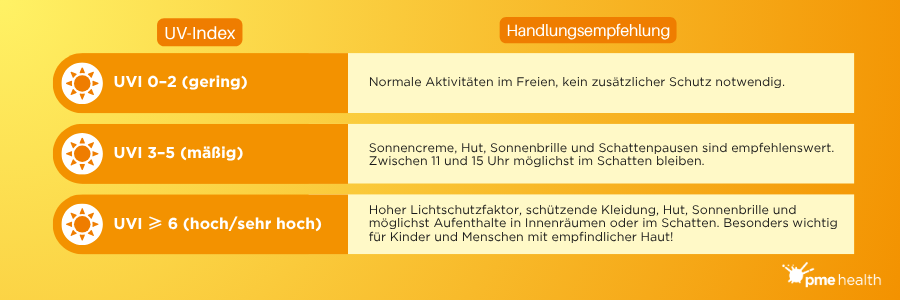
Source: WHO, Graphic: pme Familienservice
Even brief exposure to the midday sun can otherwise lead to painful redness and blistering—and, over the long term, also increase the risk of skin cancer and eye damage.
Sunscreen SPF: What You Need to Know
The sun protection factor (SPF) on sunscreen indicates how much longer you can stay in the sun after applying it without getting sunburned. The Federal Office for Radiation Protection recommends:
- When the UV index reaches 3 or higher: Sun protection for everyone!
- Children: SPF 30 or higher
- Adults: SPF 15 or higher
Even more important than choosing the right SPF is how you apply it:
- Amount: about 5–6 tablespoons for the whole body
- Reapply sunscreen: every 2 hours, as well as after swimming or drying off
Your skin type is key: Very fair skin can burn after just a few minutes. Please note: It’s important to apply sunscreen consistently and to supplement this with protective clothing and staying in the shade!
Not sure which sunscreen is right for you or how to best protect your skin from the sun? In our in-depth article, you’ll learn what matters most when it comes to proper sun protection.
Myths About the Sun and Sun Protection – Debunked
“It’s cloudy, so it’s safe”—wrong: Cloudsreduce UV radiation, but they don’t block it completely.
“Tanned skin doesn’t need protection”—wrong: Darkerskin offers some additional natural protection, but not complete protection.
“Sunscreen alone is enough”—wrong: The best approachis a combination of sunscreen, clothing, shade, and adjusting how long you stay out in the sun.
“Using sunscreen leads to vitamin D deficiency”—false:There is no scientificevidence to support this claim.
Practical tips for sun protection in your daily life
- Use UV information (from weather services, UV index charts) to adjust your daily plans—such as what to wear, how long to stay outside, and when to engage in outdoor activities. Handy tip: An UV index chart shows you the exact UV index value for your current location.
- When the UV index is high: Try to schedule outdoor activities outside of the hours between 11 a.m. and 3 p.m.
- Extra protection is necessary, especially in conditions with strong glare (water, sand, snow, bright surroundings, or in the mountains).
- Take special care to protect children—their skin is very sensitive.
Bottom line: The UV index protects your skin
The UV Index is your reliable guide for sunny days. Experts recommend consistent sun protection starting at a UVI of 3: apply plenty of sunscreen, reapply it regularly, seek shade, and keep a close eye on children.
Don't be fooled by myths. Even clouds and pre-tanned skin don't give you a free pass. Use the UV index to plan your day, avoid the intense midday sun, and enjoy the summer worry-free.
In short: By checking the UV index, you can protect yourself and others in a smart way and enjoy the sun without worry.
FAQ: Frequently Asked Questions About the UV Index & Sun Protection
At what UV index should I stop going out in the sun?
It doesn’t necessarily mean “no longer,” but once the UV index reaches 8 (very high), you should avoid direct sunlight, seek out shaded areas, and take extra precautions (high SPF, protective clothing, a sun hat, and sunglasses). Once the UV index reaches 3, you should consistently use sunscreen.
Do I need sunscreen when it's cloudy?
Yes. Clouds block some UV rays but do not provide complete protection. Even on cloudy days, UV radiation can still cause skin damage—sun protection is recommended, especially when the UV index is 3 or higher.
What does the sun protection factor (SPF) on sunscreen mean?
The SPF indicates how much longer you can stay in the sun after applying sunscreen without getting sunburned, compared to your natural protection time. For example, SPF 30 theoretically extends your natural protection time by a factor of 30.
What SPF ratings are recommended?
From UVI 3: Sunscreen for everyone. Recommended: SPF 30 or higher for children; SPF 15 or higher for adults. In cases of high intensity (UVI ≥6), experts recommend SPF 30–50+, depending on skin type and duration of exposure.
How much sunscreen should I apply?
As a general guideline: about 2 mg/cm² of skin—which is equivalent to about 5–6 level tablespoons for the entire body. In practice: apply generously; do not use just a few sparing dabs.
How often do I need to reapply the sunscreen?
At least every 2 hours, as well as immediately after swimming, heavy sweating, or drying off.
Is sunscreen alone enough?
No. The best protection comes from a combination of sunscreen, protective clothing (UV-protective clothing), shade, a sun hat, and sunglasses, as well as planning your schedule (avoiding the midday hours).
What is the difference between UVA and UVB?
In short: UVA rays penetrate deeper and accelerate skin aging; UVB rays cause sunburn and are a major factor in skin cancer risk. Both are harmful and should be minimized.
What special considerations apply to children and babies?
Babies (under 1 year old): Avoid direct sunlight; keep them in the shade and dress them in protective clothing. Children: Use sunscreen with an SPF of 30 or higher; reapply frequently; take extra precautions between 11 a.m. and 3 p.m. and in reflective environments (water, sand, snow).
How can I use the UV index to help me plan my day?
Check the UVI in the morning or throughout the day (weather services, BfS/DWD). Plan activities for the morning or later in the day, and choose appropriate protective measures based on the UVI band (e.g., UVI 3–5 → SPF 30, shade; UVI 6–7 → SPF 30–50, short stays; UVI ≥8 → stay in the shade, protective clothing, high SPF).
Sources & Recommended Reading