


When is couples therapy really worthwhile?
When a deep love begins to crumble or a marriage is on the verge of failing, it’s painful for the couple. pme couples therapist Gisela Backes uses the example of Jessica and Daniel to explain when conflicts turn into a genuine relationship crisis and how you can manage to make a fresh start. Just a heads-up: You’ll most likely have a lot of work ahead of you.
Expert: Gisela Backes, couples therapist; Editor: Christin Müller
According to couples therapist Gisela Backes, a lack of communication and misunderstandings are often the main causes of crises in relationships.
She recommends that couples actively work on their relationship, communicate openly and consciously make time for each other in order to reconnect.
Professional support can help to discover new paths, develop solutions and strengthen the partnership - provided both are willing to engage in this process.
Read the article:
- The Case of Jessica and Daniel: When Allegations Resurface
- Relationship crisis when the children arrive
- Why a Lack of Communication and Misunderstandings Strain a Relationship
- When silence and conflict dominate the relationship: The lines are hardening
- When couples go to couples therapy
- What characterizes successful partnerships and how therapy can help
- Goals, methods and process: How does couples therapy work?
- How couples can strengthen their relationship after a crisis
- Literature tips
- FAQ: Couples therapy, relationship crisis and family life
The Jessica and Daniel case: When accusations keep repeating themselves!
Jessica and Daniel have been a couple for twelve years. The two met at university. They moved from Münster to Berlin together - lucrative jobs were waiting for them in the capital. Jessica worked as a project manager in a PR agency, Daniel as an engineer at a technical institute. With their wedding four years ago and their little daughter Mia, their private happiness seemed perfect.
But problems soon began to arise. Jessica , who was now primarily taking care of her daughter, found it difficult to cope with no longer being able to do her old job, where she had often worked overtime. She had bitten the bullet and taken a lower-paying job as a team assistant—a part-time position wasn’t an option at her old job.
Daniel now saw his main task as earning money. He worked whenever he could. The earnings were also too good and the opportunities for promotion were within reach. Although the two of them had no financial worries, that one strange feeling soon crept in - that they simply no longer functioned as a couple.
Relationship crisis when the children arrive
Gisela Backes is a couples and family therapist at pme Familienservice. In recent years, she has helped many couples through a crisis, including Jessica and Daniel. "A child is a wonderful thing for a couple. It turns a relationship between two people into a small family. It inevitably has an impact on the parents' relationship." The mother often takes over the care and upbringing of the child.
1. How changes after childbirth put a partnership to the test
Just like Jessica. After her year of parental leave, she primarily took care of Mia. She kept track of all the vaccination appointments, stayed home with her when Mia had a fever, and did all the shopping after work. She slept in her daughter's room so that Daniel could sleep peacefully.
A drastic change: “When a mother has to give up her old life, dissatisfaction can quickly set in,” says Gisela Backes. She may also miss the appreciation and validation she received in her old job. That can be frustrating. But the change didn’t leave Daniel unscathed either. He longed for more time together with his wife.
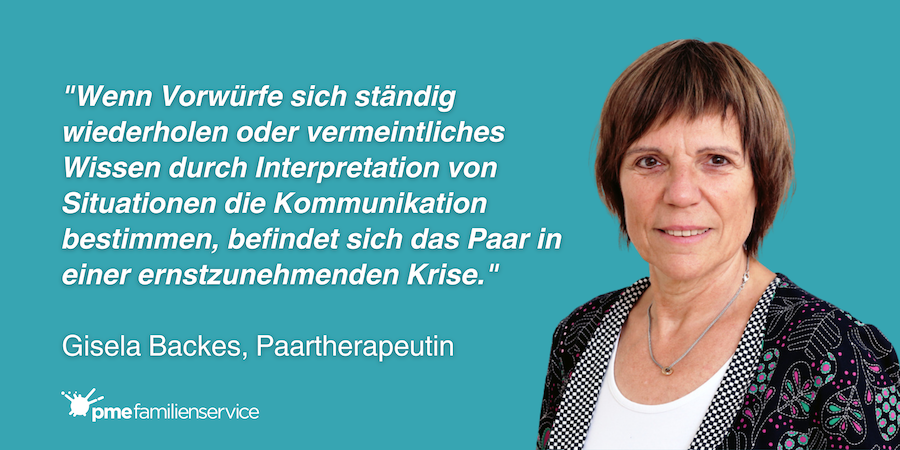
"Poor communication and misinterpretation of situations and statements are the most common causes of crises in relationships."
Gisela Backes, couples therapist, pme Familienservice
2. When parenthood displaces togetherness
Jessica wouldn’t let it happen. She was too exhausted from her day with the little one, and secretly, she blamed her husband for her unhappiness. Physical closeness with a child is often the top priority during the first year of life and shortly thereafter. When Jessica spent many hours in close physical contact with Mia, her need for physical closeness was met. This requires Daniel to be understanding and patient, but also to persistently court his wife as a partner.
Be sure to check out our podcast on the topic: What happens in couples therapy?
This letscast.fm content can only be loaded if you accept the privacy policy of letscast.fm.
To the data protection settings "A lack of communication and misinterpretations strain a relationship
The same applies to recognition at work. “When you have children, daily routines don’t necessarily leave room for conversation,” the couples therapist points out.
Often, a lack of communication between partners is the reason for misinterpreting situations and statements: “The couple believes they know each other inside and out, and the words ‘never’ and ‘always’ are frequently used,” says Backes. But if the couple does not work together to find solutions to their dissatisfaction or stress, this often triggers a serious crisis.
Important are discussions about:
- job
- Childcare
- Personal needs for sleep, rest, and physical closeness
- Distribution of tasks in the household
- Leisure activities
- Staying in Touch with Friends and Hobbies
Why we love the way we love: Recognizing attachment patterns in couple relationships
September 25, 2026 | 12:00 p.m. – 1:00 p.m.
This presentation provides in-depth knowledge about the classic attachment styles (secure, anxious-ambivalent, anxious-avoidant) and shows you how to recognize your own patterns as well as those of the person you’re interacting with. Through concrete strategies and practical examples, you’ll learn how to consciously navigate these patterns.
Registration: Recognizing Attachment Patterns in Couple Relationships
When Silence and Arguments Define the Relationship: Positions Harden
Things had gotten more tense between Jessica and Daniel. Normal communication had long since seemed impossible. At first , they argued every day; eventually, they just stopped talking to each other.
There were days when the two of them didn't say a word to each other, and when they did, it was only to yell at each other. The love that had once begun seemed to have vanished—let alone any kind of romantic life.
And somehow, neither of them really cared. At that point, divorce seemed more likely than a reconciliation. There was still one more attempt left—one last-ditch effort before taking the final step. Because they knew things couldn’t go on like this. The couple came to see Gisela Backes for counseling. The 62-year-old couples therapist helped them overcome their crisis.

Couples therapy can uncover dynamics within the relationship and help partners rediscover respect and love for one another (Photo: pme Familienservice).
When couples go to couples therapy
“Couples come to me whenever they can no longer see a way out of a critical situation on their own. This can happen at the onset of a crisis or even after years of an ongoing crisis.”
"A reason to seek counseling can be a life-changing family situation , such as a birth, a death, a serious illness, a job change, infidelity, but also disrespect, lying, hurt feelings, childlessness, frustration, a lack of sexual desire, or cultural differences," explains the therapist.
In Germany today, one in three marriages ends in divorce. Very few people seek professional help. Gisela Backes knows why that is:
"In most cases, at least one of the people involved feels embarrassed about seeking outside help, or at least one person does not believe that therapy will bring about any change."
What characterizes successful partnerships and how therapy can help
Gisela Backes can't say for sure how many couples she was ultimately able to help. She advises: “It's important to work on your relationship as a couple, to really want it, and not to just give up.”
"Successful partnerships are characterized by a mutual positive choice (the partner is the absolute No. 1), by mutual love, by mutual trust, and by respect and esteem for one another."
Even though some therapies are more difficult than others, Gisela Backes has never advised a couple to separate: “The decision is always made by the couple—or at least by one person in the relationship. Anyone who is willing to accept help or support can be helped.”
"However, if one person decides they no longer want to continue the relationship, we can also support the couple through the separation process."
Goals, methods and process: How does couples therapy work?
The approach in couples counseling depends on the goal of the counseling. "This could be, for example, improving communication, regaining trust after infidelity, reviving sexuality, or growing together as a second family," Backes continues.
There are preparatory questions for couples counseling that look back at the beginning of the relationship, at the here and now, and at hopes for the future. These questions serve as a guide during the counseling session, from which exercises for the couple can be derived as needed.
How couples can strengthen their relationship after a crisis
1. Find more time for each other
Therapy has helped Jessica and Daniel. They've made a commitment to be more attentive to each other as a couple and to invest time in their relationship.
So now there are times when they’re just there for each other. In the evenings, the TV often stays off, and sometimes the housework gets put on hold. Over a glass of wine, they reflect on the day. One date a month is firmly marked on the calendar.
In the meantime, a babysitter is watching over little Mia. For a weekend trip to celebrate their wedding anniversary, they even brought in the grandparents—who live far away—to look after the child.
“Spending time together can help. Even if it’s just 15 minutes a day, during which everyone can express themselves without judgment and work together to find understanding or solutions,” says the therapist. “It’s not always possible to find answers that satisfy everyone involved. In that case, temporary solutions should be found, and the issue should be revisited after a certain amount of time.”
2. Maintain open communication: Keep the conversation going!
Daniel will try to reduce his workload so that his wife can pursue new career plans. Everything seems to be turning out well.
However, it's important to keep the lines of communication open! Gisela Backes summarizes: "Many people find it difficult to talk to their partner about their wishes, longings, and fears. But that's precisely what keeps a relationship vibrant."
When asked why she thinks it's worth fighting for an existing partnership, she has a very simple answer: "Because it's a wonderful feeling to love and be loved and to have a partner by your side."
At pme Familienservice , we offer couples and families support in talking openly about their needs and clearing up misunderstandings.
Find out more: EAP consulting
Literature tips
- Sascha Schmidt:Being a Couple Again! A Fulfilling Relationship Despite Work and a Child(Humboldt Verlag)
- Michael Lukas Moeller:The Truth Begins with Two: A Conversation Between a Couple(rororo Verlag)
- Hans Jellouschek:How Partnerships Succeed—The Rules of Love: Relationship Crises Are Opportunities for Growth(Herder Verlag)

FAQ: Couples therapy, relationship crisis and family life
When is couples therapy really worthwhile?
Couples therapy is worthwhile when couples can no longer find a way out of a difficult situation on their own – regardless of whether they are at the beginning of a crisis or it has been ongoing for some time. Professional help is particularly beneficial when children are involved, to protect family happiness and enable a fresh start. Accepting help takes courage, but it can bring about real change.
What is the most common reason for the breakdown of a relationship?
According to couples therapist Gisela Backes, a lack of communication and misunderstandings are the main causes of relationship crises. Open, honest conversations and consciously spending time together help couples to reconnect and address problems.
How do children affect a relationship crisis?
When parents argue or are unhappy, it puts a great strain on children's emotional well-being. Having a child brings many changes to daily life and the relationship. Especially after the birth, responsibilities and traditional role models shift, which can lead to dissatisfaction if partners don't communicate openly about it.
What can I do when accusations and arguments become part of everyday life?
Recurring accusations and constant arguments are warning signs of a deep crisis. In this situation, the couple should seek professional counseling to learn to communicate respectfully with each other again and to find solutions together.
When does couples therapy become beneficial?
Couples therapy is helpful in cases of persistent dissatisfaction, recurring arguments, communication breakdowns, or after significant life events such as childbirth, job loss, infidelity, or illness. It supports couples in openly discussing their desires, needs, and fears and in addressing potential changes.
What happens during couples counseling?
The approach in couples counseling is individualized, but always tailored to the couple's goals: often it involves improving communication, rebuilding trust after conflicts, strengthening sexuality, or growing together as a family. Couples receive guiding questions and practical exercises to actively shape their relationship.
What makes for successful partnerships?
Successful relationships are based on mutual love, respect, trust, and a genuine desire to work on their shared lives. It requires the willingness of both partners to remain open, listen, and make each other their first choice.
What if only one person is ready for change?
If one partner doesn't want to change, the therapist encourages them to seek help anyway. The decision to separate or start over should be a conscious one. Counseling can also provide support during a separation.
How can couples strengthen their relationship after a crisis?
It's important to make time for each other as a couple – small rituals, regular date nights, and everyday conversations help you reconnect as partners. Support such as babysitters or grandparents allows for shared time out, even if it's short.
Why is open communication crucial?
Only by talking about desires, fears, and longings can a relationship be kept alive. Many difficulties arise from unspoken expectations. Open communication makes closeness and understanding possible.