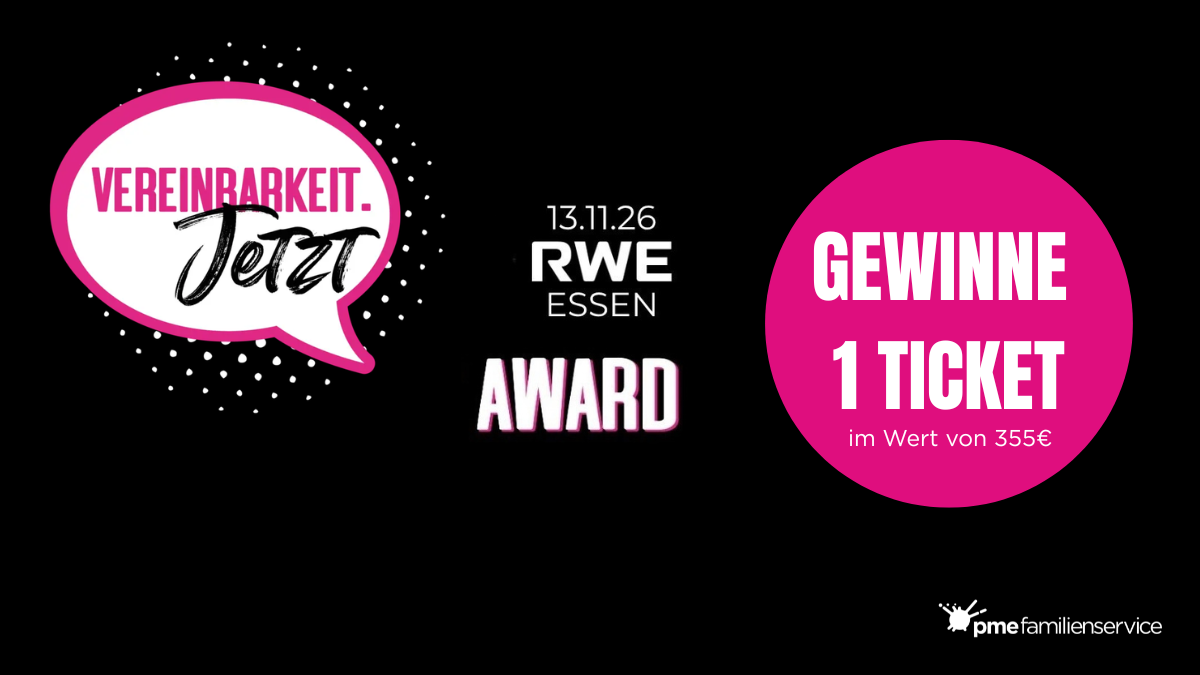
Win 1 Ticket to the Vereinbarkeit.jetzt Award
News

Win a ticket now for the 2nd Vereinbarkeit.jetzt Award

The pme Familienservice has been selected as one of the top 3 in the “TOP FAMILY BENEFITS” category of the 2nd Vereinbarkeit.jetzt Awards. The awards ceremony will take place on November 13, 2026, at RWE in Essen. And you can be there in person: We’re giving away a ticket for the entire day of the event, including the evening program, dinner, and awards ceremony.

Networking with Added Value

Inspiring presentations, practical discussions, and exciting encounters: The Vereinbarkeit.jetzt Award offers more than just a traditional awards ceremony. The event brings together representatives from companies, HR, and leadership, showcases innovative family benefits programs, and introduces role models who are making work-life balance a reality.

Vereinbarkeits.jetzt Award Contest: Here's What to Expect

We're giving away a ticket to the 2nd Vereinbarkeit.jetzt Award on our LinkedIn channel. The ticket is valid for the entire day, including dinner and the awards ceremony. Here's what the prize includes:

  • Access to all presentations, panel discussions, and exhibition areas
  • Inspiring ideas on work-life balance and family benefits
  • Exchange with experts, service providers, and decision-makers from HR and corporate management
  • a special evening program featuring an awards ceremony and a Mediterranean dinner

The contest begins with the publication of our contest post on LinkedIn on September 21, 2026, and ends on October 9, 2026, at 11:59 p.m. German time.

Would you like to celebrate this special day with us? Then enter our giveaway on LinkedIn now. We’re keeping our fingers crossed for you.

Rules for the “Ticket to the 2nd Vereinbarkeit.jetzt Award” Contest

Organizer

The organizer of the sweepstakes is pme Familienservice GmbH, Flottwellstraße 4–5, 10785 Berlin.
Entry Period

The contest begins with the publication of the LinkedIn post on September 21, 2026, and ends on October 9, 2026, at 11:59 p.m. German time.

Eligibility

Eligible to participate are adults who are residents of Germany. Each person may participate only on their own behalf; participation on behalf of others is not permitted.

Employees of pme Familienservice are not eligible to participate.

How you can participate

Anyone who, during the entry period:

  • commented on the contest post on LinkedIn with an answer to the question: “Why would you like to experience this event with us?”
  • "Liked" the contest post and
  • follows the pme's LinkedIn channel at Familienservice .​​​​​​​

 Submitting multiple entries does not increase your chances of winning.

Determination of Winners and Notification

The winner will be selected by random drawing from among all eligible participants after the contest ends. The drawing will take place on or after October 13, 2026.

The winner will be notified via direct message on LinkedIn no later than one day after the drawing. If the winner does not respond within five business days of the prize notification being sent, we reserve the right to redraw the prize.

Cash payouts or transfers of the prize are not permitted.

Exclusion from Participation

pme Familienservice reserves the right to disqualify participants from the contest for violations of these terms and conditions. This applies in particular to:

  • false information
  • Attempts at manipulation
  • automated participation
  • Comments that violate applicable law or the rights of third parties
  • comments that glorify violence, are offensive, harassing, discriminatory, or derogatory

If the prize has already been awarded to a disqualified person, it may be revoked retroactively and raffled off again.

Changes to or Termination of the Contest

pme Familienservice reserves the right to modify, suspend, or terminate the contest, in whole or in part, at any time if, for technical or legal reasons, its proper conduct cannot be guaranteed.

Data protection

To conduct the giveaway, we process the data that is visible or required as part of participation, specifically the profile name and the comment. If a participant wins, we also process the contact information necessary to notify them of their win and to organize their participation.

The data will be used exclusively for the purpose of conducting the giveaway, notifying the winner, and arranging the prize, and will be deleted afterward, provided there are no legal requirements to retain it.

For more information on how pme Familienservice handles personal data, please see the Privacy Policy.

Note on LinkedIn

This contest is not affiliated with LinkedIn and is in no way sponsored, endorsed, or organized by LinkedIn. pme Familienservice GmbH is the sole organizer and recipient of the information provided.

By entering the contest, participants agree to these terms and conditions.

zero Promoting Job Crafting as a Manager in 5 Steps

hgfwegh
Leadership & HR

Promoting Job Crafting as a Manager in 5 Steps

Layoff numbers are rising, and with them, uncertainty among employees. Through job crafting, managers can transform fears of layoffs into energy for growth and increase engagement and productivity within their teams. Leadership coach Karoline Weber explains in five steps how you can systematically introduce job crafting to your team.

Text: Karoline Weber, Career and Leadership Coach | Editor: Sabrina Ludwig

What does "job crafting" mean?

The term "job crafting" comes from occupational psychology and refers to actively shaping one's own tasks without changing jobs or positions. Instead of waiting for changes to happen, you take control of your own development.

Studies show that more and more companies are cutting jobs

Reports of restructuring and job cuts in the German economy are on the rise. As early as the end of 2025, the ifo Employment Barometer clearly showed that an increasing number of companies are planning to cut jobs or adjust their workforce structures.

Reports of significant job cuts in the industrial sector alone underscored this trend in 2025 and painted a challenging picture for 2026 as well.

Concerns about job security are growing

For employees, this means, above all, a great deal of uncertainty. Concerns about job security are growing, and the question “Do my skills still make me a good fit?” is becoming increasingly urgent.

As a manager, how can I foster stability within my team?

In this environment, your role as a leader is changing. It’s no longer just about managing performance, but about actively creating stability and pointing the way forward.

This is exactly where job crafting can be used as a leadership tool. Instead of passively reacting to changes, you can work with your team members to proactively shape their roles and responsibilities.

Would you like to foster psychological safety in your team? Read the article: 10 Tips for Psychological Safety in Teams

Job Crafting as a Leadership Tool

Job crafting is a way to adapt valuable skills to new requirements, retain employees within the company, and give them an active role in shaping change. In this way, uncertainty is transformed into an opportunity for growth.

The 3 Dimensions of Job Crafting

Job crafting means that employees proactively tailor their work to their strengths, interests, and values.

This occurs along three dimensions:

1. Task Crafting (Designing Tasks)

Employees change the scope or nature of their duties. 

For example, they take on new responsibilities that align with their strengths and/or passions, or delegate tasks that others on the team can handle better.

2. Relational Crafting (Building Relationships)

The way we collaborate is being adjusted. For example, responsibilities for specific points of contact may be reassigned because a colleague gets along better with Person X from Marketing than you do, so you take on a different point of contact instead ; or communication within the team is being structured more deliberately, for example through regular retrospectives.

3. Cognitive Crafting (Shaping Perception)

This shifts the perspective on one’s own work. By explaining the broader context, employees come to recognize the greater purpose of their work and their contribution to the company’s success, which can greatly enhance their sense of purpose: “I’m not just a call center agent—I’m also a problem-solver and a customer satisfaction representative. The quality of my work has a direct impact on our company’s image.”
​​​​​​​

Enhance your leadership skills!

Leadership, conflict management, change processes, and mental health: Enhance your leadership style and your teams with executive coaching. 

Exclusive 24/7 hotline for executives. Over 30 years of expertise.

More information: Executive Coaching

The business case for job crafting is compelling

The business case for job crafting is compelling: Companies and leaders who promote it benefit from:

  • greater motivation and a better work environment, since employees enjoy their work more.
  • Greater performance and innovation, as employees’ sense of self-efficacy is strengthened, enabling them to approach their daily work with more energy and enthusiasm.
  • greater employee retention through opportunities for professional development.
  • Personal growth and career opportunities by recognizing and leveraging your strengths and managing your weaknesses.
  • Personal growth and career opportunities by recognizing and leveraging your strengths and managing your weaknesses.

Practical Checklist: How to Actively Promote Job Crafting in Your Team

The role of leaders, therefore, is not to dictate ready-made solutions, but to create a framework in which team members can become “job crafters” themselves. The goal is to strike a balance between the company’s objectives and the legitimate interests of individuals.

The role of the manager here is that of a coach who recognizes potential and facilitates its development in a way that promotes personal growth.

5 Steps: How to Turn Your Employees into “Job Crafters”

1. Raise awareness of “job crafting”

Actively discuss job crafting with your team if you notice any uncertainty or dissatisfaction, or if you see that individual team members are already taking steps to make proactive changes.

Make it clear that you’re open to working together to further develop roles and responsibilities. Let them know: “Your job isn’t set in stone.”

2. Listening and Observing

Have regular, open conversations. Ask questions that encourage reflection: “Which of your tasks give you energy, and which ones drain it?”, “Where do you see untapped potential in your role?”, or “What problem within the team would you like to solve?”

3. Create space

Whenever possible, allow for autonomy in performing tasks or collaborating with other departments.

Support employees who want to try out new approaches or launch small, independent projects that contribute to team or company goals.

4. Delegate with a Focus on Resources

When assigning tasks, consider not only capacity but also strengths and interests. A thoughtful approach to task assignment can boost motivation across the entire team and increase efficiency, even when resources are limited.

5. Convey Meaning

Establish a clear connection between daily tasks and the company’s overarching purpose. Help your team recognize the important contribution each individual makes to the bigger picture.


Job Crafting as a Challenge for Companies

Especially during times of change, it is unrealistic to redesign each employee’s workspace individually. 

However, it is possible to introduce all employees to the concept of job crafting. To this end, it is essential to recognize job crafting as a corporate resource and to integrate it conceptually into corporate policy. 

Similarly, HR and talent development should support managers in guiding the process using specific guidelines and tools. 

Conclusion: Job crafting helps support teams through change

Job crafting is an extremely effective tool for ensuring motivation, employee engagement, development, and performance during times of change.
By encouraging and empowering your team to actively shape their own work, you are directly investing in the resilience and future viability of your department.

FAQ: Frequently Asked Questions About Job Crafting

1. What is job crafting?

Job crafting means that employees proactively tailor their tasks, collaboration, and perspective on their work to their strengths, interests, and values—within the context of their existing job.

2. Why is job crafting particularly important during periods of job cuts?

During restructuring and workforce reductions, job crafting creates stability: Employees continue to develop their skills, feel they have more influence over their work, and are more likely to remain with the company.

3. What are the three types of job crafting?

Task Crafting: Adjust the scope and type of tasks (more of what’s manageable, less of what drains your energy).

Relational Crafting: Redesigning Collaboration, Interfaces, and Communication Channels.

Cognitive Crafting: Seeing your own role in the broader corporate context in a new light and experiencing it as meaningful.

4. As a manager, what can I do to encourage job crafting?

  • Openly discuss job crafting within the team.
  • Listen regularly and ask reflective questions.
  • Allow for flexibility and autonomy in carrying out tasks.
  • Assign tasks based on strengths and interests.
  • Highlight the significance and contribution of each role to the company's success.

5. How does job crafting benefit companies?

Job crafting boosts motivation, innovation, performance, employee retention, and team resilience—especially during change processes.

6. What role does HR play in job crafting?

HR should recognize job crafting as a resource, integrate it into policies and processes, and support managers with appropriate tools, training, and coaching.


The Work:Life Academy at pme Familienservice offers a wide range of seminars and training programs for companies focused on leadership development and employee development.

Whether in-person, online, or as blended learning or blended coaching—we flexibly tailor our seminars and training sessions to the needs of your teams and leaders.

Systemic, solution-oriented, and practical:Work:Life Academy