28.08.2026
 Ifenna Ekezie
 3407
3407
How to Foster Participation in the Workplace: From Taking Part to Helping Shape the Future
Complex challenges can rarely be solved on one’s own. They require diverse experiences and perspectives, as well as spaces where contradictions can also come to light. Participation, therefore, is more than just having a say and good facilitation. It is a craft, a leadership skill, and democracy in action.
This is exactly where the School of Participation comes in; in its first pilot course, two team members from pme Familienservice are being trained as participation designers. The training is intended to serve as a means of evaluation and adjustment, to bring new ideas to the company, and to demonstrate how participation can be successfully implemented in day-to-day work.
What does employee participation mean in a company?
The Federal Agency for Civic Education defines participation as theactive involvement of members of an organization in their shared affairs.
Applied to a business context, this means:
- Employees are involved,
- can share their perspectives and experiences
- and contribute to the design of processes and solutions within a clear framework.
"Effective participation is characterized by the negotiation of different perspectives and contradictions, and is thus democracy in action." – Dr. Ruth Beilharz, graduate in business administration, supervisor, systemic consultant, and member of the School of Participation’s leadership team
Participation in a company does not mean putting every decision to a large plenary session. Rather, it is about making a conscious decision about who is involved, when, and how.
Good turnout
- highlights different perspectives,
- creates transparency
- and increases the likelihood that the people affected by these solutions will support them.
"When participation is clearly defined and firmly rooted in the company's values through consensus, decision-making processes can become significantly faster." – Nils Hofert, Head of Human Resources at pme Familienservice
For Nils Hofert, head of human resources at pme Familienservice, this also includes a willingness to critically examine one’s own structures:
- Are the decision-making processes transparent?
- Are regional and smaller units sufficiently involved?
- In what situations is broad participation appropriate—and when is a clear decision by individuals needed?

Participation as a Future Skill for Modern Leadership
Work environments are becoming more complex, change processes are accelerating, and decisions are becoming more challenging. At the same time, many employees would like to
- share their perspective,
- Take responsibility
- and influence developments.
Dr. Ruth Beilharz, a participation expert and member of the School of Participation’s leadership team, sees this as a central task of modern leadership:
- People should not merely be informed about changes; they should be made participants in the process.
- Transparent information, genuine participation, and the joint negotiation of different perspectives can strengthen a sense of identification and responsibility.
She therefore also views participation as the “art of leading”: the art of guiding people through complex situations without marginalizing their perspectives and sense of self-efficacy in the process. Forcompanies, this ability is becoming a key skill for the future.
"Learning the art of leadership is increasingly becoming an asset for companies that will set them apart from less successful ones." – Dr. Ruth Beilharz, Leadership Team of the School of Participation
Understanding Participation as a Craft
If people are to develop solutions together, it's not enough to simply invite them to a meeting. It takes
- a good framework,
- clear methods
- and an attitude that takes different perspectives seriously.
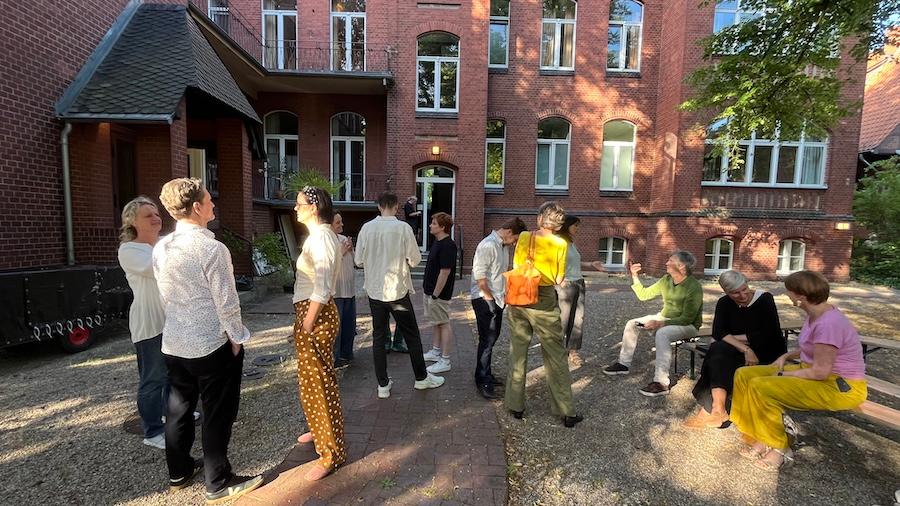
The training program for participation designers at the School of Participation therefore combines theoretical foundations with practical application. Participants learn about various methods while also exploring a democratic mindset:
- How can people work together as equals?
- How can social spaces be created and sustained?
- How can different perspectives be turned into viable solutions?
"Facilitating such processes and maintaining social spaces is more than just moderation. It is a craft that must be learned" – Dr. Ruth Beilharz, School of Participation Leadership Team
The training program itself embodies this commitment: The first training course, in which two team members from pme Familienservice are currently participating, is designed to be participatory—that is, participants can share their experiences and feedback and thus contribute to the program’s ongoing development.
Companies as Places of Learning for Democracy
According to Ruth Beilharz, companies have not only economic significancebut also social significance:Where people regularly experience that
- hearing different perspectives,
- Discrepancies Resolved
- When processes and decisions are made transparent, democracy can become a tangible part of everyday life.
"Through their leadership style, companies can become important places for learning about democratic behavior." – Dr. Ruth Beilharz, Leadership Team of the School of Participation
For pme, promoting participation is therefore linked to the question:
How can collaboration, leadership, and social responsibility be considered together?

Why pme Invests in Participation
For pme, participation is not only a socially relevant issue, but also an important part of its corporate culture. This includes,
- Strengthening democracy in the day-to-day workplace,
- to break new ground in an open and forward-looking manner,
- to continuously improve our own structures and offerings,
- Seeing Diversity as a Strength
- and to actively involve employees and support their development.
, the key factor in the decision by two pme-Tem members to participate in the training program to become participation facilitatorswas, in particular, the combination of:
- a democratic attitude,
- specific methodological knowledge
- and its relevance to one's own work with clients.
The partnership with the School of Participationcombines personal development with organizational development. At the same time, it provides an opportunity to critically examine one’s own processes and exchange experiences with other participating companies.
"We want to take a critical look at our own processes: Are we really as participatory as we think we are?" – Nils Hofert, Head of Human Resources at pme Familienservice
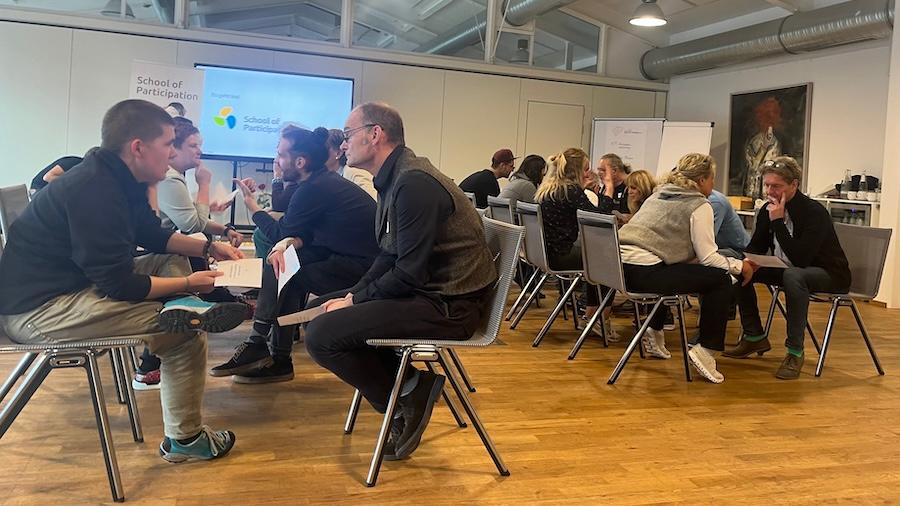
Two pme employees, two personal paths to participation
Philip Schmidt, Business Account Manager: Engagement Requires the Right Methods
Philip Schmidt is already familiar with the concept of participation from his studies in social pedagogy. The program at the School of Participation gives him the opportunity to delve deeper into the subject:
- He finds the training program to be diverse, both in terms of the range of topics covered and the variety of methods used.
- In his view, what is particularly noteworthy is the structure of the training program, as it first instills a basic commitment to democracy before moving on to methodology.
- He really appreciates that, as participants, they can help shape the first course in a participatory way and get involved.
He finds the connection between participation, transformation, and change particularly fascinating:
"When people are involved early on, different perspectives and potential resistance can come to light before they complicate the change process." – Philip Schmidt, Corporate Account Manager at pme Familienservice
However, not every situation requires the same format. The key is to choose theright method at for
- therespectivegroup,
- Research Question
- and to make a decision.
In his day-to-day work, he keeps this question in mind: How can participation be shaped in concrete terms?
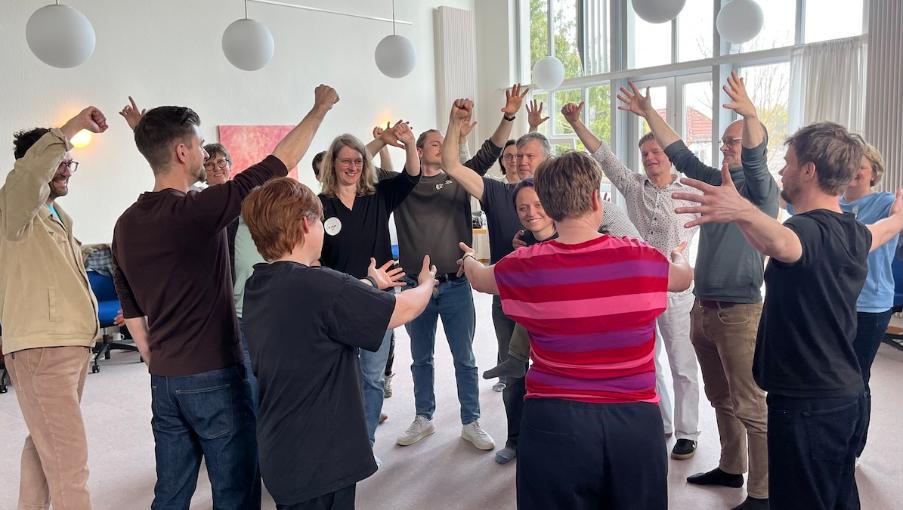
Melina Friedrich, Early Childhood Educator and Employee Representative: Participation Begins with Listening
For Melina Friedrich, participation begins with the desire to look more closely and listen more carefully: What is truly important—in society, in business, and in politics?
- The training program provides her with concrete tools to do this and, at the same time, offers a space where she feels her experiences and personality are acknowledged.
- She particularly values the open dialogue with her fellow students and the opportunity to help shape the program.
"For me, participation starts with looking more closely and listening more carefully." – Melina Friedrich, educator at the " childcare center " Wolkenzwerge daycare center in Berlin and member of the pme employee advocacy group Familienservice
She wants to help employees and employers build better relationships, engage in more open dialogue, and make a difference together.
In her daily life, she uses, among other things, the method ofmindful speaking and listening. This method helps her
- to be present,
- to listen attentively without jumping to conclusions,
- and at the same time clearly express one's own position.
What she has learned has long since become a part of not only her work life but also her personal life.
A Methodological Toolkit for Participation
Participation can take many different forms. The training provides participants with a diverse set of methods from which they can choose the appropriate tool, depending on
- Situation,
- Objective,
- affiliated group.

The following examples provide an initial insight into methods that Philip and Melina have learned during their training as participation facilitatorsor already use in their daily lives:
- Systemic Consensus-Building: This is not simply about reaching a majority decision. Instead, it brings potential resistance to light: Who still has reservations about a solution—and why? These objections can then be addressed in a targeted manner.
- “1-2-4-All”: This method involves all participants step by step: First, each person reflects on a question individually; this is followed by a discussion in pairs, then in groups of four, and finally as a whole group. This allows for a variety of perspectives—not just those of the quickest or loudest voices.
- Mindful Speaking and Listening: Melina Friedrich is certified in this method. It helps her to be fully present and listen attentively without jumping to conclusions, while at the same time expressing her own perspective clearly and honestly. In her interactions with children, parents, and her team, Melina finds that this makes conversations feel “more genuine.”
- Liberating Structures: These structures help her design facilitation sessions in a way that involves as many participants as possible. They are part of her personal toolkit and help her choose the appropriate participatory formats depending on the situation.
What happens next?
Participation begins with an attitude— —and is made effective through sound methods. At pme, this gradually gives rise to a shared learning process:
- Philip Schmidt and Melina Friedrich introduce new perspectives and tools,
- pme is reviewing its own structures,
- And the School of Participation provides a wide range of knowledge, experience, and a space for exchange.
The goal is not to have an immediate answer to every question, but rather
- bringing the right people together,
- to highlight different perspectives
- and to work together to develop viable next steps.
In this way, participation at pme Familienservice can become a skill,
- empowers employees,
- improved cooperation
- and makes democratic culture a tangible part of everyday work life.

Frequently Asked Questions
What is the training program to become a participation facilitator?
The Participation Designer training program at the School of Participation instills a democratic mindset and teaches concrete methods for shaping participatory processes in society, politics, business, and NGOs. Participants learn how to purposefully engage people, bring different perspectives to light, and support decision-making in a transparent manner.
Why does pme support vocational training?
pme supports training because participation is important for working with clients, collaboration, and change processes. The knowledge gained should be applied to other areas of the company.
Does participation mean that everyone decides everything?
No. Participation does not mean that every decision must be made by everyone. It is about finding the right framework for participation, clarifying responsibilities, and ensuring that decisions are transparent and accountable.
How do pme employees and others benefit from the training?
The training program strengthens personal and methodological skills. It helps participants conduct conversations more thoughtfully, facilitate group discussions more effectively, and foster participation in a targeted manner in a variety of situations.
Further information
School of Participation: Training to Become a Participation Designer | The School of Participation is a collaboration with the Bildungswerk Mehr Demokratie.