
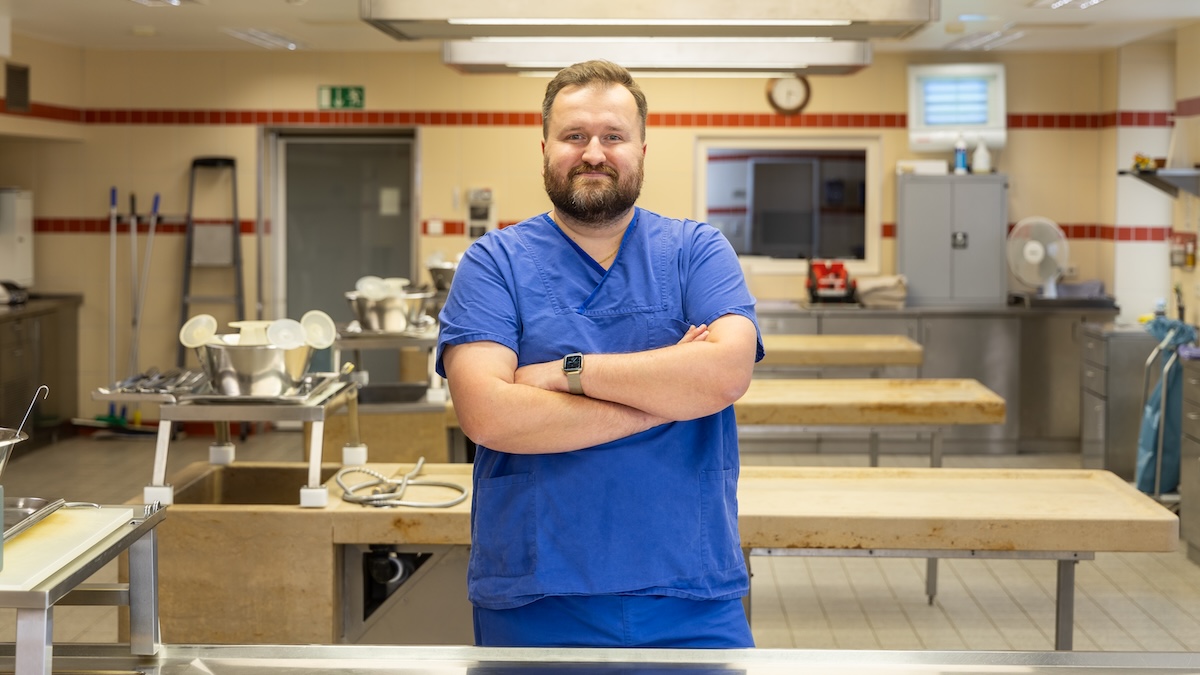
Forensic pathologist Philipp Möller
Body & Soul

Forensic Pathologist Philipp Möller: What the Dead Reveal About Life

Forensic pathologist Philipp Möller from Berlin has arguably one of the most fascinating medical professions. In this interview, he explains what medical findings reveal about life, diseases, and accidents—and why these insights are important for prevention and societal understanding. Philipp Möller is a speaker at Health Day 2026. In his keynote address, he will show what traces our lifestyle leaves on the body—and how to cope with the psychological stresses of the profession. ​​​​​​​Interview: Simone Bohny / Christin Müller, Photo: Christoph Harms

"My work regularly reminds me of how quickly a life can change or come to an end." (Philipp Möller)

When you tell people at a party that you're a forensic pathologist, what's the question you're asked most often? 

The most common question is probably, “What was your worst case?” Closely followed by, “Is it really like on *Tatort*?” And sooner or later, the question almost always comes up: Do you get used to the smell? The honest answer is: You get used to a lot of things, but not everything. And maybe that’s for the best. I want to do my job professionally, but I don’t want to become completely desensitized. 

Many people are familiar with forensic medicine mainly from crime shows or true-crime podcasts. How closely do shows like “Tatort” and “CSI” actually reflect your day-to-day work? 

Some things are surprisingly well researched, while others have absolutely nothing to do with our everyday lives. The biggest misconception is probably that we solve every case completely within a few hours—and all on our own.

In TV shows, there’s often an autopsy, a spectacular single finding, and shortly thereafter, the killer is identified. In reality, forensic medicine is often much more detailed. We document findings, collect evidence, wait for toxicological or histological test results, and piece together many individual pieces of information.

Furthermore, we do not solve murder cases. We provide medical findings and their professional interpretation. The police and the district attorney’s office conduct the investigations.

Sometimes even an unremarkable finding can be very important. This is fascinating from a scientific perspective, but on TV it might seem less dramatic than a forensic pathologist peering intently through a microscope.

True crime is booming. In your experience, what is it about real-life criminal cases that fascinates people so much? Where would you like to see fiction and reality more clearly separated?

I believe that people want to understand how something so extraordinary and threatening can happen. Criminal cases raise fundamental questions: How safe is our world? How well do we know other people? Could something have been detected or prevented?

True crime also often offers a seemingly straightforward narrative with a beginning, a crime, and a resolution. Real life, however, is often more complicated. Not every case can be fully explained, and not every question is answered.

It can become problematic when a real-life tragedy is treated merely as thrilling entertainment, or when only the smallest details are singled out and dramatized. Behind every case are people who have died, those who have been injured, their loved ones, and people whose lives may have been permanently altered.

That’s why I sometimes wish there were a clearer distinction between objective reporting and sensationalist coverage. It’s possible to tell a compelling story about a case without completely losing sight of the people involved.
What fascinates you personally about forensic medicine?

I am fascinated by the intersection of medicine, science, law, and social responsibility. We don’t just work at the autopsy table. We also examine living victims of violence and suspects, assess injuries, reconstruct the sequence of events, and explain medical findings in court.

What I find particularly fascinating is that we have to use objective findings to develop answers to very specific questions. What happened? When did it happen? Does an injury fit the described sequence of events? Can a medical condition explain the death? And yet, hardly any two cases are alike.

Even after many years, there are still situations where you see something for the first time or have to reinterpret a finding that initially seems unremarkable. This careful examination and the process of piecing together many small pieces of information continue to fascinate me to this day.

You say that the human body tells many stories. In your experience, what signs or findings reveal the most about a person’s life? 

The body bears traces of illnesses, injuries, medical treatments, and sometimes even lifestyle habits. Scars, for example, can tell the story of past surgeries or accidents. Changes in organs and blood vessels can indicate long-standing illnesses. Even healed broken bones or older injuries can reveal something about a person’s medical history.

However, one must be cautious. A single finding rarely tells the whole story. What matters is the big picture: the body, the medical records, the circumstances of death, and the results of further examinations.

The title of your talk is “What We Can Learn from the Dead.” What can the deceased actually teach the living? 

The deceased can initially help us in very concrete ways to investigate causes of death. We can identify illnesses, pinpoint risks, and sometimes even determine whether medical treatments or external factors played a role.

In addition, findings from forensic medicine can contribute to prevention. For example, we learn about the mechanisms of accidents, violence, substance use disorders, suicides, and the consequences of undiagnosed illnesses. This knowledge can help reduce risks to other people.

For me, there’s also a social dimension to this. Death often reveals where people have been overlooked, where protective measures have failed, or where health and social problems have long gone unnoticed.

The dead can no longer speak for themselves. It is therefore our task to analyze and interpret the findings and, if possible, to learn from them.

Your job brings you into contact with people facing difficult circumstances every day. How do you manage to find a healthy balance? 

Professional distance is necessary so that I can work reliably and evaluate findings objectively. For me, however, it does not mean indifference or working like a robot.

In forensic medicine in particular, it is essential to combine both scientific precision and an awareness that one is dealing with a human being and that person’s fate. This applies equally to the deceased and to examinations of living victims of violence.

Empathy doesn't always show itself in grand gestures. It also shows itself in carefully examining the situation, communicating respectfully, and not jumping to conclusions. Professional accuracy is, after all, a form of respect as well.

Has your work changed your outlook on life? 

My work regularly reminds me of how quickly a life can change or come to an end. That doesn’t mean I go through life in a constant state of gloom—quite the opposite, in fact. I try to be more mindful of the beautiful and everyday things in life. Spending time with my husband, our dog, my family, and my friends is very important to me.

I also try not to put things off indefinitely. Of course, that doesn't always work out. Even forensic pathologists sometimes don't reply to emails until three days later. I believe that my work helps me focus on what's truly important.

Many conflicts and supposedly major problems seem smaller when you experience firsthand every day just how fragile life is. At the same time, you learn that a zest for life and reflecting on death don’t have to be mutually exclusive.

People who reflect on the finiteness of life sometimes gain a better understanding of why we should make the most of life and enjoy it.

zero Team development and team building in times of upheaval

Team development
Leadership & HR

What is team development and team building?

What is the glue that keeps people in your company? The atmosphere in the team and the management style are crucial. Both are ranked far higher than salary by employees and applicants. pme team and leadership trainer Mario Müller explains what teams need now, what makes a really good team and what mistakes you should avoid when purchasing team development and team building measures.


Summary:

In times of upheaval, teams need targeted support to strengthen trust, collaboration, and efficiency. In this article, leadership coach Mario Müller explains what team development and team building entail, when external guidance is beneficial, and how leaders can successfully guide teams through change processes.
​​​​​​​Practical tips, common pitfalls, and a checklist for selecting appropriate measures help companies improve their team culture in a sustainable way.

​​​​​​​

1. definition of team development and team building

1.1 What is team building?

Team building is a suitable tool after putting together or expanding a team. Team building measures are various activities, games, exercises and methods that aim to promote cooperation and cohesion within a team.
The team gains experience together and builds trust as a result. The team members get to know each other's strength profiles and their communication needs.

1.2 What is team development?

In real team support, a method roadmap is drawn up based on surveys and team measurements, with which the team systematically works on itself over a period of months and improves sustainably. The results are measured and the achievement of interim goals keeps motivation high.

External support creates a sense of commitment and therefore increased motivation. Resources are used in a targeted manner and skills are deepened and consolidated to a greater extent than with one-off measures.

1.3 What happens in team workshops and team seminars?

In contrast to team-building measures, existing teams continue to work on their individual issues in workshops and seminars. In addition to an outside perspective, they also receive inspiration and proposed solutions that act as an impetus for the team.

If there is no team support after the one-off event, motivation often wanes within a few weeks and even interim successes can be lost again. As a rule, the results are also not measured, which makes it difficult to evaluate the investment.

2 What makes a perfect team?

A great example of outstanding teams can be found in space travel.

We are constantly investing in the physical fitness, resilience, expertise and methodological skills of our astronauts.

But that's not all: they are indispensable components of a mission, committed to each other and trust each other with their lives. The tasks are complex and sometimes involve unforeseeable disruptions to which the team must react quickly, purposefully, agilely and together. To achieve this, communication and trust must be flawless.

This YouTube content can only be loaded if you accept the privacy policy of Google LLC.

To the data protection settings "

3. when does external team development make sense?

External team consulting always makes sense when team spirit is lacking. Get an outside perspective. A holistic view that looks at the entire value chain, processes and potential as well as the individual resources and points of friction in the team. If you know exactly what will help you the most and which bottlenecks and skills you want to target, you can decide what you can solve with your own resources and what you can get external support for.

3.1 Typical occasions for external team support are

  • After a long phase of virtual collaboration, your team is now working in hybrid mode and you are looking for the right balance between online and face-to-face work as well as suitable working methods.
  • Your team has changed in terms of personnel, has new team members or the tasks, roles and objectives have changed.
  • A new manager takes over a team and wants to invest in team development right from the start.
  • A temporary project team is formed and wants to define the temporary collaboration.
  • Change processes are imminent in the company and the teams would like to be accompanied.
  • A team is under a lot of pressure (e.g. due to prolonged illness, homeschooling or staff shortages) and is looking for relief.
  • The team is very diverse and the team members want to benefit from each other.
  • Different teams are brought together and are faced with the task of growing well together.
  • There are open or hidden conflicts in the team that cannot be resolved alone.
  • The management culture is to be made sustainable and competitive.
  • Teams should work together in a more agile, flexible and efficient way.
Unleash the full potential of your managers and teams now.

Our trainers and coaches at the pme Academy support you in difficult transformation and change processes or analyze together how you can make even better use of your team's strengths. 

More information on the seminars and training courses: pme Academy

4 What do teams need in times of upheaval and crisis?

 In times of upheaval, teams have the same needs as ever:

Trust, appreciation, collegiality, participation.

It is just much more urgent that cultures also meet these needs, because otherwise employees - feeling left alone - can collapse under the strain.

The pandemic has shone a glaring light on existing problems. Companies with a good culture have hardly suffered any losses as a result of the pressure to digitize and the additional burdens, or have even grown closer together. Companies with problematic or control-based management are now often faced with a shambles. Culture does not grow overnight and cannot be imposed. When a crisis comes, you have either already invested or not.

5 What role does the manager play in the team development process?

Managers should not be role models, managers are role models.

Their behavior is always taken as a guide for mutual interaction. However, managers must not only regulate their own behavior, but also defend the culture in the team. It is a truism that people leave managers and not positions. Leadership is a complex topic that requires regular investment and which, contrary to popular belief, no one has "in their DNA".

Because competencies are shifting further and further into the teams, the "promoted clerk as manager" has almost become obsolete.

Management must give second and third level managers more time for leadership and cannot deploy them 100% (or in reality often more) as administrators "on the side". The costs for the team friction processes come in through the back door

6 Why should companies invest in team coaching?

The highest cost factor in all companies - and one that does not appear on any balance sheet - is interpersonal friction and its consequences: sick days, working to rule, low morale, the departure of frustrated people, internal dismissal, competitive thinking, burnout, bullying.

According to surveys, the three most important criteria for jobseekers are:

If you don't offer that, you disappear from the job market. Salary ranks just 7th.
The good people don't want to put up with sluggish, destructive teams and leave. Other potential applicants don't even come because they read about the experiences employees have had on the review platforms.

7. what mistakes should you avoid when purchasing team development measures?

1. the first mistake is to believe that team development a) is not necessary or b) is not worthwhile.

Team members often have a better insight into requirements than managers. And basing decisions solely on return on investment (ROI), which is only measured in euros, falls short. The value of investment (VOI) is much more decisive precisely because the brand value of the company increases through the culture, talents come and stay and get more involved.

2 The second mistake is to go to the pharmacy without seeking medical advice first.

Only diagnosis and analysis ensure that the right measures are taken and the levers are applied in the right places. It costs more time and money to book seminars according to the watering can principle than to seek professional advice on an effective approach.

3) The third mistake is to assume that causes and symptoms can be permanently eliminated with selective measures.

If you make your body ill through many years of unfavorable behavior and simply "hand it over to the doctor" in the expectation that you can then simply carry on as before, you won't have to wait long for new problems. Those who (mostly) lead a healthy lifestyle stay healthy. It's the same with teams. With the addition that even a healthy team, like a sports team, will naturally improve and perform better through training and support.


8. how does team coaching with the trainers and coaches of the pme Work-Life Academy work?

8.1 Analysis of the team

Our team support begins with a detailed analysis of your team's potential and points of friction . In order to find the critical points, we use good measuring instruments and our experienced view from the outside as well as from the inside.
This only works in cooperation with the people who make up your team - including the manager.

In the next step, you define measurable, realistic goals and suitable methods with our support. Over time, input and implementation alternate. The team members apply what they have developed and come back with the experience they have gained. The team process is reflected upon and iteratively improved.

8.2 What methods are used in team development?

During the process, the resources are directed to the areas where they have the greatest leverage for improvement. In concrete terms, the measures ideally consist of team training, workshops, information impulses and individual coaching sessions in addition to the kick-off and closing events. Your team can turn to the trainer or coach in confidence at any time. A typical support period starts at two to three months and can also extend over a year or more.

​​​​​​​

Mario Müller is a trainer and conference facilitator specializing in neurology, agile cooperation and improvisation. He has published several books on these topics and has worked for small and large companies on three continents.

pme Academy: Our 360° offers for managers and teams

Personnel management, communication, error culture, digital leadership - with our webinars and training courses in the 360° series, we focus directly on the day-to-day work of team leaders. For experienced managers and junior staff.

Learn more: pme Academy

FAQ: Team Development & Team Building

1. What is team development?

Team development is a long-term, ongoing process in which teams systematically work on their collaboration, communication, and structures—usually with the support of experienced coaches.

2. When is it worth hiring an external team coach?

External team coaching is recommended when there are conflicts within the team, new challenges need to be addressed, the way the team works is changing significantly, or external input is needed.

3. What are some common mistakes in team development?

Common mistakes include failing to conduct a needs analysis, implementing measures that are too narrow in scope, focusing solely on ROI rather than sustainable value (VOI), and assuming that teams will develop “on their own.”

4. How does team development work with the pme Work-Life Academy?

The support process begins with an analysis of the team, sets measurable goals, combines training sessions, workshops, and coaching, and provides ongoing support to the team—usually over several months.

5. What is team building?

Team building involves specific activities designed to strengthen collaboration and trust within a team. Typical examples include a group escape room, a cooking class, a canoe trip, or improvisational theater. Team building is particularly beneficial after new teams are formed, during staff changes, or following extended periods of remote work. This helps teams build trust quickly and work together more effectively.

6. When is team building a good idea?

Team-building is recommended after new teams are formed or when there are personnel changes, in order to quickly build trust and foster collaboration.