


The Best Private Retirement Plan for Those Starting Their Careers: Start Saving at Age 20
At age 20, very few people think about their retirement savings. And why should they? Retirement is still many years away. But in 30 to 40 years, the government pension alone will hardly be enough to maintain one’s accustomed standard of living in old age. Those who start saving for retirement early benefit the most from the power of compound interest.
Expert: Stephanie Bartsch, Income and Budget Counseling | Editor: Sabrina Ludwig
Private Retirement Savings – Good to Know:
- Why is it worth setting up a private retirement plan starting at age 20?
- How can I find out how much I can save?
- What is the 50-30-20 rule?
- ETFs are the perfect way for young people to get started
- Employer-Sponsored Retirement Plans – Partner with Your Employer
- Which is better: an ETF savings plan or a company retirement plan?
- Five Tips for Getting Off to a Successful Start with Retirement Planning
- Conclusion: Retirement planning is a marathon—and it's worth it!
- 2025 Youth Study: “Youth, Retirement Planning, and Finances”
- Helpful Links on Private Retirement Planning
- FAQ: Frequently Asked Questions – Explained Simply
For young people who have just started their careers, income is often still a bit tight and expenses are high. So why worry about old age? There’s still so much time until then. It’s better to spend the money on leisure activities and things that are fun—right?
Why is it worth setting up a private retirement plan starting at age 20?
Pension levels under the statutory pension insurance system are trending downward . As life expectancy rises, an ever-smaller number of working people must help support the growing number of retirees through the intergenerational contract.
That's because the birth rate is falling in Germany. This means we have more and more older residents than younger ones in this country. The taxes paid by young people are barely enough to cover the pensions of older people.
Added to this is inflation, which erodes the purchasing power of money over the years.
In addition to statutory and employer-sponsored retirement plans, private retirement savings are therefore becoming increasingly important.
"The German government’s upcoming pension reform will bring private retirement planning even more into focus. Long-term investment options and future-proof strategies are needed. This also includes investing in one’s own health and education."
Margret Kunz, pension coach, income and budget advisor at pme Familienservice
How can I figure out how much I can save each month?
A solid understanding of your personal finances is the foundation for creating a viable savings plan.
First, you should create a budget to get an overview of your income and expenses. Second, you should figure out how much money you can set aside to build up savings .
Are you moving into your first apartment and want to know what costs to expect and how you can save money? Read the article: How much will my first apartment cost?
What is the 50-30-20 rule?
The 50-30-20 rule can help you create a good structure for how to allocate your income.
- 50 percent of my net income is available for necessary expenses (rent, electricity, club dues, insurance, etc.)
- 30 percent for wishes and
- 20 percent for savings.
In reality, there's often less potential for savings, but even small amounts can have a big impact over the long term.
ETFs are the perfect way for young people to get started
One of the best options for young people is saving with ETFs (exchange-traded funds).
What are the benefits of ETFs for young adults?
The big advantage of starting early: the power of compound interest. Since you can save for over 40 years, even a small monthly amount— as little as 25 euros—is often enough to build up a substantial nest egg over the years.
The main advantages are:
- Broad Risk Diversification
- Low administrative fees
- Flexibility Through Stock Market Trading
- Option for regular savings plans, starting at just 25–50 euros per month
What are the best ETFs for beginners?
So-called “All Country” or “All World” ETFs are often the perfect way to get started. These index funds invest broadly across many companies in various industries and countries. This spreads the risk and keeps costs relatively low.
How long should I invest in ETFs?
You should invest in ETFs for at least 15 years . That's a general rule of thumb.
Stock markets do fluctuate. Over a 15-year period, for example, a crash tends to even itself out statistically.
Stephanie shares how she saved up the money for ETFs
“When I calculated how much I spend each year on five café lattes a week, I was briefly shocked—and felt guilty because I hadn’t set anything aside for retirement yet. Realizing how much that amounted to, I wanted to do something good for myself in the long run—so that I can still enjoy a cup of coffee without worry when I’m older.”
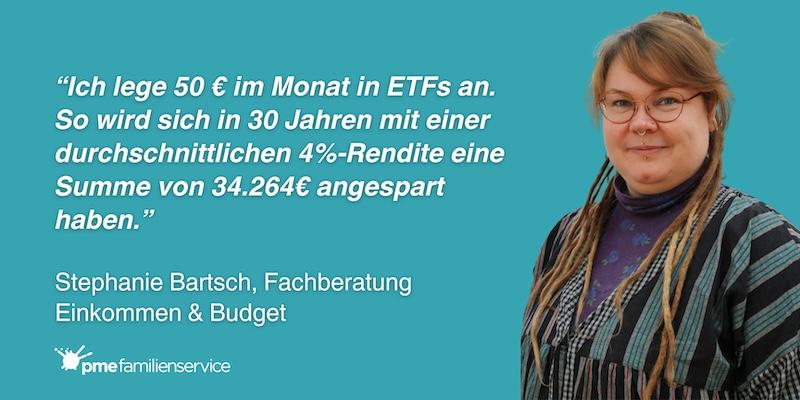
"Now I only treat myself to a latte to go twice a week and invest the money I save in an ETF savings plan for the long term. That’s €42 a month; to stay motivated, I’ve rounded the amount up to €50. With an average return of 4%, I’ll have saved a total of €34,264 in 30 years."
Stephanie Bartsch, pme Expert Advisor on Income and Budget
Employer-Sponsored Retirement Plans – Partner with Your Employer
Many companies offer an employer-sponsored retirement plan. Under this plan, a portion of an employee's gross salary can be set aside to provide an additional pension later on.
Occupational pension plans often offer tax and social security contribution benefits, making them an attractive supplement to the statutory pension. Young employees should definitely learn more about these plans and take advantage of what their employer offers.
Which is better: an ETF savings plan or a company retirement plan?
That depends on your personal situation. An ETF savings plan is flexible and well-suited for long-term wealth accumulation. A company pension plan can be attractive due to employer contributions and tax benefits.
It often makes sense to combine a statutory pension, an employer-sponsored retirement plan, and a private savings plan.
5 Tips for Getting Off to a Successful Start with Retirement Planning
1. Start saving early: Every euro you invest today can grow over the long term.
2. Save regularly: Automatic savings plans make it easy—even small amounts add up that way.
3. Pay attention to the costs: Lower fees mean a higher return for you.
4. Build your knowledge: Books , podcasts, and independent websites are great for learning.
5. Think long-term: Short-term price fluctuations are normal—don't panic and sell; instead, stick to your strategy.
Conclusion: Retirement planning is a marathon, not a sprint—and it's worth it!
A private retirement plan needs one thing above all else: plenty of time. And as a young person, that’s exactly what you have. That’s why it’s worth investing in your retirement early on, even if it’s just a small amount each month.
By combining a statutory pension, an employer-sponsored retirement plan, and private wealth accumulation— particularly through ETFs—you can lay the foundation for a financially secure retirement. If you start early, even small amounts can have a big impact.
The 2025 Youth Study reveals widespread anxiety: 75% of 17- to 27-year-olds fear poverty in old age.
Young people want to actively plan for retirement, especially through stocks, mutual funds, and employer-sponsored retirement plans, but they need clear, unbiased information to do so. 71% are interested in financial matters, but only 31% feel well-informed about retirement planning.
MetallRente Youth Study: "Youth, Retirement Planning, and Finances"
Helpful Links on Private Retirement Planning
Sparkasse Pension Gap Calculator
Understanding ETFs at extraETF
FAQ - Frequently Asked Questions About Private Retirement Savings
What is the compound interest effect, explained simply?
With the compound interest effect, earnings are not paid out but are reinvested. As a result, not only do the amounts invested generate a return, but so do the profits already earned. The longer the money remains invested, the greater this effect can be.
Which is better: an ETF savings plan or a company retirement plan?
That depends on your personal situation. An ETF savings plan is flexible and well-suited for long-term wealth accumulation. A company pension plan can be attractive due to employer contributions and tax benefits. Often, a combination of a statutory pension, a company pension plan, and a private savings plan makes sense.
Can I still make sensible retirement plans even with a limited budget?
Yes. Young people in particular benefit from starting early, even if they can only save small amounts. Even 25 or 50 euros a month can make a difference over many years. What matters isn't the perfect starting amount, but consistency.
Will the statutory pension be enough later on?
The statutory pension provides an important foundation, but for many people it is unlikely to be sufficient to fully maintain their accustomed standard of living in retirement. That is why it makes sense to have additional retirement savings, for example through an employer-sponsored retirement plan, private savings plans, or other long-term investment options.
Where can I find reliable information about private retirement savings?
Reliable information is available from independent counseling centers, consumer advice centers, reputable financial websites, and pension gap calculators. Employers can also provide information about workplace retirement plans. It is important to critically evaluate your sources and not let yourself be pressured into signing a contract too quickly.
Our Income and Budget Counseling for Young Employees
We advise employees on income and budgeting issues—both those who have lost track of their finances and those who want to make the most of their income.
If you want to empower your employees in the long term, learn more here about the services offered by pme Familienservice how we can provide personalized support.