


Hormone health and work: what companies can do
Hormones accompany us throughout our entire lives—and therefore also throughout our entire working lives. Nevertheless, surprisingly little is said about them in the workplace. Yet hormonal changes can have a major impact on how we live and work.
Text by Michèle Penz (Head of pme Familienservice) and Christin Müller (Editor)
Summary
In this article, we show why hormone health is a business issue, how menopause, menstruation, and men's health affect work performance, and what companies can do today with seven concrete steps to better support their employees and strengthen their health in the long term.
What you can expect in this article:
- Why hormone health is an issue for companies
- Menstrual cycle and menopause: specific changes at work
- Men's health: What is the truth about "male menopause"?
- Cortisol and stress: why stress management is part of hormonal health
- 7 tips for a hormone-friendly workplace
- Conclusion: Hormonal health as a factor for success
- FAQsabout hormone health in everyday stable work
1. Why hormone health is an issue for companies
For a long time, hormones were considered a purely private matter. Today, various studies show that hormonal changes have a noticeable impact on work ability, career paths, and productivity. Hormones therefore influence our well-being, concentration, and resilience—and thus our everyday working lives.
Hormones have a specific effect on:
- Energy and drive
- Concentration and memory
- Stimmung und Stresslevel
- Sleep and regeneration
1.1. Typical hormonal phases and situations
Hormonal changes accompany us through many stages of life, for example:
- puberty
- cycle-related symptoms (e.g., PMS)
- infertility
- Pregnancy and breastfeeding
- (surgical) hormone changes
- Perimenopause and menopause
- Andropause or age-related hormonal changes in men
- Thyroid or metabolic disorders
- hormone therapies
1.2. Possible symptoms that can also be felt at work
- Cognition: memory lapses , concentration problems, "brain fog"
- Body: Hot flashes , sleep disturbances, exhaustion
- Psyche: mood swings , irritability, sadness, anxiety
Health coaching from pme offers personalized 1:1 support on key health topics such as nutrition, exercise, sleep & relaxation, and hormone health. Find out more about health coaching from pme Familienservice now.
Many affected individuals do not dare to talk about it and try to "function" without knowing that hormones could be triggering their symptoms.
For companies, this means that hormonal health is an often underestimated factor in health, performance, and employee retention.
Michèle Penz, Head of Occupational Health Management at pme Familienservice:
"When companies introduce clear regulations and offers relating to hormonal health, this creates a more open and supportive culture. If we want to retain employees in the company for a long time, this inevitably means that they will grow older with us. It is therefore important to support employees in different stages of their lives."
2. Menstrual cycle and menopause: specific changes at work
During their working lives, women's bodies go through various hormonal phases – from the monthly cycle to menopause. Many women are familiar with this: some days everything comes easily, while on others even the smallest task feels exhausting.

The monthly cycle can affect women's performance.
2.1. Cycle: when performance changes over the course of the month
Throughout their cycle, many women report feeling more focused, resilient, and eager to learn during the follicular and ovulation phases. In contrast, fatigue, an increased need for sleep, or greater irritability are more common during the luteal phase.
Most people cope well with the changes. For some, however, the symptoms have a noticeable effect on their concentration, decision-making, and social interactions in their everyday working lives.
2.2. Menopause at work: When symptoms remain invisible
With the transition to menopause—the phase in which cycle hormones decline over the long term—these patterns shift again. Typical symptoms such as hot flashes, sleep disturbances, or mood swings can occur during this transition period (perimenopause) and during menopause itself.
Read the article "From brain fog to job stress: coping with menopause"
An international study of 2,900 female employees revealed that:
- 91 percent had at least moderate to severe symptoms.
- 37 percent stated that these symptoms affect their work performance.
- Around a third had not discussed it with anyone at work.
Many women would like to see significantly more support—and at the same time more knowledge and normality in dealing with menopause at work.
Particularly relevant: women between the ages of 45 and 55 are among the fastest-growing groups in the workforce—and they are often at important stages in their careers, frequently on their way to leadership positions or already in them.
Gynecologist Dr. Konstantin Wagner:
Companies should be aware that women go through many complex phases that affect their bodies, their mental health, and therefore also their careers. Ignoring this leads to frustration and dissatisfaction for everyone. Whether it's the desire to have children, PMS, pregnancy, or, above all, the onset of menopause, which can be very stressful and even life-limiting: if employers show understanding, promote education, and create appropriate structures, this not only relieves the burden on the women affected, but also improves the overall working atmosphere."
Read the full interview with gynecologist Dr. Konstantin Wagner
3. Men's health: What is the truth about "male menopause"?
Hormones also change in men over the course of their lives. From around the age of 30 to 35, testosterone levels slowly decline on average. In technical terms, this is called "partial androgen deficiency in aging men (PADAM)", colloquially sometimes referred to as "andropause".
3.1. Is andropause comparable to female menopause?
The answer is clearly no.
- The changes are more gradual than during menopause.
- Not all men have symptoms.
- There is no clear fertility limit.
- The term "male menopause" is scientifically controversial.
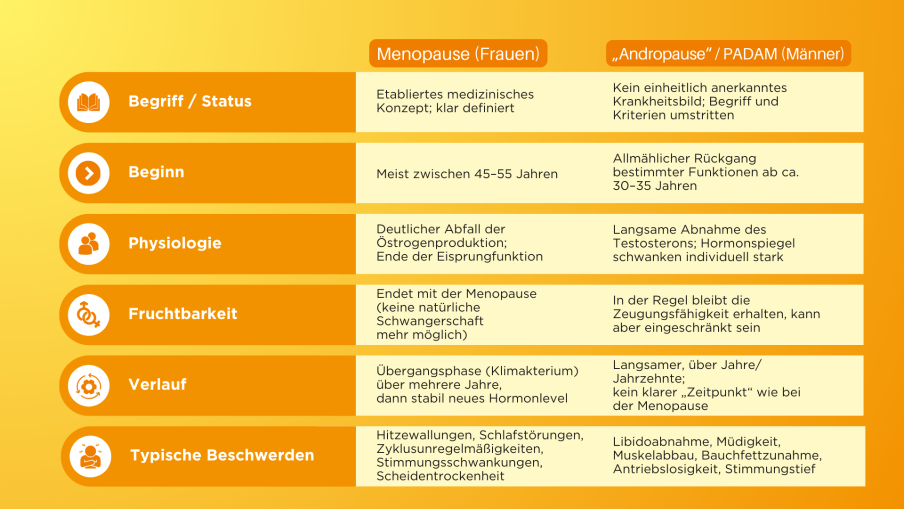
Comparison of menopause and andropause I Graphic: pme Familienservice
3.2. Testosterone deficiency: possible symptoms in men
If there is a testosterone deficiency, the following symptoms may occur, for example:
- Decreased libido and sexual dysfunction
- Fatigue and loss of energy
- Mood swings, irritability, depressive moods
- Decrease in muscle mass and bone density
- increase in body fat
- Concentration and decision-making problems
In everyday working life, however, these changes are often interpreted differently: "no longer interested in the job," purely a sign of aging, or a lack of motivation.
After pme Familienservice the event series for women "HerHealth" in 2025, the range of services was expanded in 2026 to include the new lecture series "Hishealth". It encourages male employees to take active responsibility for their health and focus on their own well-being.
Urologist Dr. Christoph Pies:
Preventive care is not a sign of weakness, but rather of responsibility for oneself. Unfortunately, many men lack this awareness because, unlike women, they are not accustomed to regular visits to the doctor from an early age. In addition, doctor's office hours are often not tailored to working people, which makes preventive care difficult. A rethinking of society and the healthcare system is necessary.
Listen to the podcast with urologist Dr. Christoph Pies "Understanding men's health.""
3.3. Men's health: Important for companies
It is therefore helpful for HR to consider men's health not only from the perspective of "back, cardiovascular, stress," but also to take hormonal aspects into account. It is important to create frameworks in which men can talk about changes, are made aware of counseling and medical services, and prevention is integrated into health programs.
4. Cortisol and stress: why stress management is part of hormonal health
Chronic stress activates the hormone cortisol. While a short-term increase can be stimulating, a permanent excess of cortisol is harmful in the long term:
- Sleep quality decreases.
- Irritability increases.
- Creativity and resilience decline.
- The immune system is weakened.
- Changes in hormone levels also affect mood-regulating neurotransmitters. This can lead to increased sadness, anxiety, and irritability—with direct consequences for cooperation, conflict behavior, and leadership.

Health in everyday working life is not just an issue for women and older men.
5. 7 tips for a hormone-friendly workplace
How can companies get started in concrete terms? These seven approaches can help—even with a small budget.
1. Raise awareness among managers
- Consciously addressing menstrual cycles, menopause, men's health, and stress hormones as part of workplace health
- Train managers to recognize signs – similar to stress or burnout
2. Make working models more flexible
- Enable flexible working hours and genuine breaks
- Where possible, create flexibility: not only where, but also when work is done
- Examples:
- - Flexible break times for doctor's appointments
- - Adjusted working hours during periods of severe symptoms
- - Temporary changes to tasks if certain activities are particularly difficult at the moment
3. Set up appropriate health services
This allows different stages of life and needs to be visibly integrated:
- Workshops on cycle and menopause competenceWorkshops on cycle and menopause competence
- Offers for women's and men's health
- Programs on stress, sleep, and resilience
- Additional services related to reproductive health (e.g., fertility, miscarriage, hormone treatments)

Prevention should not be a taboo subject in the workplace either.
4. Foster an open and supportive culture
Hormonal health is not a taboo subject, but rather a part of overall health—just like back pain or stress. Create various offerings such as:
- Spaces for exchange: round tables, networks, employee groups
- Lunch and learn sessions with healthcare professionals
- Anonymous surveys to better understand needs
5. Make confidential counseling visible
- Actively communicate external, confidential counseling services (e.g., employee assistance programs).
- Clearly state that hormonal issues also have a place there.
- Provide guidance on: medical assessment, psychological support, further assistance services
Important: These services must be low-threshold, easily accessible, and trustworthy.
6. Inform rather than advise
- Provide short, easy-to-understand formats: fact sheets, intranet posts, short online sessions, or keynote speeches.
- Addressing different target groups:
- - Executives
- - Shift workers
- - Younger employees (menstrual cycle, contraception, desire to have children)
- - Men (age-related changes, preventive healthcare culture)
7. Review structures and services
- Check whether guidelines, shift schedules, performance indicators, and occupational health management measures take hormonal health into account.
- View health services:
- - Are hormone therapies and specialist consultations covered?
- - Are there any psychological services that take into account the connection between hormones and mood?
- - Are there any additional, low-threshold offerings such as coaching or digital tools?
6. Conclusion: Hormonal health as a factor for success
Hormonal health is not a fashionable side issue, but a growing, strategically relevant success factor. Companies that take hormone-related changes seriously and address them openly are investing in health, motivation, and sustainable success.
7. FAQ: The most important questions and answers about hormones in working life
How do hormones affect work performance?
Hormones such as estrogen, progesterone, testosterone, and cortisol determine energy levels, concentration, mood, and sleep—and thus have a direct impact on productivity, team behavior, and well-being. Changes or imbalances can lead to physical complaints, emotional fluctuations, and cognitive impairments.
Are only women affected by hormonal changes?
No. Women experience a particularly large number of hormonal transitions throughout their lives (menstrual cycle, pregnancy, breastfeeding, menopause), but men also experience hormonal changes from around the age of 30–35 that can affect their energy levels, motivation, and resilience. In addition, there are hormonal issues that can affect everyone—such as stress (cortisol), thyroid disorders, or metabolic disorders.
What can HR do to promote hormonal health?
Important factors are:
- flexible working hours and, if necessary, adjustments to working conditions,
- Targeted health services (menstrual cycle, menopause, men's health, stress, sleep, reproductive health)
- open, taboo-free communication and trained managers,
- clear, confidential support channels (e.g., EAP, specialist counseling, internal and external contact persons),
- and policies that embed hormonal health as part of an inclusive, non-discriminatory corporate culture.