


Stop Overthinking: 5 Tips to Curb Rumination
We all overthink things. But when we can’t seem to stop overthinking, we call it “overthinking.” And overthinking takes a toll on our mental health over time, because the thoughts that go round and round in our heads for hours are rarely positive ones. What strategies and exercises can help us step off this mental merry-go-round and break this pattern?
Expert: Nina Lizon, Systemic Coach | Editor: Sabrina Ludwig
Stopping overthinking means interrupting the stressful cycle of thoughts and learning new ways of thinking. Studies show that over 91% of our worries never come true. Coach Nina Lizon recommends five exercises: externalizing thoughts, paradoxical intervention, emotion tracking, the 3R method, and brain dumping. These techniques help manage rumination and find more inner peace.
In this article you can read:
Why Most Worries Are Unfounded (Research Findings)
Most of our worries are self-inflicted. Over 91 percent of anxious thoughts never become reality. This is the finding of a 2019 study by Pennsylvania State University with participants suffering from generalized anxiety disorder.
Over the course of ten days, participants recorded every single worry in real time using their smartphones. The researchers then checked whether the feared events had actually occurred. The result: On average, 91.4 percent of the feared negative events did not occur at all.
But does that mean we shouldn’t worry about the future anymore? Or about how we’ve behaved toward our friends and colleagues? Was it okay to point out our colleague’s mistake? Or have we prepared well enough for tomorrow’s presentation?
No, because our critical thinking has helped humans survive and solve many problems. Being able to think ahead also means being able to recognize dangers early and protect ourselves.
It's normal to have phases or issues where we rack our brains. Thinking only becomes burdensome when we can't stop our thoughts, when they are negative, and when they turn against ourselves.
Does bad news put you in a bad mood? Read the article:7 Tips for Staying Optimistic Despite Bad News

What is overthinking?
Overthinking is a form of brooding. Thoughts circle around a problem without leading to a solution.
On the contrary: Instead of clarity, overthinking often leaves you feeling worse; you feel frustrated and demotivated, and all that mental rumination can even make you feel a little dizzy.
A typical characteristic of overthinking is:
- Can't find a solution
- There's no better feeling afterward
- Often self-doubt
Examples of thoughts associated with overthinking:
- Was the boss's praise earlier really sincere?
- Why haven't I received a reply to my email? Did I phrase something incorrectly?
- I'll never be able to do it as well as the others…!
- What if I end up regretting my decision?
Overthinking vs. Normal Thinking
The key difference is that normal thinking follows a linear path—that is, it leads from A to B and is goal-oriented. Normal thinking leads to ideas and solutions. And that’s why we feel lighter and more relaxed afterward.
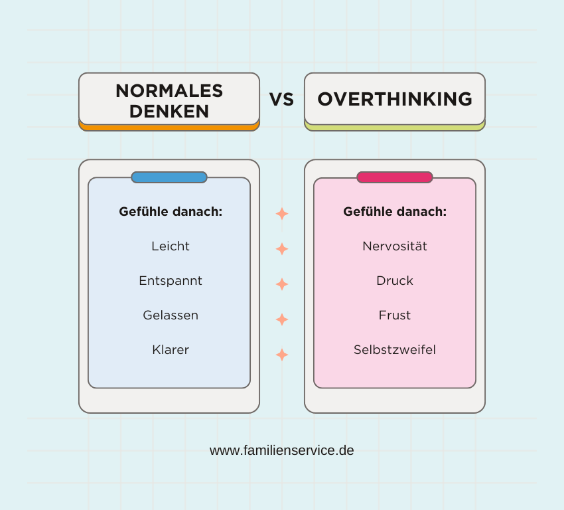
Emotions according to conventional thinking:
- Light
- Relaxed
- Calm
- Clearer
Self-reflection and self-awareness are usually helpful—we learn about ourselves, gain new perspectives, and solve problems in a targeted way. When we overthink, however, our inner, very harsh critic often steps in, making us feel insecure and fueling our fears.
Feelings after overthinking:
- Nervousness
- Frustration
Ask yourself this:Is my thinking currently leading me toward the next concrete step? Or am I just going around in circles? And does my way of thinking actually make my stress and anxiety worse?
This letscast.fm content can only be loaded if you accept the privacy policy of letscast.fm.
To the data protection settings "Two Types of Overthinking: Rumination and Worrying
Rumination and worrying are thought patterns that constantly repeat themselves in your mind and can really bring you down.
When you “ruminate,” you keep thinking about past mistakes ormissed opportunities.
Worrying, on the other hand, focuses on the future —all the things that could go wrong or the things you’re unsure about. Both can lead to anxiety, poor sleep, or a low mood.
“I often come across this topic in my coaching sessions: What do others think of me? Most people are just as preoccupied with themselves as we are. And they usually don’t think much about us.
Nina Lizon, Women’s Coach, Munich
Examples of rumination: dwelling on the past
- Was I too unfriendly in the meeting earlier?
- Why didn't my boyfriend call me? Did I do something wrong?
Examples of worrying: Worries about the future
- What happens if something goes wrong?
- I'm definitely going to fail the job interview!
- This date is definitely not going to go well!
Break the "cycle of rumination" by writing down positive thoughts. Read here to find out how: Writing down positive thoughts
Constantly thinking about something—without finding a solution to the problem—gives our brain a dopamine rush. And that makes us addicted to brooding.
However, while ruminating gives our brain a temporary sense of control, it doesn’t help in the long run. After such an intense period of ruminating, we often hit a wall, leading to exhaustion and a loss of focus.
“We often end up being destructive, especially when we’re perfectionists. For example, when we think: ‘If I read through my email one more time—or 350 times—then I’ll be on the safe side.’ Perfectionism can also lead to procrastination very quickly, because we want to make and think through everything so perfectly.”
Nina Lizon, Life & Business Coaching
How to Stop Overthinking: 5 Exercises
With these simple exercises, you can learn to better control your thoughts. The exercises are all easy, and if you do them regularly, your nervous system will learn to let your thoughts rest from time to time.
"Choose the exercise that is most difficult for you – and that takes you out of your comfort zone."
1. Externalize your thoughts
As soon as you notice that your thoughts start to race;
1. Give them a form (e.g., as a figure or object). This helps to distance yourself a step away from fears and worries.
2. Then metaphorically put your worry in the passenger seat.
2. Paradoxical Intervention
The paradoxical intervention involves letting thoughts run completely free, even to the point of absurdity:
- Consciously exaggerate the negative thought to the point of absurdity
- Recognize that even the worst-case scenario, while possible, is quite unlikely.
The benefit of this exercise: Feelings we suppress usually only grow stronger. If you deliberately exaggerate your worries during a quiet moment, you can often see through them—perhaps even with a smile. Instead of pushing negative thoughts aside, let yourself feel them. This way, you’ll realize: Even in the worst-case scenario, I’ll find a way forward.
3. Emotion Tracking
Overthinking can also be a coping mechanism. It often stems from a feeling that one doesn’t want to acknowledge, which is then pushed aside through intense thinking.
But if we learn to focus on our body, we reach the core and can stop the rumination machine:
- Ask yourself: What emotion needs to be felt right now?
- Stay with that feeling for a moment without pushing it away
"Start with less intense and acute feelings, such as boredom. Where in your body do you feel this?"
4. The 3Rs Approach
The 3R method helps you become more aware of your thoughts and make them more helpful. And above all, it helps you identify thoughts that support you—rather than criticize or belittle you.
1. Recognize
Identify the negative thoughts that keep coming back to you. For example: “I’m not good enough,” “I shouldn’t even volunteer for this project,” or “Who am I to apply for this job?” It’s best to write these thoughts down specifically or say them out loud to make them visible.
2. Reflect
Ask yourself what need lies behind these thoughts. What is really driving them? More often than not, doubts and fears mask important desires and needs that you should take seriously.
3. Reposition (Reposition)
Find thoughts that help you move forward, instead of belittling you. The important thing is: it's not about simply replacing bad thoughts with good ones or constantly striving for self-improvement. Instead, look for thoughts that support you without judging, comparing, or diminishing you.
5. Brain Dumping
Brain dumping, also known as "clearing your mind," is an effective method for relieving mental stress.
All thoughts, tasks, and worries are written down unfiltered and without judgment—whether on paper or digitally. This technique helps reduce stress, stop ruminating, and clear the mind by relieving the brain of the burden of constantly storing information.
1. Set aside some time each day for reflection
2. Write everything down without filtering it
3. Make a conscious effort to wrap things up
Note: These exercises were developed with input from Nina Lizon. Personal experiences and recommendations can help you manage overthinking in your daily life.

FAQ: How to Stop Overthinking – The Most Important Answers
What is overthinking, and how can I recognize it?
Overthinking refers to the repeated, unproductive ruminating on problems without arriving at a solution.
Typical signs include: no improvement in how one feels, a lack of solutions, and frequent self-doubt. After ruminating, those affected often feel worse and experience frustration or exhaustion.
How does overthinking differ from normal thinking?
Normal thinking is goal-oriented, leads to solutions, and leaves you feeling relaxed and clear-headed. Overthinking, on the other hand, goes in circles, increases stress and uncertainty, and rarely results in a concrete next step.
What are the different types of overthinking?
There are mainly two types:
1. Rumination: Recurring thoughts about the past, such as mistakes or missed opportunities.
2. Worrying: Dwelling on possible future negative events or uncertainties. Both patterns can lower your mood and lead to sleep problems.
Are my worries usually justified?
No, according to a study by Pennsylvania State University (2019), on average 91% of the negative events we fear never actually happen. Most of our worries are therefore unfounded and arise in our minds—proof that overthinking is rarely helpful.
Why is it so hard to stop overthinking?
Overthinking gives the brain a short-term sense of control and even releases dopamine, which makes the behavior almost “addictive.” In the long run, however, overthinking reduces well-being and can lead to procrastination and perfectionism.
What helps with overthinking?
What exercises are there? These five exercises can help combat racing thoughts:
1. Externalize thoughts: Give thoughts a symbolic form (e.g., as an object or “put them in the passenger seat”).
2. Paradoxical intervention: Exaggerating worries to the point of absurdity in order to recognize how unlikely many fears are.
3. Tracking your emotions: Consciously acknowledge and allow the emotion underlying your rumination.
4. The 3R Method: Identify negative thoughts, reflect on the underlying need, and shift your perspective.
5. Brain Dumping: Write down all your thoughts unfiltered to clear your mind.
Is overthinking dangerous or pathological?
Overthinking is, at first, a normal reaction and has evolutionary roots. Only when overthinking consistently impairs your quality of life, exacerbates stress or anxiety, and leads to sleep problems should you consider seeking professional help.