


Long-Term Care Reform 2027: What Changes Are Coming to Long-Term Care Insurance?
In late September 2026, the Federal Cabinet approved the draft of the 2027 Long-Term Care Reform. Among other things, the plan calls for changes to the long-term care allowance, home care services, care levels, and long-term care insurance premiums.
Subject Matter Expert: Jürgen Griesbeck, Product Manager for Home Care and Elder Care, pme Familienservice
Read more in this article:
- Current Status of the 2027 Long-Term Care Reform
- Why is long-term care insurance being reformed?
- From the Draft Bill to the Cabinet Draft: The Most Important Changes
- What changes are planned for long-term care insurance premiums?
- New Rules for Home Care
- Focus on Prevention and Care Support
- More Digitalization
- What applies until the reform takes effect?
- What should people in need of care and their family members do now?
- FAQ: 2027 Long-Term Care Reform
Summary
On September 30, 2026, the Federal Cabinet approved the draft of the Long-Term Care Reform Act. The law has not yet entered into force. The existing entitlements will continue to apply in 2026. The draft provides for changes to premiums, benefit budgets, care levels, and prevention measures. Amendments are still possible during the parliamentary process. As of October 7.
Current Status of the 2027 Long-Term Care Reform
In June 2026, the Federal Ministry of Health presented an initial draft bill for a law on the reorganization of long-term care insurance (PNOG). Following criticism from associations and coalition partners, as well as a change in leadership at the Ministry of Health, the draft was significantly revised.
On September 30, 2026, the Federal Cabinet approved the draft bill for the Long-Term Care Reform Act (PNOG). This marks the start of the parliamentary process. The Bundestag and the Bundesrat will deliberate on the bill, and amendments are still possible as the process continues. The goal is to pass the law before the end of the year. As things stand now, the key provisions are scheduled to take effect on January 1, 2027.
Why is long-term care insurance being reformed?
The Social Long-Term Care Insurance (SPV) is under massive financial pressure. For several years now, expenditures on long-term care services have significantly exceeded revenue from premiums.
The goal of the reform is to restructure the system financially and thereby stabilize it. At the same time, the reform is intended to help ensure the long-term availability of long-term care.
From the Draft Bill to the Cabinet Draft: The Most Important Changes
The Cabinet's draft bill dated September 30 no longer includes several particularly controversial cuts, including:
Reduction in Pension Insurance Contributions for Family Caregivers: Long-term care insurance should continue to cover the full amount of pension insurance contributions for family caregivers.
The initial plan to cut the long-term care allowance in half during the first three months following an initial classification into care level 2 or 3 has also been scrapped.
"The proposed changes are part of a cabinet draft and have not yet been finalized. We are monitoring the legislative process and will update this post as soon as new, reliable information becomes available."
Jürgen Griesbeck, Homecare-Eldercare, pme Familienservice
What changes are planned for long-term care insurance premiums?
The good news: According to the draft bill dated September 30,the general contribution rate for long-term care insurance is set to remain stable at3.6 percent.
For insured individuals without children, the premium surcharge is set to increase by 0.3 percentage points to 0.9 percent as of January 1, 2027.
The contribution assessment ceiling for 2027 is to be raised by 300 euros per month on a one-time basis. Starting in 2028, a contribution surcharge of 0.52 percent is planned for the contribution-free co-insurance of spouses and domestic partners—in line with the reform of the statutory health insurance system.
Exceptions are to be made, among others, for parents of children with disabilities and family caregivers.

New Rules for Home Care
Care Allowance and Outpatient Benefits Will Be Combined
According to the draft bill , long-term care allowances and outpatient benefits in kind are to be transferred to new benefit budgets. The following monthly amounts are proposed for long-term care allowances:
- Care Level 2: 380 euros
- Care Level 3: 630 euros
- Care Level 4: 890 euros
- Care Level 5: 1,080 euros
Budgets for benefits in kind are also set to increase compared with current levels. However, the higher amounts should not be viewed simply as an increase in benefits. The new budgets combine various benefits that were previously provided separately in some cases.
Among other things, benefits for certain care aids—which were previously provided separately—as well as substitute care benefits are to be financed from the new budgets in the future.
Respite Care and Bridging Budget: What's Planned?
Under the draft bill, respite care will no longer be recognized as a separate entitlement to benefits. However, the option for substitute care will remain and will be financed through the new budgets.
In addition, the bill provides for a bridging budget of up to 2,285 euros per year for care levels 2 through 5 in cases of acute care needs or temporary situations. This budget is intended to be used, for example, for emergency outpatient services or short-term care.
Social Services Budget and Relief Amount
According to the bill , the current tax relief amount of 131 euros per month is also to be restructured.
- For care levels 2 through 5, a social services budget of 175 euros per month will be made available, which can be used for approved services that provide support with daily living.
- For individuals in need of care who are 25 years of age or younger, up to 300 euros per month is provided.
- In the future, no relief amount or social services budget will be provided for Care Level 1.
Important: Care Level 1 will not be eliminated, but it will be refocused more on counseling, support, and prevention. For people who already have a care level, their previously recognized care level will generally remain in effect. For new assessments, the thresholds for Care Levels 1 through 3 will be adjusted. The federal government’s goal is to assign care levels more precisely.
Focus on Prevention and Care Support
Another key focus is “rehabilitation before long-term care.” In the future, care assessments will more consistently evaluate whether rehabilitation can reduce the need for long-term care.
Insured individuals aged 60 and older are to be entitled to a “Check-up 60+.” The goal is to identify health risks and stressors early on in order to prevent a loss of independence or the need for long-term care.
According to the draft bill, families who care for people in need of care at home are to receive support in the form of prevention-oriented, professional care guidance. In addition to establishing a stable, sustainable care arrangement, this is intended, in particular, to improve the health and care situation of those in need of care and to relieve the burden on family caregivers.
More Digitalization
In the future, a digital “care cockpit” will consolidate information, applications, and other services into a single, centralized digital portal. Care facilities will also be given more opportunities to utilize digital and technical innovations.
What applies until the reform takes effect?
The cabinet decision is an important step, but it is not yet law. Parliamentary deliberations are still to come. In addition, a structural commission is to address other fundamental issues related to long-term care insurance and develop proposals for a long-term reform.
Important: A clear distinction must be made between the law currently in effect, the original draft bill, and the cabinet draft that has now been adopted. Until a new statutory provision takes effect, the existing entitlement to benefits will continue to apply.
What should people in need of care and their family members do now?
Anyone who needs assistance with daily living and has not yet applied for a care level should submit their initial application before the reform takes effect, if possible. The current rules are expected to remain in effect until December 31, 2026.
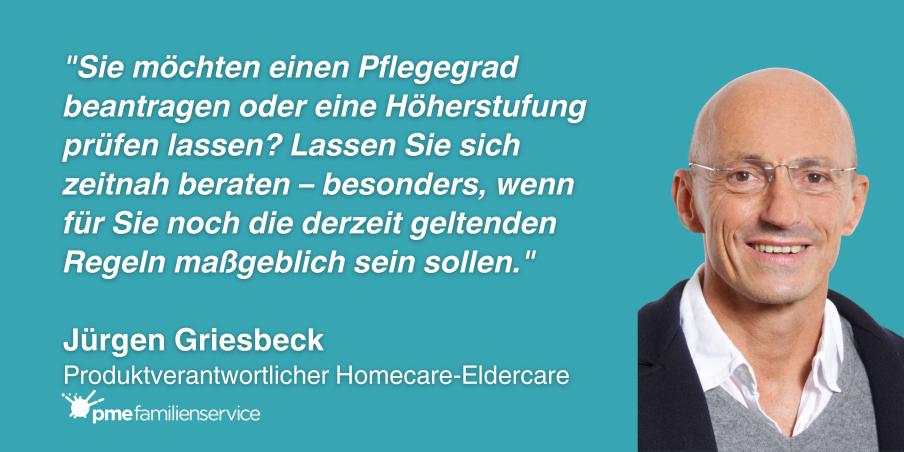
"Would you like to apply for a care level or have your care level reassessed? Get advice as soon as possible—especially if you want the currently applicable rules to still apply to you."
Jürgen Griesbeck, Product Manager for Home Care and Elder Care, pme Familienservice
Applying for a Care Level: The First Steps
- Contact the long-term care insurance provider: You can initially submit your application by phone, in writing, or through the provider’s available online services. The provider will inform you of the next steps and the required documents.
- Fill out the application: Describe the need for assistance in daily life as specifically as possible. If you are acting on behalf of another person, find out whether a power of attorney or other documentation is required.
- Preparing for the assessment: Keep a record over several days of when and how often assistance is needed. Have medical reports, test results, medication schedules, and other relevant documents ready.
- During the open assessment appointment: Describe the actual difficulties you face in daily life. Do not downplay your need for assistance; the assessment is intended to provide a realistic picture of your daily life.
- Review the decision: Read the decision and the information on legal remedies carefully. If you believe the decision is incorrect, be sure to meet the deadline for filing an appeal specified therein.
For those with public health insurance, the long-term care insurance fund typically commissions the Medical Service to conduct the assessment. For more information, see the Familienservice article on applying for a long-term care level determination.
Our expert advisors provide information on legal regulations, offer personalized guidance, and connect you with suitable service providers to ensure that you can balance caregiving and work as effectively as possible.
Our pme Homecare-Eldercareteam ishere to assist you online, by phone, and in person. This offer is available to employees of our contract partners.
FAQ: 2027 Long-Term Care Reform – What Might Change for People in Need of Care and Their Families
Has the 2027 Long-Term Care Reform already been adopted and gone into effect?
No. The Federal Cabinet approved the bill on September 30, 2026; the Bundestag and Bundesrat are still debating it. Until it takes effect, the existing entitlements remain in force.
What changes are planned for the long-term care allowance in 2027?
The cabinet draft proposes a restructuring of benefits for home care. It calls for monthly payments of 380 euros for care level 2, 630 euros for care level 3, 890 euros for care level 4, and 1,080 euros for care level 5. These amounts are intended to consolidate benefits that were previously provided separately.
Will Care Level 1 be eliminated?
No. According to the cabinet draft, Care Level 1 will remain in place; however, the services will be focused more on counseling, support, and prevention.
What applies to people who already have a care level?
The cabinet draft provides for grandfathering provisions for care levels that have already been recognized. Changes to the classification thresholds are intended to apply primarily to new assessments. However, the current law still applies.
What is supposed to replace the 131-euro tax credit?
For care levels 2 through 5, a social services budget of 175 euros per month is provided; for those under 25, the amount is set at up to 300 euros. The draft does not provide for a corresponding budget for care level 1. Until the law is amended, the current entitlements will continue to apply.