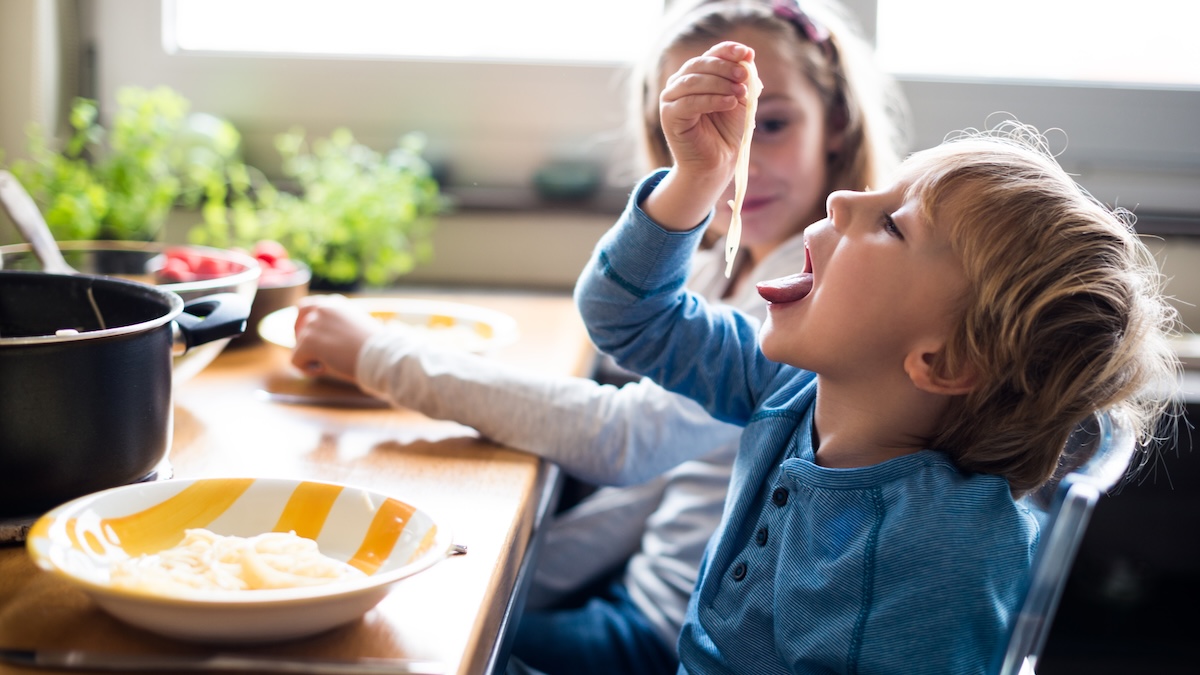


Picky eating in children: tips for parents
Does your child only eat pasta or refuse to try new foods? Many parents are familiar with this situation. Picky eating in children is more common than you might think. This selective eating behavior is usually a normal stage of development, but it can be unsettling.
In this article , Julia Gehm, BA in Early Childhood Education and Nutrition and Health Consultant (IHK), explains why many children are particularly picky eaters, what causes so-called picky eating, and how parents can deal with it calmly in everyday life. You will receive practical tips on how to gently introduce your child to new foods, as well as advice on when professional support is advisable.
Understanding picky eating in children
What is a picky eater?
The English term "picky eater" refers tochildren who are selective in their eating habits. These children usually have limited eating habits. They are very particular about the food they eat and tend to reject new foods at first.
Typical characteristics of picky eating in children include:
- The selection of foods and dishes is significantly limited.
- Children take a long time to "sort things out": they look closely at the food, smell it, and perhaps try only a very small amount.
- Certain foods are suddenly completely rejected, even though they were eaten before.
- Eating habits can vary from day to day. Today, the tomato sauce tastes good, but tomorrow, only the pasta without sauce will be eaten.
- New things are usually rejected at first, even if they look familiar.
Important to know:Picky eating is not an illness!
Why are some children picky eaters?
Picky eating is particularly common in early childhood—and often causes uncertainty and stress for parents. This makes it all the more important to understand why some children are particularly picky.
Does genetics determine how picky a child is?
An exciting insight comes from a joint study by King's College London, the University of Leeds, and University College London. The researchers examined the eating habits of identical and fraternal twins born in 2007. The result:
- Identical twins, who are genetically almost identical, showed very similar picky eating habits.
- In the case of fraternal twins, who are genetically more different, eating habits varied significantly more.
From this, the researchers concluded that whether a person tends to be a picky eater is largely related to individual genetics —and less exclusively to upbringing or external influences.
"Just because your child is a picky eater doesn't mean you've done everything wrong as a parent. Genetic factors play a major role, but they are not set in stone. Especially in early childhood, there is still a lot you can do to influence your child positively. So you are not powerless – on the contrary: you shape the environment in which your child experiences food." – Julia Gehm, BA in Early Childhood Education, Nutrition and Health Consultant (IHK)
8 factors that influence picky eating in children
1. Development phase
Children go through natural phases in which they are more cautious about eating new or unfamiliar foods. This is a normal protective mechanism and, from an evolutionary perspective, essential for survival.
2. Sensory sensitivities
Some children are particularly sensitive to certain textures, smells, or flavors and therefore reject certain foods.
3. Neophobia – the fear of new things
A natural fear of unfamiliar foods can cause children to consistently reject new things at first. Sometimes it takes many encounters before a child will even try a food.
4. Learned behavior
Eating habits and preferences can be influenced by the eating behavior of parents or siblings. Children observe closely: What do Mom, Dad, and my siblings eat? What comments are made at the table ("I don't like this," "This is kind of gross")?


5. Need for control
When choosing food, children can exercise immediate control: "I'll eat this – I won't eat that," "I'm not eating any more." Picky eating can therefore also be an expression of "self-determination."
6. Health complaints
When eating causes pain or discomfort, it is understandable that children avoid certain foods, for example when gastrointestinal problems, allergies, or other physical causes occur after eating.
7. Nutritional environment and mood
Stressful eating situations, pressure ("You have to try this!"), or negative experiences can lead to rejection.
8. Cognitive development
As they get older, children develop their own ideas, dislikes, and preferences that go beyond taste, e.g., "beautiful" vs. "ugly" foods.

What parents of picky eaters can do – 7 tips for everyday life
Our coach Julia Gehm has compiled seven tried-and-tested tips to help you deal with your child's picky eating habits.
1. Observe instead of evaluate: What does your child really eat?
Before you make any changes, it is worth taking an honest look at the situation. First ask yourself:
- What exactly is bothering me right now?
- Am I worried that my child is not getting enough or the "right" nutrients?
- Is it really getting too little—or is it just eating differently than I would like?
A list can help you keep track of your child's eating habits:
- What does my child like to eat, and what does he or she refuse to eat?
- What characteristics do these foods have?
For example, do they prefer soups and mushy dishes, or crispy and dry foods? These observations are an important basis for better understanding eating habits and offering your child suitable food options.
2. Build bridges and vary your favorite foods
If you know what your child likes to eat, you can use this as a basis for building bridges to greater variety in their diet.
Example 1:
If your child likes soups or mushy dishes, you can build on this and offer them a vegetable soup with different types of vegetables, for example. This keeps the consistency and mouthfeel familiar, while increasing the nutritional content.
Example 2:
If your child loves pizza, this can also be put to good use:
- Change the pizza base step by step, e.g., first with a proportion of buckwheat flour mixed with wheat flour, and later completely with buckwheat flour.
- Buckwheat provides high-quality nutrients such as calcium, magnesium, and potassium and contains lots of fiber, which is filling and aids digestion.
- Let your child top the pizza themselves. This gets them actively involved, allows them to have a say, and helps them see food as something they help to create.
Such "bridges" connect what your child likes with what you want in terms of nutrition.
3. Involve children – planning, shopping, cooking
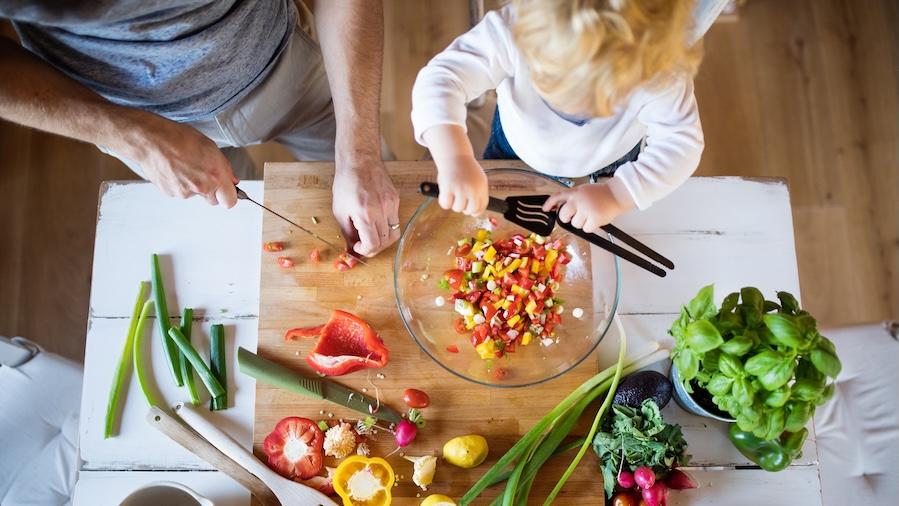
Children have a natural desire to be part of everyday life. This includes eating. Especially in this stage of development, participating is an important need. You can easily take advantage of this by letting your child:
- Include them in meal planning ("What could we try this week?")
- Let them help decide when shopping —for example, during a joint visit to the weekly market.
- Actively participate in cooking and preparation: stirring, washing, picking herbs, arranging plates (depending on age).
"Everything that children do themselves, accompany, and actively shape is more important to them than a plate of food that suddenly appears on the table." – Julia Gehm, childhood educator B.A., nutrition and health consultant (IHK)
The rainbow principle means incorporating colorful foods into the diet. Your child can decide whether they would rather try a blueberry or some red cabbage today.
It is important that the plate is colorful overall. This increases the chance that a wide range of nutrients will be covered, even if your child initially only chooses individual colors.
4. Create a relaxed dining atmosphere – eating without pressure
As important as the choice of food is, so too is the atmosphere at the table.
Helpful for a relaxed dining atmosphere:
- Children are allowed to help set the table.
- Everyone eats together—as far as possible.
- There is conversation about the day, about experiences, not just about the food, and the children are given space to talk.
- No child has to finish their meal. A "no" is accepted, and your child feels that "my signals are being taken seriously."
Avoid:
- Coercion or pressure ("Three more bites, then ...").
- Power struggles at the table, where it's no longer about the food, but about who gets their way.
- Dealing with worries and conflicts surrounding eating habits in the midst of the situation itself.
The dining table should not be a place for arguments and pressure; eating should be a joy for children.
If you are worried or feeling stressed, it is often better to discuss these issues away from mealtimes with your partner, professionals, or counseling centers.
5. Be a positive role model and trust
Children have very natural, intuitive eating habits. They usually sense what is good for them and what is not. Over time, this feeling is overshadowed by social rules, norms, and expectations. When it comes to picky eating, it is worth trusting your child's inner compass first.
- Pay attention to how you talk about food and your body.
- Be aware that growth spurts and growth phases cause children to eat more at times and less at other times. This is normal.
- Trust that your child will get the food and nutrients they need—within the limits of what you offer.
"No child will waste away if they eat less sometimes. More important than a 'perfect' plate at every meal is that children are not forced to eat. Coercion creates pressure and stress—and children associate something that should actually be enjoyable and sensual with negative feelings. That is exactly what needs to be avoided." – Julia Gehm, BA in Early Childhood Education, Nutrition and Health Consultant (IHK)
When is it time to seek professional help?
Even though picky eating is not unusual in toddlers, there are certain signs that you should pay close attention to:
- Frequent gagging, vomiting, or pain when eating
- Strong defensive reactions such as fleeing or tantrums
- Very limited food selection, with eliminated foods no longer returning to the diet
- Significant weight loss or failure to gain weight appropriate for age
- Signs of nutrient deficiency (e.g., when energy requirements are no longer being met!)
- Significant restrictions in everyday life
- Noticeable emotional stress in your child or yourself
In these cases, you shouldseek professionalassistance , for example from:
- pediatrician
- Nutritionists
- Psychologists or child and adolescent psychotherapy
- Professionals in childcare center kindergartens
Our parent counselors support parents in all matters from pregnancy to the child's adulthood.
Personal and confidential: We are there for you online, by phone and on site. You can find more information on the pme parent counseling page.
Recommended reading on picky eating by Julia Gehm
Book recommendations for parents:
- “Picky Eaters: What You Can Do When Your Child Won't Eat” by Tatje Bartig-Prang (GU Verlag)
- “The Ingenious Family Cookbook – Vegetarian” by Edith Gätjen & Markus Keller (TRIAS Verlag)
For children and parents to read together:
- “Feelings – That's how I feel!” (Usborne Publishing)
- “What do you need? Resolving conflicts in a child-friendly way with giraffe language and nonviolent communication” by Sigrun Eder & Barbara Weingartshofer (edition riedenburg e.U.)