

pme Donates: Opportunities for Girls and Families in Uganda
"We don't want to make people dependent; rather, we want to help them become independent." (Nadine Oesterle)
For many people in Germany, it’s hard to imagine that girls can’t go to school because of their periods. In Uganda, this is a reality for countless girls: They stay away from class, fall behind in their studies—and some eventually lose touch with their education entirely. Nadine Oesterle wants to change that. Through Yeshanah Mission, she educates girls about menstruation. But that’s only part of the work: Through sponsorships, the initiative enables children to attend school and supports families with educational programs and training that open pathways to self-sufficiency. The pme Familienservice has supported Yeshanah Mission with 6,250 euros.
What was your personal motivation for establishing the “Yeshanah Mission” family center in Uganda?
Nadine Oesterle: Yeshanah Mission is intended to become a family center where families are trained and equipped with skills that will support their independence, and to which a clinic will also be attached.
For example, the family center will offer computer classes that enable local residents to keep pace with today's rapidly advancing developments.
The catalyst was our close contact with the families of the children in our sponsorship program, which has given us deeper insight into these families’ concerns and hardships. Through the family center, we want to look beyond education and empower families in the long term to provide for themselves independently.
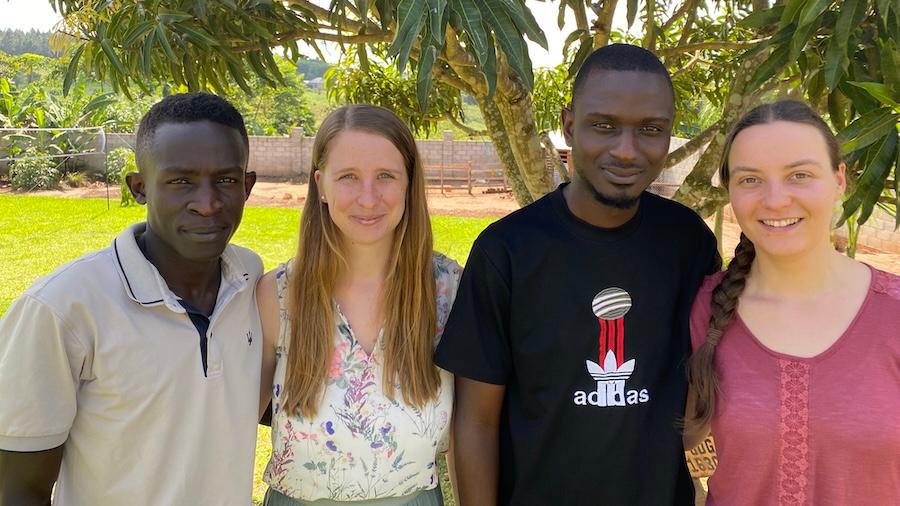
Nadine Oesterle (second from the left) and her team are working to help Ugandan families.
How exactly do you support the children? What projects have you already carried out, and which ones are still in the planning stages?
We support the children through sponsorships so that they can return to school or attend for the first time. Sponsors cover the school fees, but the families are responsible for school supplies such as uniforms and books, in order to involve them in taking responsibility for their children’s education.
We now have 35 children in our sponsorship program, including one young man who is in college. We support the children and stay in touch with the local schools and the children’s relatives and families.
With the support of Patenschaft+ we reach and empower girls and young women in schools and villages. Our educational program aims to educate young women about their bodies and empower them to make their own decisions.
We’ve recently started offering training sessions for women. Here, they learn how to sew reusable hygiene kits using simple, locally available materials. This enables them to help others while also equipping them to start a business by selling these hygiene kits. We’d like to expand this area further to promote self-reliance, broaden our reach, and achieve a long-term impact.
In addition, there will be a section in the future dedicated to startups, designed to provide families with financial start-up assistance. This will include training on topics such as how to start and run a business, how to write a business plan, and how to calculate income and expenses.
Can you tell us more about the “Patenschaft +” project?
It all started with sponsorship programs that enable children to attend school. But when we took a closer look, we found that only a fraction of the children go on to secondary school, and an even smaller proportion even finish elementary school. And this affects girls in particular.
One reason is that girls often fall out of the system as soon as they start their periods. Another reason is the extremely high rate of teenage pregnancies. It’s a major taboo, and very few girls have received sex education or know about their periods and how to manage them properly.
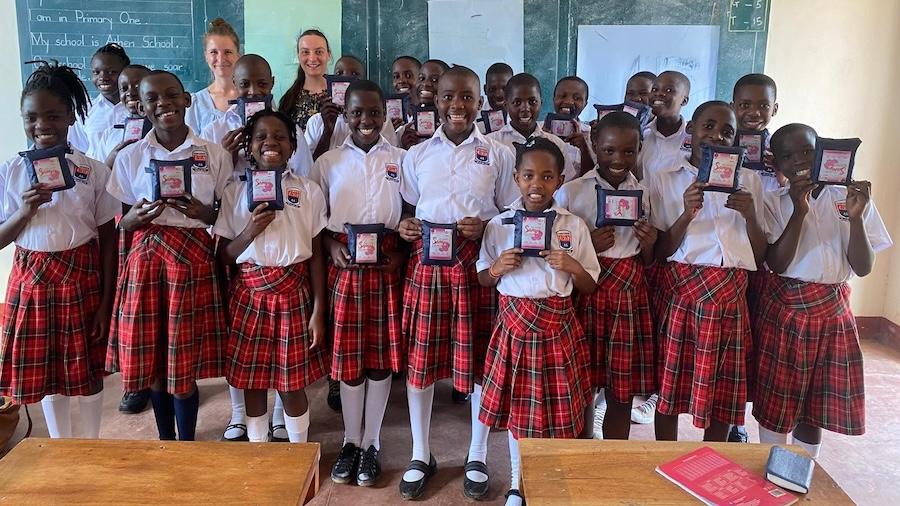
Health Education in Uganda: The girls receive washable hygiene kits.
They often miss school on the days they have their period, and eventually stop going to school altogether because they've missed so much class. And that's exactly where Patenschaft+ comes in.
We want to do more than just help children attend school; we also want to help ensure they stay in school. That’s why, through Patenschaft+, we visit schools, provide education about sexuality and menstruation, encourage the girls, and are there to listen to their questions.
In addition, all girls receive a washable hygiene kit so they can go to school even when they have their period.
Through outreach programs in villages and schools, you aim to reach people directly in their communities. What needs do you encounter most frequently in this work?
The average age in Uganda is about 15 years. This means there are an extremely large number of young people with limited prospects for the future and few opportunities in the job market. This is already having an impact on the situation in schools. The pressure on students is enormous. Even in kindergarten, children learn to read and write, take tests, and receive report cards. Great emphasis is placed on academic performance.
What does sustainable aid mean to you in a country facing poverty, unemployment, and limited access to education and health care?
That is a very important question, and it is also the reason why we founded Yeshanah Mission. “Simply giving money” is not the solution to the problem; in fact, it makes it worse. We do not want to make people dependent; rather, we want to help them become self-reliant.
For children, it all starts with education. So many children don’t have the opportunity to go to school and learn to read and write. Education can help break the cycle of poverty.
Equipping parents with the skills they need so that they can eventually become capable of providing for their families again is the most sustainable form of assistance.
How does the MT:28 organization help you put your ideas into practice?
MT:28 is our guide in all areas. With their wealth of experience gained from working with missionaries around the world, they support us with advice and practical assistance. MT:28 also supports us by managing donations, ensuring that they reach their intended recipients.
One year later—What projects were you able to carry out with the donation from pme Familienservice ?
This year, thanks to the wonderful support from pme Familienservice , we were able to distribute 549 washable hygiene kits during our outreach efforts and also train 7 women to sew their own hygiene kits.
In addition, we have a major project planned for October in western Uganda, during which we will visit two schools—each with 80 female students—and provide them with hygiene kits. We will also train 11 more women to sew hygiene kits.
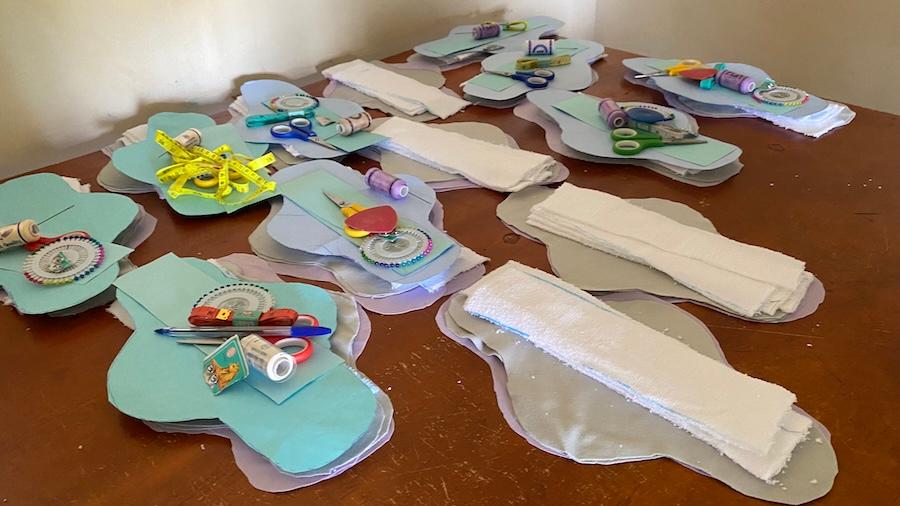
Women are being taught how to sew their own hygiene products.
For more information about the "Patenschaft+" project, visit the organization's website: MT:28.
Social commitment of the pme Familienservice
The "pme donates" fundraising campaign has been running for five years, giving pme team members the opportunity to nominate charitable organizations in the fields of "international development aid," "social work," "climate and animal protection," and "culture" for a donation that they actively support. All team members then vote on the organizations they want to support. The organizations with the most votes receive a donation from pme Familienservice.
In 2025, five national and international organizations received a total of €50,000 in donations—a joint demonstration that social engagement is an integral part of pme's corporate culture.