



Time Management: Tools and Tips for Work and Personal Life
Do you have a growing pile of tasks in front of you and feel like you can’t get anything done? Do constant interruptions also mean you’re just reacting instead of taking action? If so, it’s worth improving your time management skills. Learn about the methods available to help you make better use of your time, both at work and in your personal life.
Summary:
Learn how effective time management can help you prioritize tasks, reduce interruptions, and gain more control over your work and daily life. Learnto identify your own time wasters and determine your time management style using self-tests. You’ll learn seven proven methods ( ALPEN, ABC Analysis, Pomodoro, the Salami Tactic, the Not-to-Do List, the Eisenhower Principle, and the Pareto Principle) with specific steps for implementation, practical rules for daily planning, recommendations for simple tools, and tips for taking breaks, delegating, and establishing routines . The goal isn’t to get more work done in less time, but rather to achieve greater focus, less stress, and a better quality of life.
Read more in this article:
- Time management definition: What is time management?
- Why is good time management important?
- What makes for good time management?
- Seven time management methods - for every type
- ALPEN method - structuring the daily routine
- ABC analysis - making better decisions
- Pomodoro technique - for anyone who likes to procrastinate
- Salami tactics - for large projects, seemingly without end
- The not-to-do list - eliminate unnecessary time wasters
- The Eisenhower principle - hand over unimportant tasks
- Pareto principle
- Other time management methods
- Time management tools: Keep it simple!
- Time management: tips for everyday life
- Time Management Podcast: More Time for Me
- FAQ: Improving Time Management
1. time management definition: What is time management?
Time management is not about getting more done in less time. Rather, it is about using your time in such a way that you get closer to your goals.
Good self-organization helps you to structure yourself and your everyday life better. The basis of all successful self-management is the right time management.
But what exactly does that mean? Time passes in exactly the same way for everyone, doesn't it?
We all deal with the time available to us differently. The term "time management" therefore initially only refers to the handling of available time in general. In other words, we all practice time management - whether consciously or unconsciously.
Seminars, workshops and lectures on time management focus on improving time management. Various methods are presented for efficiently completing tasks and deadlines within a certain period of time.
Because what may be the right time management method for one person may not be for another.
It is therefore important to get to know different methods and find the right strategy for yourself.
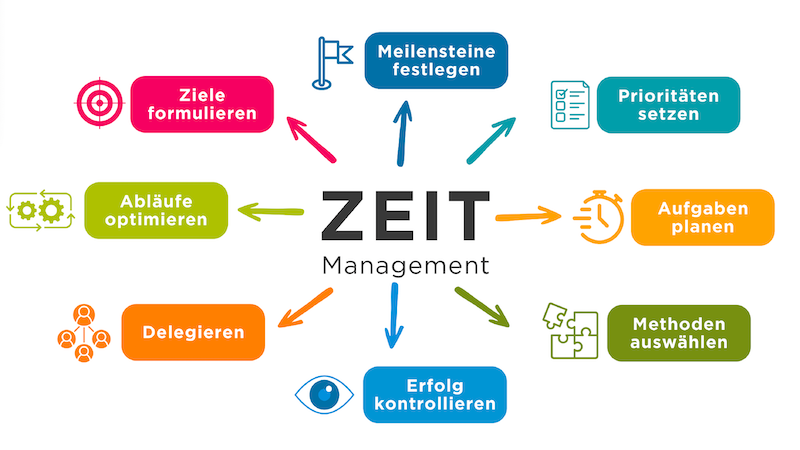
Source: https://karrierebibel.de/zeitmanagement
2 Why is good time management important?
The aim of good time management is not to complete more tasks at work or do more laundry and dishes at home. It's about taking the pressure off in all areas of life and finding more time for yourself.
Time management methods increase productivity, but also show ways to prioritize better and expose so-called time wasters.
Advantages of optimized time management:
- More efficiency and productivity in everyday professional and private life.
- Less stress through prioritization and reduction of to-do's.
- More quality of life through "acting instead of reacting".
- Less procrastination thanks to the elimination of disruptive factors.
- Make decisions quickly and achieve goals with a better overview
3. what makes for good time management?
In order to plan your time well, you need to know yourself well. As already mentioned, not every method suits every person or personality.
3.1 Self-test: What type of time am I?
Do you prefer to work in a structured way or do you need chaos to be productive? The time type test helps you to determine your type and organize your time optimally.
3.2 Self-test: What are my stress amplifiers?
Our thoughts have an influence on our time management. Our own expectations and ideas about ourselves or how things should be can cost us time and further exacerbate a stressful situation.
This test will tell you which stress intensifiers are particularly pronounced in your case.
3.3 Recognizing time thieves
Recognize your time thieves! Such self-tests help you to recognize what you need for improved time management. Do you lack structure and therefore also an overview? Or are you overwhelmed when a task comes in spontaneously that doesn't fit into your daily schedule?
4. seven time management methods - for every type
ALPEN method, salami tactics, ABC analysis, Eisenhower principle, Pomodoro technique, not-to-do list: Get to know the 7 most important time management methods.
Try out the methods and, more importantly, find the method that suits you!
"The right time management can be recognized by the fact that "the individual person (...) is the focus, not the method. Each participant takes from a broad portfolio of time and self-management tools what suits his/her personal working style and life."
Darina Doubravova, certified business trainer & coach for self- and time management, pme Familienservice
4.1 ALPEN method - structuring the daily routine
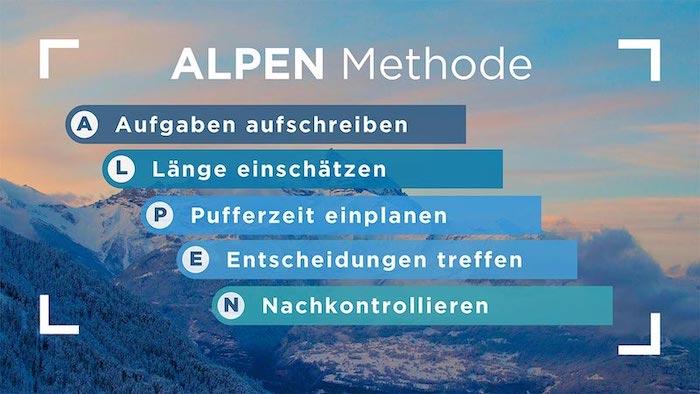
The ALPEN method stands for five time management terms and has nothing to do with the mountain range of the same name. The aim of the method is to structure and prioritize the daily routine in the best possible way, taking time buffers into account. The five letters are an acronym for the 5 steps of the method.
The ALPEN method involves the following steps:
- Write down tasks
- Estimate length
- Allow for buffer time
- Make decisions
- Follow-up check
1. write down tasks
This first step is similar to making a classic to-do list. Which tasks need to be completed? Which meetings are on the agenda today? List all the activities that are scheduled for the day.
2. estimate length
In the second step, you add the expected time required for the upcoming tasks. This will give you an overview of whether you can even manage the workload in one day. Make sure you remain realistic. And set deadlines with specific timescales, this will increase efficiency enormously.
3. allow for buffer time
Now reconsider the tasks you have listed so far with time specifications and plan buffer times. As a rule, unexpected incidents and delays occur every day. You should plan a maximum of 60 percent of your working time, with 40 percent as a buffer.
4. make decisions
This step is the most important. Here you need to prioritize the individual tasks. Which tasks are important and which can I postpone? What is unimportant and not urgent should be removed from your daily schedule. What is urgent but not so important can perhaps be delegated. You should definitely tackle everything else today.
5. recheck
At the end of the day, we take stock. Did I get everything on my list done? Were the planned buffers enough? Was the schedule realistic?
Please do not give up if you are unable to implement the daily plan at the first follow-up check. The ALPEN method should be used over a longer period of time. This will allow you to optimize your daily plans and eliminate repetitive time wasters.
4.2 ABC analysis - making better decisions
In the ABC method, all pending tasks are divided into three categories. These categories determine the importance of the task.
This method is particularly helpful in making decisions.
Category A is very important,
Category B is less important,
Category C is hardly important.
Also think about how you want to deal with the tasks in each category. Tasks in category C may never be completed because more important tasks keep coming in. In this case, it is advisable to keep checking back to eliminate any unnecessary tasks.
4.3 Pomodoro technique - for all those who like to procrastinate
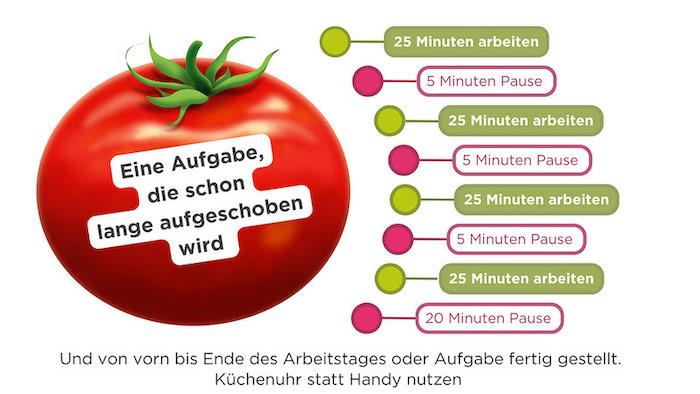
With this time management method, working time is divided into small intervals and fixed breaks. The Pomodoro technique was developed by Francesco Cirillo. He used a tomato kitchen timer to control his intervals.
This tactic is particularly suitable for people who like to procrastinate or forget to take breaks.
If you are easily distracted, you should not use your cell phone as a clock. Instead, it is better to use the kitchen clock or the alarm clock.
The following steps must be taken to make the working day more effective:
1. select one (!) task that you would like to complete. Formulate your work goal in writing. Make a note of the steps you need to take to complete the task.
2 . start your task with a 25-minute first work section, the first "pomodoro".
3. after the first 25 minutes, take a 5-minute break. Set yourself an alarm clock for this too. Get something to drink, move around briefly, do what you have been avoiding for the last 25 minutes.
4 . work on your task for a further 25 minutes. Complete a total of four 25-minute work intervals.
5. after the fourth "pomodoro", take a longer break of 15 to 20 minutes.
6. start the method from the beginning.
4.4 Salami tactics - for large projects, seemingly without end
The term salami tactic describes the approach to a task: instead of tackling everything in one go, you divide the task into several small sections. Just as you would eat a salami: you cut it off slice by slice.
The advantage of the salami tactic is that it is easier to motivate yourself because the task is small and manageable. In a relatively short period of time, you can complete a sub-step and thus achieve a sense of achievement more quickly. This reduces stress and makes it easier for you to dedicate yourself to the next subtask and persevere.
This method is particularly suitable for large projects that seem to have no beginning and no end.
You can use the following steps to apply the salami tactic to a project:
- Formulate the task in writing.
- Break down the overall task into subtasks.
- Prioritize the subtasks and schedule them.
- Get active and complete the tasks.
- Check every result and optimize your planning if necessary.
4.5 The not-to-do list - eliminating unnecessary time wasters
The best-known method of organizing tasks is the to-do list. Sometimes it is difficult to have an overview and a structure because the to-do's seem endless. What then remains is the feeling of having a huge mountain of tasks in front of you.
The "not-to-do list" method therefore takes a completely different approach.
1. make a note of all the things you shouldn't do at work. This refers to unnecessary time wasters that slow you down and ensure that the day is not as productive as you had planned.
2. the not-to-do list is most effective when it is clearly visible in the workplace.
The method has the following advantages:
- Time wasters are identified and eliminated.
- Tasks and areas of responsibility are more clearly delineated.
- The focus is directed to the essential things.
- Important and unimportant items are differentiated.
You will see that a working day becomes much more efficient and satisfying when the unnecessary things are eliminated!
4.6 The Eisenhower principle - handing over unimportant tasks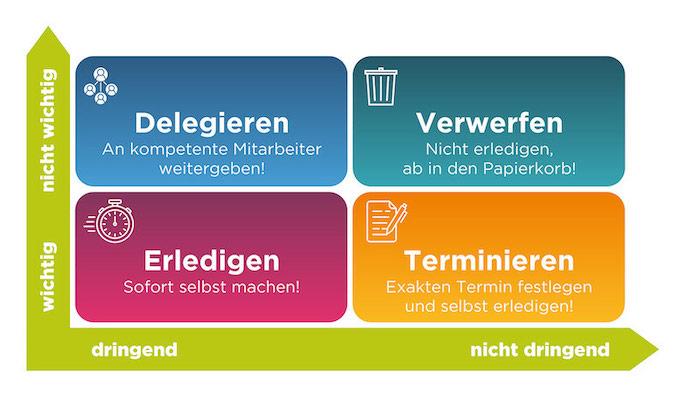
The Eisenhower principle helps to separate important and urgent tasks from unimportant and non-urgent tasks.
In this method, you divide tasks into 4 areas, namely tasks that you:
1. do it first (urgent and important),
2. tasks that you postpone until later (important, but not urgent),
3. tasks that you delegate (urgent, but not important), and
4. tasks that you discard (not urgent, not important).
Important tasks must be completed immediately, unimportant tasks delegated or eliminated.
This means that you need to be able to plan and structure your tasks yourself - and understand which tasks are very important for your boss, for example.
However, using this method requires you to be able to plan and structure your own tasks and delegate tasks.
4.7 Pareto principle
The Pareto principle - also known as the 80/20 rule - assumes that 80 percent of the result can be achieved with just 20 percent of the effort. However, the remaining 20 percent of the final result requires 80 percent of the effort.
Understanding this principle simplifies tasks. It helps you to concentrate on the important things and not get bogged down in the little things.
To get the most out of this method, you should find out which of your tasks are the most important for your company or your team and focus on this task (80 percent). You should devote less time to tasks that have a lesser impact (20 percent).
The method is not about doing everything with just 20 percent effort. Instead, it is about investing time and effort in important aspects and projects.
4.8 Other time management methods
The list of methods for successful time management could go on almost indefinitely.
Other time management methods are:
- Personal Kanban
- Eat-the-Frog method
- Getting Things Done (GTD) method
- Time flow analysis
5. time management tools: Keep it simple!
There is a wide range of time management tools on offer. From complex and paid project management tools to simple free to-do lists, everything is represented. If you search online, you will quickly find what you are looking for.
If you are looking for a suitable tool for your own self-management, start with pen and paper. You can easily find a suitable method for time management. You don't have to get lost in complicated technical tools. Make sure that these tools are not time wasters.
Are you looking for a tool to organize yourself and your team? Then use a digital program for your daily work or individual projects. But the same applies here: keep it simple!
As a team, define a few but important rules on how tasks are maintained and documented in the respective tool. If the tool or the work in it is too complicated, think about another option.
6. time management: tips for everyday life (away from work)

No matter which method or tool you end up using, it has to suit you!
Don't spend a lot of time theorizing about how to become as efficient as possible. The important thing is that you get into action! You don't have to implement the methods in exactly the same way. Try out different ones and take the best for you.
Whether for business or pleasure, you will find the right method for efficient time management:
1. write down your tasks: Whether analog or digital, individual pieces of paper or a list.
2 . prioritize, delegate, delete: Here too, play with different ways of sorting tasks.
3 . stay away from multitasking: no brain is capable of doing several things at the same time. Don't make things unnecessarily complicated for yourself, but stay focused.
4 . don't put yourself under pressure: there are always setbacks when trying things out, so don't let this demotivate you. You need to give yourself time to develop routines.
5 . don't forget your breaks: the goal is not to be efficient 24/7. At the end of the day, time management is there to provide relief and prevent excessive demands - above all, this means giving your body enough breaks to get going.
7th podcast: Time management: More time for me
Cordula Nussbaum is a book author and time management expert. In the podcast, she explains how you can protect yourself from time wasters. She also gives tips on how to take care of the important things and people.
FAQ: Improving Time Management
What is time management, explained simply?
Time management means consciously planning your available time and using it to achieve important goals. This includes identifying and prioritizing tasks, minimizing interruptions, scheduling breaks, and regularly reviewing your schedule. Time management should not lead to working more and more, but rather to greater clarity, focus, and a lighter workload.
Why is good time management important?
Good time management helps you prioritize tasks, identify time wasters, and structure your daily routine more effectively. This allows you to focus better on your work and reduces the feeling that you’re merely reacting to new demands. A realistic schedule also takes into account breaks, unexpected tasks, and personal limits.
How can I improve my time management in my daily life?
Improve your time management by first writing down all your tasks, selecting the most important ones, and setting aside specific time slots for them. Start with a few simple, easy-to-follow rules:
- Collect tasks in one central location
- Set three to five important tasks each day
- Estimate the time required realistically
- Allow for a buffer in case of interruptions
- Limit notifications and other time-wasters
- Work on tasks one after another rather than in parallel
- At the end of the day, take a moment to review what went well
The key is not to use as many methods as possible at the same time. Choose one method and try it out over several days.
Which time-management method is the best?
The best time-management method is the one that fits your task, your work style, and your daily routine. For daily planning, for example, the ALPEN method is suitable; for prioritization, the Eisenhower Principle or the ABC analysis. If you tend to procrastinate, you can start with the Pomodoro Technique. For large projects, the “salami tactic” helps break down a complex undertaking into manageable steps.
Therefore, there is no single best method. The method should simplify your work, not create additional administrative burdens.
How does the ALPEN method work?
The ALPEN method breaks down a workday into five steps: write down tasks, estimate how long they’ll take, plan for buffer time, make decisions, and follow up.
1. Write down all your important tasks and appointments.
2. Make a realistic estimate of the time required.
3. Set aside time for interruptions and unforeseen events.
4. Set priorities and eliminate or delegate unimportant tasks.
5. At the end of the day, check to see if your plan was realistic.
This method is particularly well-suited for people who want to gain a better overview of their workday. A daily schedule shouldn't be completely filled out, so that there is enough flexibility.
How does the Pomodoro Technique work?
The Pomodoro Technique divides work time into short, focused work intervals and scheduled breaks. A common routine consists of 25 minutes of focused work, followed by a five-minute break. After four work intervals, a longer break of about 15 to 20 minutes is taken.
Here's how to apply the method:
1. Choose a specific task.
2. Formulate the goal for the next work interval.
3. Work for 25 minutes without consciously letting yourself get distracted.
4. Take a five-minute break.
5. Repeat the process and plan for a longer break after four intervals.
The time intervals aren't set in stone. You can adjust them to suit your task and your ability to concentrate.
What is the Eisenhower Principle?
The Eisenhower Principle organizes tasks according to two criteria: urgency and importance. This results in four categories:
Approach to the task:
Urgent and important = Do it right away
Important, but not urgent = Schedule and plan for it
Urgent but not important = delegate whenever possible
Not urgent and not important = cross out or discard
This method prevents urgent but less important tasks from consistently taking precedence over important goals. However, delegation is only possible when responsibilities, resources, and decision-making authority are clearly defined.
How can I identify my personal time-wasters?
You can identify your personal time wasters by observing, over the course of several days, what causes you to lose planned time. Briefly note the interruption, its duration, what triggered it, and how it affected your task.
Typical time wasters include:
- Frequent email and messenger notifications
- Unplanned conversations and meetings
- Lack of priorities
- Perfectionism
- Unclear responsibilities
- Multitasking and Frequent Task Switching
- overly optimistic scheduling
- A lack of breaks, which can later impair concentration
Not every interruption can be avoided. The goal is to recognize recurring patterns and make targeted changes.
How can I plan my workday realistically?
Schedule only a portion of your available work time and leave room for follow-up questions, delays, and unexpected tasks. Start by writing down all your tasks, then select the most important ones and estimate how long they will take.
A simple daily schedule consists of 6 tasks:
1. A short-term goal
2. A few prioritized tasks
3. Set aside specific blocks of time for focused work
4. Scheduled Breaks
5. A buffer for the unexpected
6. A brief follow-up check
If your list regularly gets longer than you can handle in a single day, you should postpone, delegate, simplify, or cross off tasks.
What time management tools do I need?
To manage your time effectively, you don't need a complicated digital tool to start with. A pen and paper, a calendar, and a simple to-do list are enough for many tasks.
A tool should only be used if it provides a specific benefit, for example:
• Collect tasks in one place
• Make dates and deadlines visible
• Schedule recurring tasks
• Clarify responsibilities within the team
• Make the status of a project transparent
Start with a simple solution. If the tool itself requires more maintenance than the task, the solution should be simplified.




 In this e-book you will learn why yoga really is ideal for everyone. Whether plus sizer, beginner, professional, pregnant, golden age, fit or physically limited: Yoga is for every body and every figure! In this guide, you will receive valuable tips on which yoga style suits you, which exercises you can do despite discomfort or limitations and how you can find more self-love and self-acceptance.