
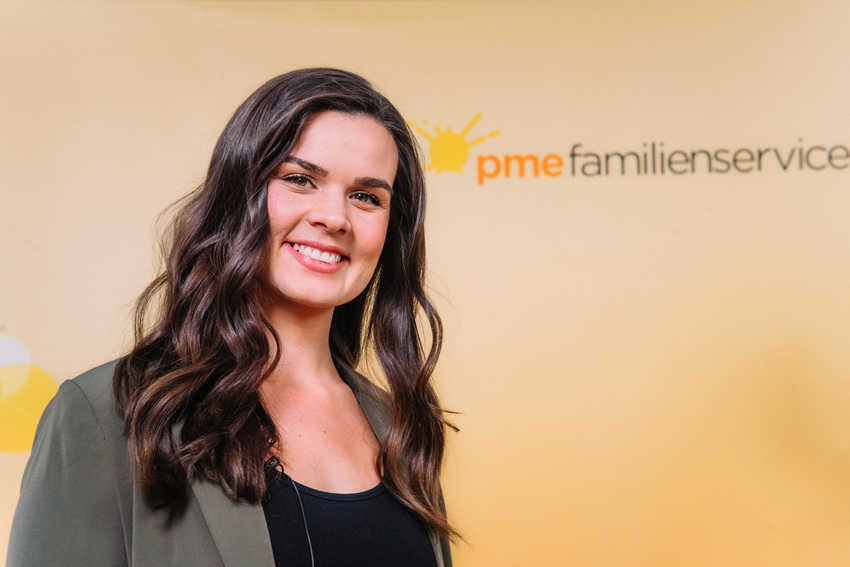


That was Health Day 2022: a top-class health day
Six hours of program, 16 top speakers and 6,000 spectators - the Health Day is the brilliant conclusion to the 30th anniversary of the pme Familienservice.
Health for every taste
It's all in the mix: Entertaining and informative presentations by top speakers such as Frédéric Letzner, Dr. Matthias Manke, Gaby Köster and Michael "Curse" Kurth on the topics of physical health, mental health, mindfulness, nutrition and trends in health management offered a great and varied program for every health taste.
Right on time at 2 p.m., pme CEO Alexa Ahmad and presenter Jessica Mina-Knopp welcomed the audience live from the pme Academy in Hamburg's Hafencity. What followed was a health day with new impulses, exciting specialist knowledge and great entertainment.
Frédéric Letzner: Health can also be sexy
Speaker and author for nutrition and health psychology Frédéric Letzner started with his presentation on the topic of "Health can also be sexy" and discussed the question of why so many people don't actually want to talk about health and what can be done about it. In his talk, Letzner, a nutritionist, author and speaker, provided interesting insights into our childhood conditioning and fears when it comes to healthy eating.
With his vivid plea against "superheroism" in the workplace, he shook the participants awake: "The most expensive employees are the superheroes, because they eventually run into the wall," said Letzner. According to him, the idea of efficiency is not compatible with health.
Where it is all about functioning, there is no time for healthy eating and good sleep. He presented the "4 Gs" as a means to a healthier life: patience, enjoyment, frugality, serenity: away from self-optimization and challenges, an end to multitasking, and instead an appreciation for yourself and your own priorities.
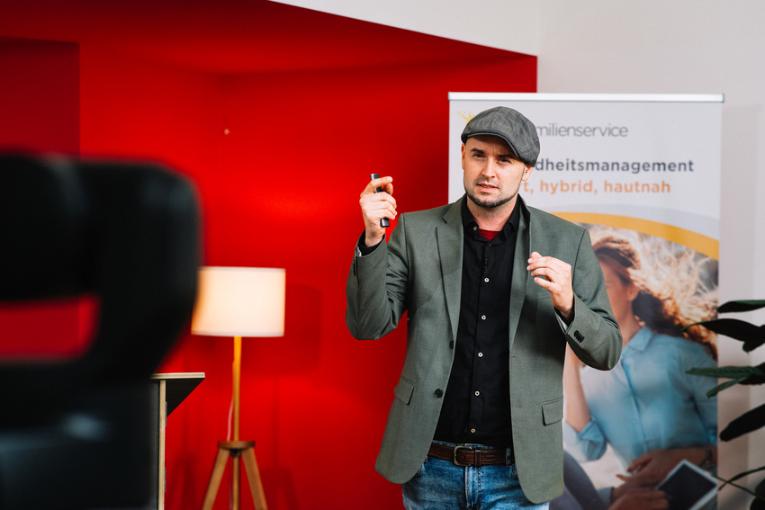
The opener: Frédéric Letzner goes full throttle.
Bastienne Neumann: The psyche also eats
Nutritionist Bastienne Ne umann followed in the footsteps of the previous speaker. Bastienne Neumann herself has experienced how food can become something that defines your existence.
As a former judoka, she has experienced it herself: in order to be successful in her sport, she had to gain and lose weight, and competition phases were characterized by sacrifice. When injury put an end to her sport, there was no stopping her. She compensated by eating and gained a total of 25 kilos. In order to understand what was behind this, she studied nutritional science.
However, the game changer, as she herself describes it, was nutritional psychology, i.e. the question of why we eat what we eat. In her presentation at the Health Day, she encouraged the participants to take a closer look: Why do we reach for a chocolate bar in stressful situations?
Why do we go to the canteen at lunchtime, even if we're not hungry? The answer: food is more than just nourishment, it is, for example, a source of comfort, a reward, gives us a break and allows us to interact with others. Unavoidable in stressful everyday life? No. In her talk, she presented a suitcase of resources that can take the place of food.
"If hunger is not the problem, then food is not the solution." (Bastienne Neumann)
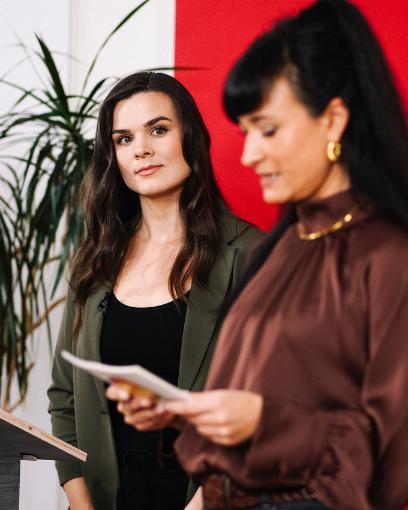
Bastienne Neumann in conversation with presenter Jessica Mina-Knopp.
"Revierdoc" Matthias Manke: When the orthopaedist has his back
In his lecture at the Pott, Revierdoc Dr. Matthias Manke explained how important exercise is for the body. "To move is to live" - that is the credo of "Revierdoc" Matthias Manke. "We lack the balance of movement in everyday life," says Manke. When you no longer have to leave the house to go shopping or meet people, you don't get enough exercise.
In practical terms, he addressed the most important problem areas for many people, such as the neck, which is often overstretched and cramped. Or the pelvic floor, which, contrary to popular belief, is not just something women have to worry about after giving birth. "Pelvic floor training is the solution for a stable core," said Manke. He enriched his entertaining lecture with live exercises, such as a simple exercise for a strong neck or a pelvic floor exercise that can easily be performed at work.
"We lack the balance of movement in everyday life." (Dr. Matthias Manke)
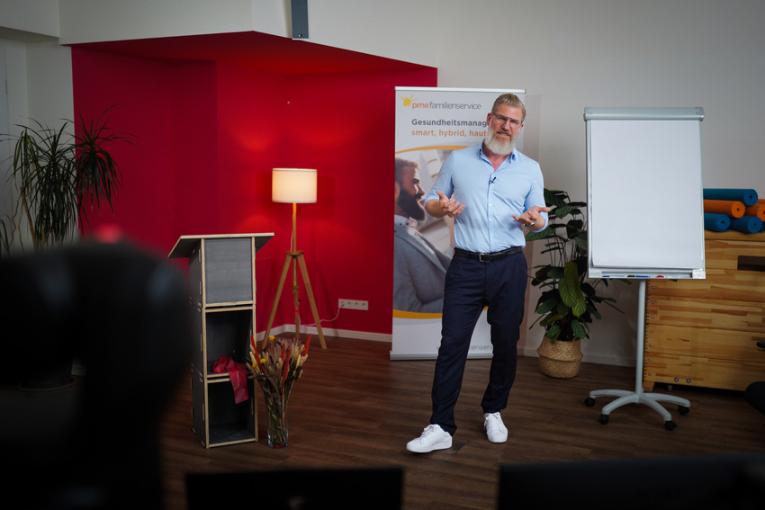
Revierdoc Dr. Mathias Manke is one of the best-known orthopaedic surgeons in Germany.
Trends in digital BGM - with Pia Grocholl and Michèle Penz
This was followed by a real premiere. Pia Grocholl and Michèle Penz, who head up the new "Health" pillar of pme Familienservice in a dual leadership role, presented the new BGM offering from pme Familienservice in a talk with presenter Jessica Mina-Knopp and explained where the journey in digital BGM is heading.
Health in companies is a huge trend, according to the health experts. With increasing workloads and a shortage of skilled workers, occupational health management offers many different starting points. In the talk, they presented the combination of relationship prevention and behavioral prevention on which the pme Health offerings are based. Looking at the framework conditions and structures is just as important as the question of what individuals can do to stay or become healthy.
The ideal approach is the blended approach: employees can flexibly acquire content via e-learning, podcasts or articles, while combined live interventions such as coaching sessions ensure the necessary commitment. An interesting insight that ended with the claim: Health should be fun!
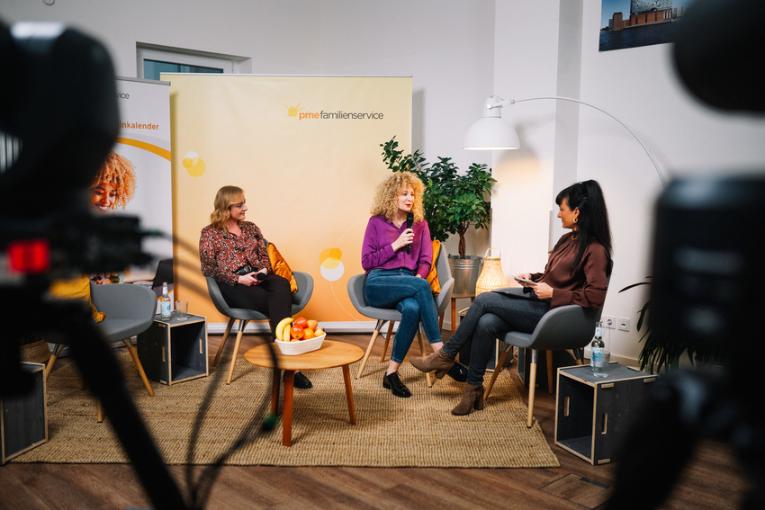
Michèle Penz (left) and Pia Grocholl (center) talk to presenter Jessica Mina-Knopp about trends in digital BGM.
Trend talk: Gender in health management
Three talk guests, one goal: the following trend talk on the topic of diversity in occupational health management was intended to raise awareness of target groups that have so far been under the radar. Fee Reinoso, founder of Vision Period, wants to sensitize companies to the potential and resources that lie in the female menstrual cycle - an "asset for the economy", according to Reinoso. Until now, the needs of menstruating women have been completely ignored. She would like to see "mental awareness" from companies, i.e. acceptance and an infrastructure that caters to the needs of women.
Silke Burmester is convinced that the menopause is also an important "business case". The journalist and author wants to establish a new image of ageing. Burmester found that the menopause is primarily associated with a lack. Yet this time often offers underestimated potential. "There is a lot of power," says Burmester. Women often have more time during this phase because the children are getting older, they want to continue their careers and feel like working. With her online magazine "Palais Fluxx", she offers an information portal for women aged 47 and over who are going through intoxication, revolt and menopause.
Finally, Volker Baisch had the men in mind. He is an expert on the topic of work-life balance from a father's perspective and believes that the topic of men's health should be on the radar of companies. "Men talk less about their health or mental stress than women," says Volker Baisch. On the one hand, they need different offers, and on the other hand, the form and approach must be changed so that men feel addressed.
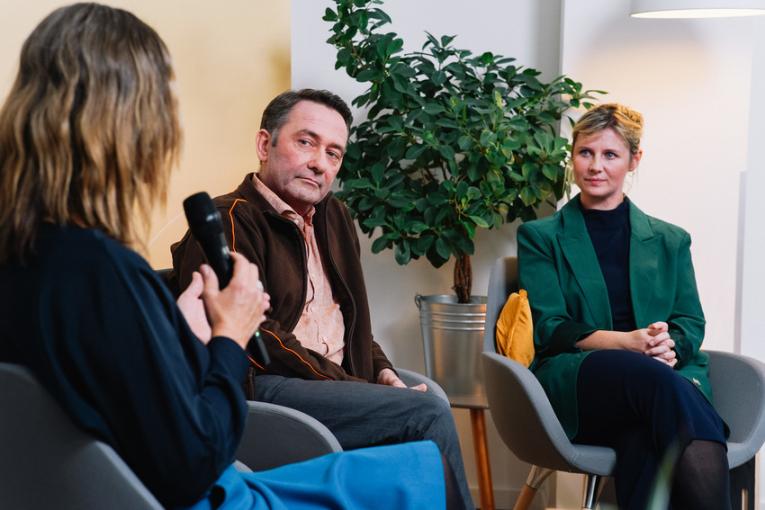
Silke Burmester (left), Volker Baisch (center) and Fee Reinoso (right) have a lively discussion about diversity in BGM.
Gaby Köster: My life after the stroke
Sometimes joy and sorrow lie close together. As in the case of Gaby Köster. In an interview with Jessica Mina-Knopp, the most famous woman in the German comedy landscape told us how she suffered a serious stroke at the height of her career - at the age of 46. She had to learn everything again: walking, speaking, driving, crying.
Even today, after almost 15 years, she is still affected by the consequences of the "stroke", as she calls it herself. At Health Day on November 8, 2022, Gaby Köster spoke about how she was knocked out by the stroke - and how she worked her way back into life and onto the stage bit by bit. What has helped her is her sense of humor: "I can still see the joke even in the biggest chaos," she says.
Even though her life today is different from before the stroke, she has regained many freedoms, such as traveling alone again. An inspiring contribution from one of Germany's most humorous women, which not only made for an exciting 30 minutes, but also for many light-hearted moments.
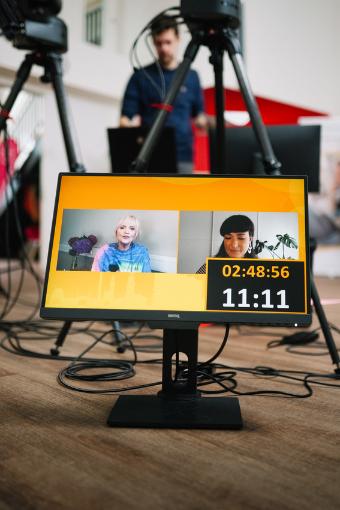
Comedy icon Gaby Köster brought a good atmosphere with her.
Diana Doko: Depression - Talking saves lives
Due to the high levels of absenteeism in companies, mental illness is an issue that must naturally be addressed at a Health Day. Diana Doko, founder of "Freunde fürs Leben e.V." and Benthe Untiedt, Managing Director of Shit Show - Agentur für psychische Gesundheit, will provide information about depression.
Diana Doko's motto is "Talking about depression saves lives!" The recipient of the Order of Merit of the Federal Republic of Germany believes there is a lack of awareness campaigns on depression in Germany. She is therefore calling for mental illness to be put on the health policy agenda and for it to be communicated that we as a society must finally talk more openly about depression and suicide - this can save lives. The aim is for signals to be better recognized and understood and for suicides to be prevented.
"The more we know about depression and the more we know about suicide, the better we can help each other." (Diana Doko)
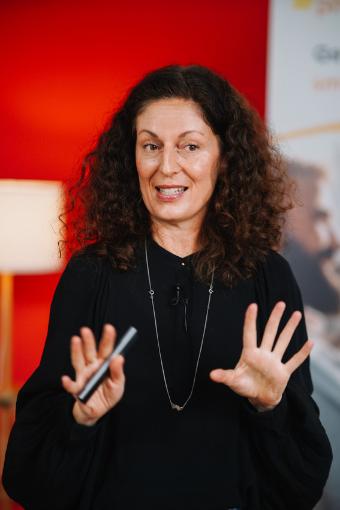
Talking about depression saves lives," is Diana Doko's motto.
Benthe Untiedt: Mental health at your fingertips
Benthe Untiedt showed what it feels like when depression "weighs someone down". And why the supposedly well-intentioned advice to "cheer up" only makes things worse.
The qualified psychologist brought her "moodsuits" to the Health Day, which make mental stress tangible. There is the "Beuger", a kind of rucksack that presses the head down so that the wearer feels small and depressed. Or the "bell", which looks like a diving helmet and makes contact with others more difficult. And finally, the "choker", which creates the feeling of having a lump in your throat. Our moodsuits are "symptoms to wear", says Bethe Untiedt. They help to build a bridge to people who experience such feelings and make this difficult topic relatable.
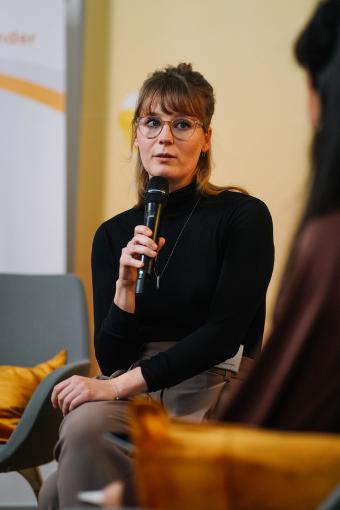
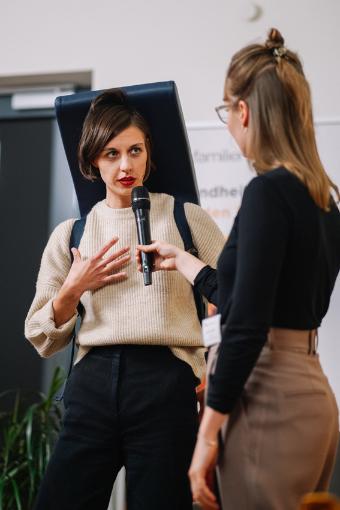
Benthe Untiedt shows her mood suits on our colleague Susanna.
Carola Kleinschmidt: Surf your energy: in harmony with your biorhythm
Bestselling author Carola Kleinschmidt continued with a lot of power. In her talk "Surf your energy: in tune with your biorhythm", she explained how to successfully surf your own energy wave. Because when we are in tune with our biorhythm, we are happier, work better and are more creative.
According to Carola Kleinschmidt, energy swings through the day in a wave; there are energy highs and energy lows. When our energy is high, everything is easier - sport, negotiations, conflicts in the family. But the energy low also has its justification, says Carola Kleinschmidt: it is perfect for processing things that we have learned during the energy high. "No learning without an energy low," she concludes.
She also discussed the differences between morning people and evening people and encouraged them to make small adjustments to suit their own biorhythm. According to Kleinschmidt, sleeping just half an hour longer can make a huge difference.
"No learning without an energy slump." (Carola Kleinschmidt)
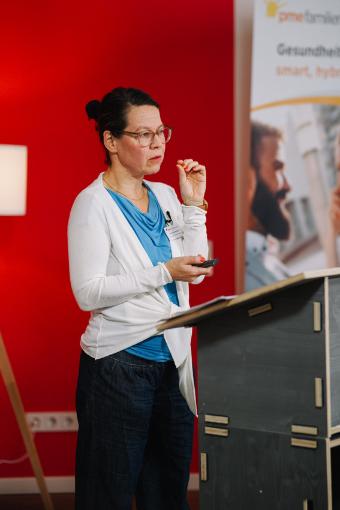
Carola Kleinschmidt explains how the biorhythm works.
Michael "Curse" Kurth: Easy, anti-eso and for everyone: how to relax properly!
The crowning finale was the talk "Easy, anti-eso and for everyone: how to relax properly" by Michael "Curse" Kurth. The rapper and systemic coach took the audience into his own life, which was characterized by an early desire for success - and an abrupt upheaval when he realized that success is not a guarantee for happiness. He presented a 3-phase recipe for simply relaxing without esotericism. What does it involve? Taking a deep breath, questioning the problem and yourself and finally, discovering "the secret of the water bottle".
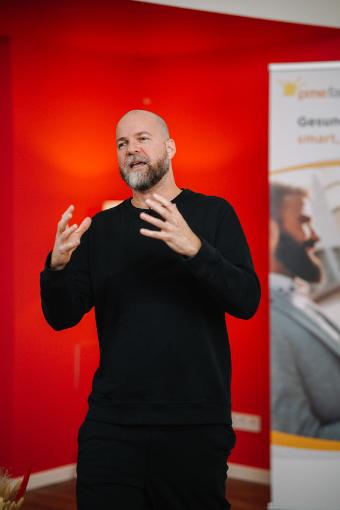
From rapper to systemic coach - Michael Kurth shows how to relax properly.
Movement breaks with yoga instructor Fjodor Kendzierski and relaxation sessions with the Mindance app rounded off the varied and highly topical program.
Gisela Erler and Alexa Ahmad: That was 30 years of pme
At the end, presenter Jessice Mina-Knopp brought pme CEO Alexa Ahmad and surprise guest Gisela Erler, founder of pme Familienservice, on stage once again. Alexa Ahmad emphasized how important the topic of health is for everyone: "What unites us all: Health is important from the cradle to the grave" and thanked all the speakers for their encouragement and numerous tips.
pme founder and former State Councillor Gisela Erler reviewed the company's transformation over the past 30 years and concluded: "For me, health is not just mindfulness and no stress, there are incredible crises and suddenly companies are doing incredible things that you never thought possible before."
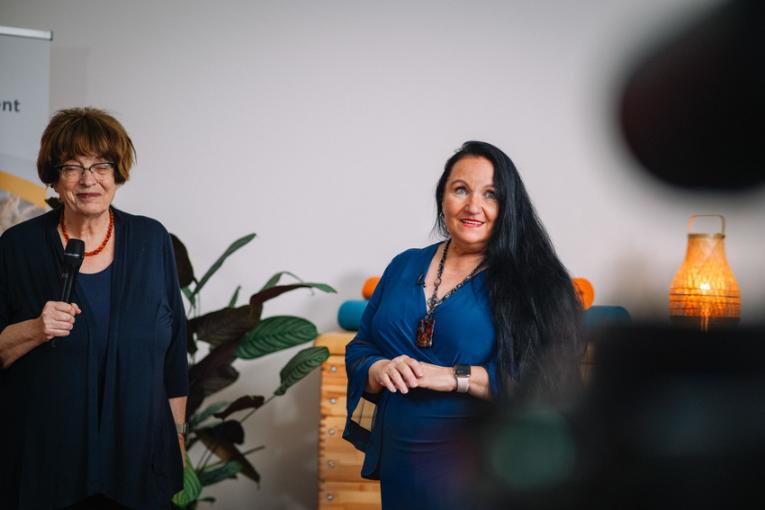
Gisela Erler (left) and Alexa Ahmad (right) are clearly having fun.
Health Day 2022: Many thanks to our partners
pme health: Effective BGM in blended learning format
Organizational consulting, GBU Psyche, BEM: Our occupational health management (OHM) services are characterized by their holistic and individual approach. From strategy development, needs analysis and action planning to evaluation, we establish, supplement and optimize companies' occupational health management portfolios in order to keep their employees healthy, productive and motivated.
Personal support for employees based on a new holistic mind-body & soul approach is one of our key factors and goes hand in hand with our blended learning concept. We combine digital and live formats to promote physical activity, nutrition, stress prevention and mindfulness and make our knowledge available regardless of time and place.