
Digital Health Expert Inga Bergen
Body & Soul

Inga Bergen: How Generation Z Is Changing Healthcare

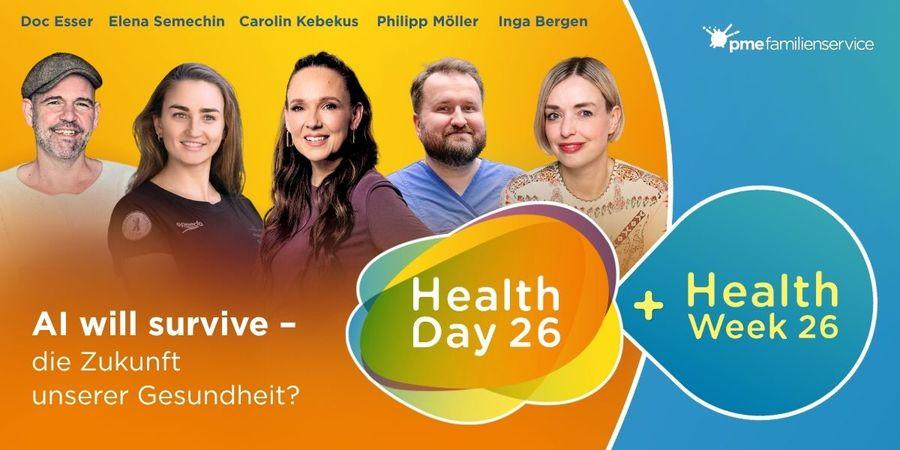
Inga Bergen is THE expert when it comes to digital health in Germany. As an entrepreneur, investor, podcaster, and sought-after speaker, she is shaping the discussion on the future of healthcare. In this interview, she discusses why our healthcare system still lags behind technological possibilities, how Generation Z is changing the way we approach health, and which innovations are actually making a difference. Inga Bergen will be speaking at Health Day 2026.Interview: Simone Bohny/Christin Müller

​​​​​​​"I look forward to a medical field that recognizes that women aren't just little men." (Inga Bergen)

What motivates you to be so passionate about the future of healthcare?

Inga Bergen: I’ve founded and led two companies in the digital health sector—and in doing so, I’ve learned just how slowly a system moves that should actually be the most innovative one we have. What drives me is the gap between what has long been medically and technologically possible and what people actually experience when they’re sick. This gap isn’t a technological problem. It’s a problem of structure, incentives, and courage. And that’s exactly why I’m staying the course: because it can be solved.

In your opinion, what makes Generation Z different from other generations when it comes to health?

I’m cautious about generational narratives—they often explain less than they claim to. But what I really observe is this: This generation no longer makes a clear distinction between health and everyday life. Mental health, sleep, nutrition, exercise, work—these form a continuum, not a set of separate areas of responsibility. This clashes with a system that is organized precisely along lines of responsibility: boundaries between medical specialties, between sectors, and between payers. The conflict isn’t “young versus old.” It’s “integrated experience versus fragmented care.”

Gen Z is the first generation to have grown up entirely with digital technologies. What expectations will they therefore have of doctors, hospitals, and health insurance companies in the future?

Three that I consider to be structural:

First: Expectation sovereignty. People who are used to every service being transparent, bookable, and easy to track won’t accept that an appointment takes six weeks and no one can explain why.

Second: Access to data as a given. Not as a right that must be fought for, but as a fundamental condition.

Third—and this is often underestimated—is the quality of the relationship. Digital literacy does not mean a desire for distance. On the contrary: the more interchangeable the transaction, the greater the value of genuine medical care. Anyone who thinks an app can replace that connection has misunderstood the issue.
What digital developments will truly change the way we approach health in the coming years?

Not so much the spectacular ones, but rather the mundane ones. Interoperable data. AI in documentation and decision support—not because it replaces doctors, but because it frees up their time. And above all: moving diagnostics forward—from the hospital to everyday life, from acute care to early detection.

What interests me more than the technology is the question of who benefits from it. We’re currently in danger of building a system that works exceptionally well for digitally empowered, well-insured people who are health-conscious—and makes things worse than before for everyone else. This isn’t a technical issue, but a matter of distribution.

Many young people today are much more critical of medical advice than previous generations. Is this a sign of greater health literacy or a dangerous overconfidence?

To be honest: neither. I think the question doesn't quite capture the issue.

What we are seeing is not an increase in competence or arrogance, but a loss of trust in institutions coupled with a radical shift in information sources. That is something different.

Health literacy—as measured by standard tools—tends to be rather low across all age groups in Germany, including among young people. What has changed is not people’s ability, but their access: Today, every recommendation is immediately accompanied by a thousand other voices, and none of them bears a seal that can be recognized at a glance.

The answer to this isn’t to reclaim authority. You either have it or you don’t. The answer is to provide a rationale. Saying “That’s just how we do it” doesn’t work anymore. Saying “That’s how we do it because—and here’s the evidence, and here are its limitations” does work very well. It’s more work. But it’s also better.

You speak with many thought leaders in the healthcare sector and have been following innovations for years. Looking ahead to the next ten years, which developments are you most excited about?

The moment when “prevention” is no longer just a buzzword everyone tosses around in political speeches but that no one actually funds. We’re currently witnessing a rare convergence of factors: the technology is here, cost pressures are inevitable, and a new generation is emerging for whom prevention isn’t a sacrifice but a form of self-empowerment. When these three elements come together, something fundamental shifts.

And, to be more specific: I’m looking forward to a medical field that recognizes that women aren’t just little men. Things are finally moving in that direction—too slowly, but they’re moving.

To wrap things up, here’s a quick generational quiz: If you could “steal” one trait from Generation Z, which one would it be? And conversely, is there anything Generation Z could perhaps learn from older generations?

If I could, I’d steal the ease with which this generation talks about mental health. My generation dealt with it on our own and called it strength. It wasn’t.

Conversely: Be patient with systems. Not compliance—patience. Some important things don’t change in eighteen months, but in eighteen years, and anyone who’s only looking for quick results will walk out before things get interesting.

No one approaches the truly major shifts in the healthcare sector as a sprint.

pme Health — Holistic Workplace Health Management

We offer in-person and digital consulting in organizational development, GBU Psyche, and BEM design and support—supplemented digitally by our Mindance app, which features over 1,000 interactive video and audio sessions, bookable one-on-one coaching sessions, and a 24/7 ExpertLine. 

Discover Now: Health Management for Businesses

zero Promoting Job Crafting as a Manager in 5 Steps

hgfwegh
Leadership & HR

Promoting Job Crafting as a Manager in 5 Steps

Layoff numbers are rising, and with them, uncertainty among employees. Through job crafting, managers can transform fears of layoffs into energy for growth and increase engagement and productivity within their teams. Leadership coach Karoline Weber explains in five steps how you can systematically introduce job crafting to your team.

Text: Karoline Weber, Career and Leadership Coach | Editor: Sabrina Ludwig

What does "job crafting" mean?

The term "job crafting" comes from occupational psychology and refers to actively shaping one's own tasks without changing jobs or positions. Instead of waiting for changes to happen, you take control of your own development.

Studies show that more and more companies are cutting jobs

Reports of restructuring and job cuts in the German economy are on the rise. As early as the end of 2025, the ifo Employment Barometer clearly showed that an increasing number of companies are planning to cut jobs or adjust their workforce structures.

Reports of significant job cuts in the industrial sector alone underscored this trend in 2025 and painted a challenging picture for 2026 as well.

Concerns about job security are growing

For employees, this means, above all, a great deal of uncertainty. Concerns about job security are growing, and the question “Do my skills still make me a good fit?” is becoming increasingly urgent.

As a manager, how can I foster stability within my team?

In this environment, your role as a leader is changing. It’s no longer just about managing performance, but about actively creating stability and pointing the way forward.

This is exactly where job crafting can be used as a leadership tool. Instead of passively reacting to changes, you can work with your team members to proactively shape their roles and responsibilities.

Would you like to foster psychological safety in your team? Read the article: 10 Tips for Psychological Safety in Teams

Job Crafting as a Leadership Tool

Job crafting is a way to adapt valuable skills to new requirements, retain employees within the company, and give them an active role in shaping change. In this way, uncertainty is transformed into an opportunity for growth.

The 3 Dimensions of Job Crafting

Job crafting means that employees proactively tailor their work to their strengths, interests, and values.

This occurs along three dimensions:

1. Task Crafting (Designing Tasks)

Employees change the scope or nature of their duties. 

For example, they take on new responsibilities that align with their strengths and/or passions, or delegate tasks that others on the team can handle better.

2. Relational Crafting (Building Relationships)

The way we collaborate is being adjusted. For example, responsibilities for specific points of contact may be reassigned because a colleague gets along better with Person X from Marketing than you do, so you take on a different point of contact instead ; or communication within the team is being structured more deliberately, for example through regular retrospectives.

3. Cognitive Crafting (Shaping Perception)

This shifts the perspective on one’s own work. By explaining the broader context, employees come to recognize the greater purpose of their work and their contribution to the company’s success, which can greatly enhance their sense of purpose: “I’m not just a call center agent—I’m also a problem-solver and a customer satisfaction representative. The quality of my work has a direct impact on our company’s image.”
​​​​​​​

Enhance your leadership skills!

Leadership, conflict management, change processes, and mental health: Enhance your leadership style and your teams with executive coaching. 

Exclusive 24/7 hotline for executives. Over 30 years of expertise.

More information: Executive Coaching

The business case for job crafting is compelling

The business case for job crafting is compelling: Companies and leaders who promote it benefit from:

  • greater motivation and a better work environment, since employees enjoy their work more.
  • Greater performance and innovation, as employees’ sense of self-efficacy is strengthened, enabling them to approach their daily work with more energy and enthusiasm.
  • greater employee retention through opportunities for professional development.
  • Personal growth and career opportunities by recognizing and leveraging your strengths and managing your weaknesses.
  • Personal growth and career opportunities by recognizing and leveraging your strengths and managing your weaknesses.

Practical Checklist: How to Actively Promote Job Crafting in Your Team

The role of leaders, therefore, is not to dictate ready-made solutions, but to create a framework in which team members can become “job crafters” themselves. The goal is to strike a balance between the company’s objectives and the legitimate interests of individuals.

The role of the manager here is that of a coach who recognizes potential and facilitates its development in a way that promotes personal growth.

5 Steps: How to Turn Your Employees into “Job Crafters”

1. Raise awareness of “job crafting”

Actively discuss job crafting with your team if you notice any uncertainty or dissatisfaction, or if you see that individual team members are already taking steps to make proactive changes.

Make it clear that you’re open to working together to further develop roles and responsibilities. Let them know: “Your job isn’t set in stone.”

2. Listening and Observing

Have regular, open conversations. Ask questions that encourage reflection: “Which of your tasks give you energy, and which ones drain it?”, “Where do you see untapped potential in your role?”, or “What problem within the team would you like to solve?”

3. Create space

Whenever possible, allow for autonomy in performing tasks or collaborating with other departments.

Support employees who want to try out new approaches or launch small, independent projects that contribute to team or company goals.

4. Delegate with a Focus on Resources

When assigning tasks, consider not only capacity but also strengths and interests. A thoughtful approach to task assignment can boost motivation across the entire team and increase efficiency, even when resources are limited.

5. Convey Meaning

Establish a clear connection between daily tasks and the company’s overarching purpose. Help your team recognize the important contribution each individual makes to the bigger picture.


Job Crafting as a Challenge for Companies

Especially during times of change, it is unrealistic to redesign each employee’s workspace individually. 

However, it is possible to introduce all employees to the concept of job crafting. To this end, it is essential to recognize job crafting as a corporate resource and to integrate it conceptually into corporate policy. 

Similarly, HR and talent development should support managers in guiding the process using specific guidelines and tools. 

Conclusion: Job crafting helps support teams through change

Job crafting is an extremely effective tool for ensuring motivation, employee engagement, development, and performance during times of change.
By encouraging and empowering your team to actively shape their own work, you are directly investing in the resilience and future viability of your department.

FAQ: Frequently Asked Questions About Job Crafting

1. What is job crafting?

Job crafting means that employees proactively tailor their tasks, collaboration, and perspective on their work to their strengths, interests, and values—within the context of their existing job.

2. Why is job crafting particularly important during periods of job cuts?

During restructuring and workforce reductions, job crafting creates stability: Employees continue to develop their skills, feel they have more influence over their work, and are more likely to remain with the company.

3. What are the three types of job crafting?

Task Crafting: Adjust the scope and type of tasks (more of what’s manageable, less of what drains your energy).

Relational Crafting: Redesigning Collaboration, Interfaces, and Communication Channels.

Cognitive Crafting: Seeing your own role in the broader corporate context in a new light and experiencing it as meaningful.

4. As a manager, what can I do to encourage job crafting?

  • Openly discuss job crafting within the team.
  • Listen regularly and ask reflective questions.
  • Allow for flexibility and autonomy in carrying out tasks.
  • Assign tasks based on strengths and interests.
  • Highlight the significance and contribution of each role to the company's success.

5. How does job crafting benefit companies?

Job crafting boosts motivation, innovation, performance, employee retention, and team resilience—especially during change processes.

6. What role does HR play in job crafting?

HR should recognize job crafting as a resource, integrate it into policies and processes, and support managers with appropriate tools, training, and coaching.