
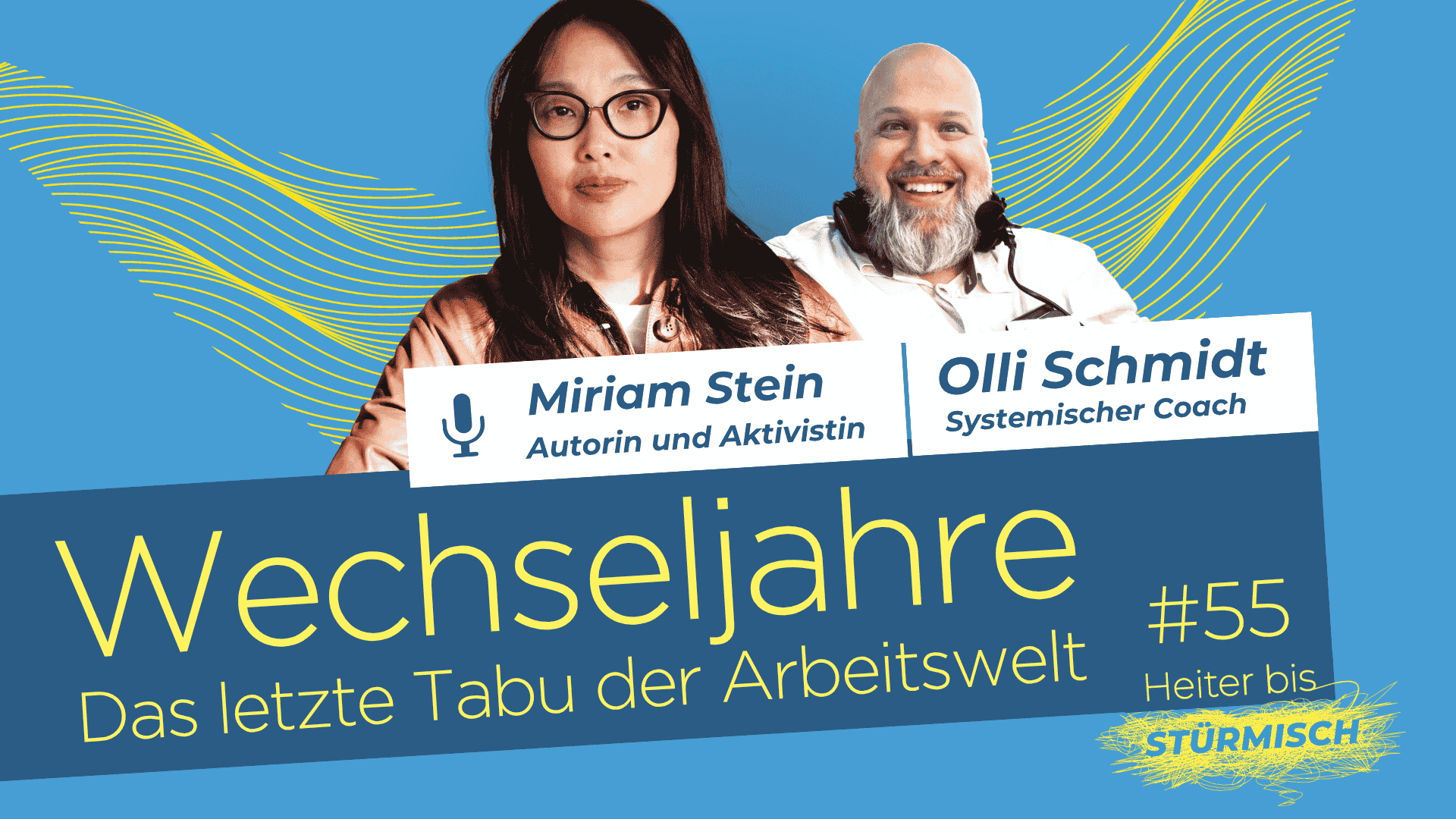
Pictured are author Miriam Stein and podcast host Oliver Schmidt

#55: Menopause at Work: Let's Talk About It Now!

Sleep problems, exhaustion, mood swings, or brain fog: Menopause can affect daily life and work. Nevertheless, many women going through menopause initially lack the knowledge to make sense of these changes—and often lack the space to talk openly about them.

In the new episode of “Heiter bis stürmisch,” Oliver Schmidt speaks with author and activist Miriam Stein. With her book *Die gereizte Frau*, she has sparked a social debate about menopause, women’s health, and women’s knowledge. 

Miriam Stein is not a doctor—she approaches the topic from a social, political, and structural perspective: Why is women’s health still given too little attention in research and the workplace? And what needs to change so that those affected are no longer left to fend for themselves at work?
You can also read more about symptoms and how women can navigate menopause successfully in our article “Menopause: Coping with Symptoms—Tips for Everyday Life.”


.embed-responsive-16by9 > ARTICLE.privacy-content-box { position: absolute; top: 0; } ARTICLE.privacy-content-box { margin-bottom: 10px; max-width: 650px; padding: 20px 40px; background-color: #EEEEEE; text-align: center; } ARTICLE.privacy-content-box I.cm-icon-lock { color: #3C4859; font-size: 100px !important; } ARTICLE.privacy-content-box P.privacy-box-description { margin-bottom: 5px; } ARTICLE.privacy-content-box A.privacy-link { display: inline-block; margin-bottom: 15px; } ARTICLE.privacy-content-box .btn-green { background-color: #28A745; border-color: #28A745; color: #FFFFFF; } ARTICLE.privacy-content-box .btn-green:hover { background-color: #218838; border-color: #218838; }

How can managers support female employees going through menopause?

From a structural perspective, Miriam Stein recommends three things above all: listening without making assumptions; breaking the taboo surrounding the topic, for example through open communication within the team; and creating concrete support measures—such as flexible work schedules, quiet spaces, or informational resources as part of the company’s health management program.

Through the pme Familienservice , we help employees and companies assess stressors and promote healthy work practices—for example, through psychosocial counseling and workplace health management programs.

If menopausal symptoms are affecting your daily life or work, counseling sessions can help you identify your needs, plan your next steps, and prepare for conversations in the workplace. Medical symptoms should be discussed individually with a healthcare professional.

Cheerful to stormy - the everyday podcast with Olli Schmidt

Welcome to "Heiter bis stürmisch" - the everyday podcast. Cheerful or saddened to death: life has its ups and downs. That's what we're all about: everyday crises such as arguments with your partner, parenting issues, work overload, insecurities and anxiety. We talk to experts and give you practical tips to help you deal better with crises and challenges.

You can listen to our podcast on all major podcast platforms (Spotify, Apple Music, Audible, etc.)! Questions, suggestions, feedback, or requests? Feel free to email us at:
podcast@familienservice.de

Miriam Stein: The Irritable Woman
Miriam Stein: The Outrageous Woman
Dr. Sheila de Liz: Woman on Fire
Dr. Katrin Schaudig: Hot Stuff – Menopause Tips on the Go
Dr. Judith Bildau: Body in Balance 


zero Butterfly hug: acute help for stress or anxiety

Woman concentrates and makes a butterfly hug
Psyche

Butterfly hug: acute help for stress or anxiety

Sweating, a racing heart, dizziness, an acute feeling of being overwhelmed: there are always situations in everyday life or at work that can trigger enormous feelings of stress or anxiety. With the butterfly hug, we show you a simple and effective first aid exercise for acute situations.

​​​​​​​​​​​​​Summary: What Is the Butterfly Hug?

The butterfly hug is a simple self-calming exercise for times of acute tension, stress, or anxiety. To perform it, cross your arms in front of your chest and gently tap the opposite shoulders one at a time. This exercise can help you refocus your attention on your own body and the present moment.

Health impulses with our 5-minute exercises

The Butterfly Hug is a simple self-help exercise. It is not a substitute for medical or psychotherapeutic treatment. If this exercise intensifies your anxiety or triggers distressing memories, please stop.

Our 5-minute exercises give you ideas for more relaxation, balance, activity and feel-good moments in your everyday work and private life. They are not a substitute for professional help from counselors and psychologists. Please seek professional advice, for example from pmeLebenslagencoaching, if you feel permanently depressed, have persistent excessive stress or deeper mental problems.

Butterfly hug: Acute help for stress and panic

Whether it's the panic before an important pitch presentation, a termination without notice, an enormously stressful day without time for a break, the sudden death of a loved one, a severe thunderstorm during a flight - the list of triggers is long and most of us have been at that one point where nothing works anymore. 

How can you quickly get these panic attacks—triggered by acute stressful situations —under control ? The butterfly hug, also known as a self-hug, is an effective self-help exercise that you can use quickly and effectively in panic situations and that can help you calm yourself down fast.

How the butterfly hug works

  1. Find a quiet place.
  2. Sit in a relaxed position on a chair or stand comfortably.
  3. Place your hands crosswise on your chest so that it feels comfortable for you. Your fingers should always point towards your neck.
  4. If you like, close your eyes now.
  5. Inhale deeply through your nose and exhale slowly.
  6. Now tap the opposite shoulder with each hand in turn. The frequency doesn't matter; tap as fast or as slow as you feel comfortable.
  7. Accept negative feelings and emotions. But try to gradually focus on yourself. Tell yourself that your feelings are okay for now. This will help you increase your self-love and self-acceptance.
  8. Lower your arms when your body signals that it is enough.

Where does the Butterfly Hug come from?

The butterfly hug was first used by trauma therapists Lucina Artigas and Ignacio Jarero. They had cared for the survivors of Hurricane Pauline in Mexico in 1997 and used the exercise to emotionally stabilize and psychologically support the traumatized people.

Since then, it has been used effectively by many therapists, especially in dealing with trauma and anxiety disorders. As the exercise is very easy to implement without professional guidance, it can be easily integrated into everyday and professional life.

pme Health — Holistic Workplace Health Management (BGM)

We offer in-person and online consulting services in organizational development, the GBU Psyche, and BEM planning and support.

Our workplace health management services include, among other things, health coaching, health days, challenges, as well as expert presentations and training sessions on various health topics; we also offer medical consultations.

Our offering is complemented digitally by our Mindance app, which features over 1,000 interactive video and audio sessions, bookable one-on-one coaching sessions, and a 24/7 ExpertLine. Discover it now: Health management for businesses.

FAQ: Frequently Asked Questions About the Butterfly Hug

Does the "butterfly hug" help with panic attacks?

It can help some people calm down during a strong feeling of anxiety or panic and reconnect more deeply with the present moment. However, in cases of recurring panic attacks or severe stress, this exercise is no substitute for professional help.

How long should I hold the butterfly hug?

There is no set duration. Continue the exercise as long as it feels comfortable and stabilizing. If you start to feel uncomfortable, stop.

Do I have to close my eyes?

No. You can keep your eyes open. Especially in a highly stressful situation, it can be helpful to consciously take in your surroundings.

Is the "butterfly hug" a form of EMDR therapy?

No. The "butterfly hug" is a single self-help exercise described in the context of EMDR. A full course of EMDR therapy is conducted under professional supervision.

Sources

Artigas, L., & Jarero, I. (2010). The butterfly hug. In M. Luber (Ed.), Eye Movement Desensitization and Reprocessing (EMDR) Scripted Protocols: Special Populations (pp. 5–7). Springer Publishing Company.