Nico Löffler, who has autism, and podcast host Olli Schmidt
Psyche

Episode 47: Understanding Autism

What does autism mean in everyday life—and how does the diagnostic process actually work? In this podcast episode, Nico shares his personal experiences and explains what terms like neurodiversity, masking, and sensory overload really mean. The podcast offers practical insights into the symptoms, challenges, and support services related to the autism spectrum.

That's what this episode is about:

  • Neurodiversity and Neurotypical: An Overview of the Terms
  • Common Symptoms and Daily Coping Strategies for Autism
  • Masking, Overload, and Coping with Sensory Overload
  • Diagnosis: The Pathways and Challenges of Autism Diagnosis

This letscast.fm content can only be loaded if you accept the privacy policy of letscast.fm.

To the data protection settings "

Excerpt from the Podcat interview with Nico Löffler:

Nico, what exactly is neurodiversity, and what does the term "neurotypical" mean?

Nico: The umbrella term "neurodiversity" refers to the fact that human brains function differently. There are neurotypical people—that is, the average. And then there are people whose neurology—that is, the way their brains function—differs slightly more. These people are called neurodivergent. This includes diagnoses such as autism or ADHD, for example.

What are the symptoms of autism?

Nico: Difficulty with change, a need for routine, a need for structure— , for example. It’s important to know that autism can occur with or without cognitive impairments. So you could say it affects all areas of intelligence.

It’s possible that someone has significant cognitive impairments and struggles as a result. But it’s also possible that someone has average or above-average intelligence and doesn’t really have any problems in their daily life—for example, with understanding things cognitively. That’s the case for me; I don’t have any cognitive impairments. Nevertheless, I face a lot of difficulties due to autism. These generally fall into the broad categories of communication, interaction, and repetitive behaviors.

You need to explain that briefly. It's repetitive.

Nico: Yes, "repetitive" means something that repeats itself. So , behaviors that are stereotypical— things that are done over and over again in the same way. For example, this includes having daily routines, because they provide a sense of security and are familiar, allowing you to plan your schedule precisely and minimizing your exposure to spontaneous changes.

But it also applies to special interests, for example. These are interests that are very intense and sometimes focus on very specific, niche topics. For me, for instance, it’s Harry Potter, or the universe—I find that totally fascinating too—and I can spend hours engrossed in it, to the point where I can lose myself in it and maybe even forget about important everyday matters for a while.

Are there any other symptoms that are important to consider when discussing autism?

Nico: Absolutely. So, of course, a major area is the social aspect—specifically, when it comes to communicating with other people. For example, when I try to use certain facial expressions and gestures myself, or when I try to recognize them in the person I’m talking to.

And then there’s interaction. That’s the ability to engage in back-and-forth conversations—conversations where people respond to one another. One person says something, the other person responds to it, and then the first person responds to that. These are exactly the kinds of things that people on the autism spectrum find difficult. 

Overwhelm, Overload, and Coping Strategies in Everyday Life. What Happens When It All Gets Too Much?

Nico: For example, when some people on the autism spectrum become so overstimulated that they experience what’s called an “overload.” This is sensory overload, where you become completely overwhelmed by the various environmental stimuli. Maybe people around you are talking really loudly, and then there’s a bright light, and then you catch a whiff of some unpleasant smell, and at some point it’s just too much. Then, under certain circumstances, you might experience a so-called overload, and your mind basically shuts down—you feel completely overwhelmed inside—and that can end up being a pretty rough experience.

What helps you in a moment like that?

Nico: The best thing would be to prevent that kind of overload. Make sure it doesn’t get to that point in the first place. Seek some space beforehand, maybe even warn the people around you and say, “This or that can quickly lead to me feeling overstimulated or overwhelmed.” I’ll make myself known and maybe step back. Small aids can also help, like headphones or sunglasses when there are stimuli. Then there’s the concept of “stimming”—which, by the way, also falls under these repetitive behaviors, these repetitive actions—where you do small things that stimulate the senses, but in a positive way.

Cheerful to stormy - the everyday podcast with Olli Schmidt 

Welcome to "Sunny to Stormy" – the everyday podcast. From the heights of joy to the depths of despair: life has its ups and downs. That’s exactly what we’re all about: the everyday crises, such as arguments with your partner, parenting issues, work-related stress, uncertainties, and anxiety. We talk to experts and provide you with practical tips to help you better cope with crises and challenges. 

You can listen to our podcast on all major podcast platforms (Spotify, Apple Music, Audible, etc.)! Questions, suggestions, feedback, or requests? Feel free to email us at: familienservice 

 

zero What is stress management - definition, methods and exercises

A young woman sits relaxed on the balcony and works
Psyche

What is stress management? Definition, methods, exercises

Deadlines, appointments, family life, loneliness - in everyday life and at work, we encounter situations that quickly stress us out. We often don't even realize that we are stressed or simply carry on as before. Until we can no longer cope and, in the very worst case, burnout threatens. The World Health Organization (WHO) classifies stress as one of the greatest health risks of this century. 

Good stress management helps to make it easier to cope with work and everyday situations and gradually reduce stress levels.

1 What is stress and what are the symptoms of stress?

1.1 How does stress arise?

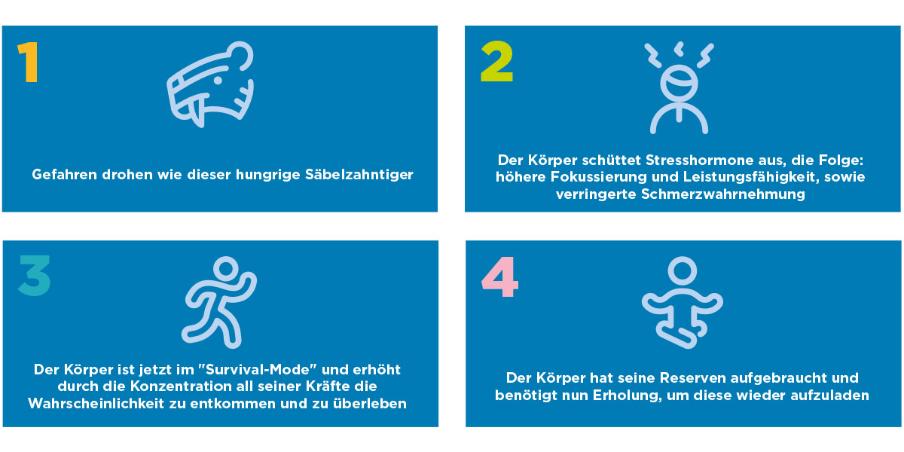
A stress response is an emergency program in our body that was vital for the survival of our ancestors: if danger threatens, for example from a tiger, the body runs a program that prepares it for fight or flight. The sympathetic nervous system, a part of our autonomic nervous system, ensures that our body releases adrenaline.

Adrenaline increased:

  • the breathing rate
  • the heart rate
  • the muscle activity

Adrenaline inhibits:

  • the digestion
  • the sex drive
  • the flow of saliva

The stress response makes our body stronger, faster and less sensitive to pain for fight or flight. Once the tiger has disappeared, the parasympathetic nervous system is activated and puts the body back into a resting state.

From a medical point of view, stress is a physical reaction that is intended to make the body particularly efficient in the short term - and has no pathogenic effects. 

On the other hand, prolonged stress can seriously damage body and soul. Chronic stress makes itself felt in the body through increased cortisol levels.


Chronic stress can have the following consequences:

  • Impaired memory function
  • Headaches and back pain
  • High blood pressure, coronary heart disease
  • Gastrointestinal complaints
  • Potency / menstrual cycle disorders
  • Sleep disorders
  • Weakened immune system & susceptibility to disease

The most important things when dealing with stress are therefore exercise and rest periods, which allow the body to return to normal operation.

You may also be interested in this article: "Anti-stress: exercises for relaxed productivity"


1.2 What causes stress in the workplace?

Fortunately, tigers are rarely seen in the workplace.

Nevertheless, the job is full of stressors. An excessive workload, deadline pressure, interruptions and disruptions, information overload and poor workplace conditions are the main stressors in the workplace, according to the 2021 study by the German health insurance provider "Relax, Germany".

However, what exactly triggers stress in an employee can vary greatly. Stress, stressors and stress symptoms are as diverse as we humans ourselves.

Company stress management can create a framework to provide preventative and acute relief.  

1.3 Test: Do you know your personal stress intensifiers?

Use this test to find out what triggers stress in you personally:

Test: What are my personal stress boosters?

2 What is stress management?

Stress management refers to all methods and strategies for preventing, reducing or coping with stress.

Personal stress management encompasses the individual's methods for dealing with stressful situations.

Workplace stress management is primarily aimed at creating an atmosphere for employees in which they can work in a particularly creative and productive way . However, many offers in this area also help to improve employees' personal stress management.


3. develop stress competence

3.1 What methods of stress management are there?

Especially in our fast-paced world, we find it difficult to avoid interruptions and the flood of information. This means that stress cannot be avoided.

If we can't get rid of stress, we have to learn to live with it and cope with stressful situations. This means increasing our personal stress competence so that we can recognize delicate moments early on and counter them with the right strategy.

It also helps to strengthen your own resilience, i.e. to build up stress resistance. If it is not possible to avoid stressful situations, you can at least change them in order to prevent stress.

There are different methods of stress management. Everyone has to find out for themselves which method suits them best. Effective stress management should include a variety of stress management methods.

Below we provide an overview of possible stress management strategies.  

3.2 Multimodal stress management (Kaluza)

Multimodal stress management goes back to the psychologist Gert Kaluza , who still uses this principle. The model shows different levels of stress management that start at different points. The environment plays a key role here, as do personal attitudes and how we deal with stressful situations. 


This Vimeo content can only be loaded if you accept the privacy policy of Vimeo, LLC.

To the data protection settings "


3.3 What is the Kaluza stress model?

Prof. Gert Kaluza, psychological psychotherapist, trainer and coach, has been considered one of the leading experts in the field of stress management since the 1990s. Numerous health insurance companies recommend the stress management program he has developed.

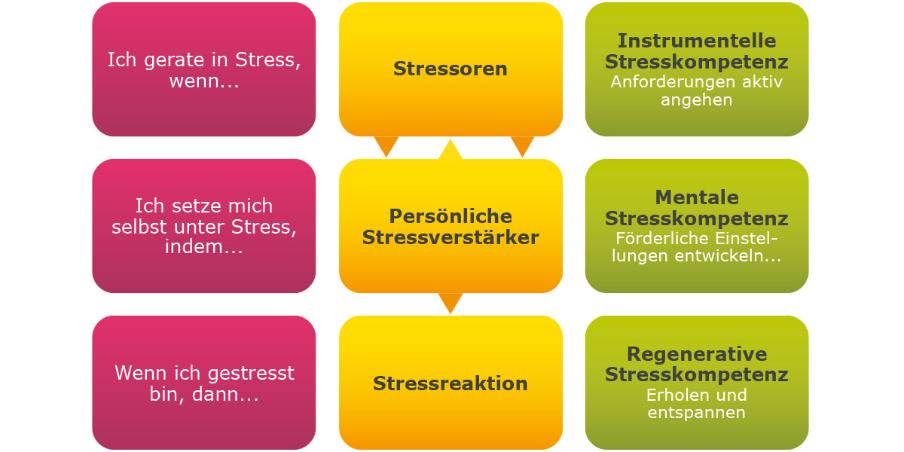
At its core, the model states that stress is made up of three key factors. This so-called "stress traffic light" consists of:

  1. All external circumstances that trigger stress. So-called "stressors" include time pressure, arguments and information overload. ("I get stressed when...")
  2. All internal circumstances that trigger stress. These "personal (mental) stress intensifiers" are, for example, your own thought patterns, negative beliefs and the urge to be a perfectionist. ("I put myself under stress by ...")
  3. All physical reactions to stress. Such "stress reactions" can manifest themselves on three levels. Stress can manifest itself physically, e.g. through heavy sweating, or behaviorally, e.g. through excessive irritability or in a cognitive-emotional way, e.g. in the form of a blackout. ("When I am under stress, then ...")

3.4 The three pillars of stress competence

Kaluza has designed the three pillars of individual stress competence on the basis of this model.   

Instrumental stress competence

Reducing stressors with the help of instrumental stress competence:

  • Professional training against excessive demands
  • Increase problem-solving skills
  • Help with self-management
  • Learning to accept and demand support
  • Learning to say no and set boundaries

Mental stress competence   

Change your inner attitude thanks to mental stress competence:

  • Exposing negative beliefs from childhood
  • Learning to develop supportive ways of thinking 
  • Formulate positive beliefs
  • Promoting belief in your own skills

Regenerative stress competence

Defuse stress reactions through regenerative stress competence:

  • Sufficient and correct exercise
  • Healthy diet
  • Break culture
  • Sleep hygiene
  • Relaxation techniques


4 What is part of company stress management?

When we hear the word stress management, we probably think first of relaxation, breaks and yoga. However, Kaluza's stress model clearly shows that stress management needs to be taken a step further. Although stress is individual, it is possible to create a framework for all employees in which personal stress competence can be trained.

4.1 Organizational level: reducing stressors

Of course, the workload is sometimes difficult to manage. But optimized work processes can reduce the workload for individual employees. 

  • Invest in professional training and prevent excessive demands.
  • Trust your employees and free yourself from rigid working hours and compulsory attendance.
  • Flexible working time models make it possible to adapt to personal performance curves and provide scope for reconciling private and professional interests.
  • Offers on time and self-management can help to cope better with the workload

4.2 Reducing personal stressors

Of course, colleagues or managers are not always the right people to deal with difficult childhood memories and the resulting personal stressors. But there are many ways in which a company can offer its employees support in this regard.

Offer a neutral point of trust where employees can turn to if necessary.

4.3 Relaxation programs for employees

It's no coincidence that company health programs are booming. Business yoga, massages or free sports activities create a healthy balance to everyday working life and also ensure greater motivation among employees. After all, employees who feel respected and valued by their employer in their personal matters build a bond with the company.

You may also be interested in this article: What is business yoga?

5. simple and effective exercises for stress management

1. quick relaxation with the 4-7-8 breathing exercise

2. three simple yoga exercises for the back

3. sensory mindfulness exercise

4. finger yoga: relieve neck tension in 3 minutes

6. stress management with the pme Familienservice

Whether it's communication training for managers, support in establishing a healthy error culture, a varied health day or a hybrid OHM concept?

We would be happy to make you an offer for customized, company stress management.

Get advice from your business customer advisor or contact the advisors on our 24/7 service hotline: 0800 8010070-80.

Lectures and seminars against stress

In our calendar of events you will find a wide range of offers for stress prevention.

To the calendar of events


Sources:

www.tk.de/resource/blob/2116464/9ff316aaf08870ed54aa8a664502ac67/2021-stressstudie-data.pdf

www.gkm-institut.de/downloads.html

coachinglovers.com/coaching-tool/stress-ampel-nach-kaluza/

coachinglovers.com/stressmanagement/stressmanagement