



9 tips for a positive error culture
Establishing a positive culture of error tolerance within a company helps take the pressure off managers and team members and fosters team members’ self-confidence. In contrast, a “zero-error” culture can be a major hindrance in an era where the ability to react and adapt quickly is crucial. Effective tips on how to embrace a culture of error tolerance while remaining authentic.
Read more in this article:
1. Create a climate of psychological safety
A fundamental prerequisite for a positive culture of error is psychological safety. Only when team members do not have to fear negative consequences or disparaging remarks will they speak openly about mistakes and voice their questions and concerns.
2. Ask "Why?"
The first step is to examine the reasons. Why do you want to establish a culture of learning from mistakes in your team? What do you hope this will change? Personally, I’ve come to realize that I will always make mistakes because it’s simply impossible to be perfect—and that I can learn something from every mistake. But if I insist on doing everything right and don’t change my mindset, I’ll end up stressed and pass that stress on to others.
Before you establish a culture of learning from mistakes, clarify the following:
- Why do you want to establish a culture of learning from mistakes within the team?
- What exactly is supposed to change as a result?
- What attitude toward mistakes do you want to let go of?
3. Consistent and Fair: Be Transparent in Your Communication
A positive culture of learning from mistakes thrives on communication. Encourage your team members to own up to their mistakes and learn from them. Nothing is worse than when mistakes are covered up out of fear of the consequences.
However, this requires one key ingredient: fairness. If you let one team member get away with something—perhaps for good reason—but not another, it creates uncertainty and a sense of unfairness. This makes it all the more important to communicate decisions transparently and be open to critical feedback.
A credible culture of error requires:
- Encouragement: Team members are open about their mistakes instead of covering them up
- Justice: The Same Standards for Everyone—No Special Treatment for Individuals
- Transparency: Communicate decisions openly and encourage feedback
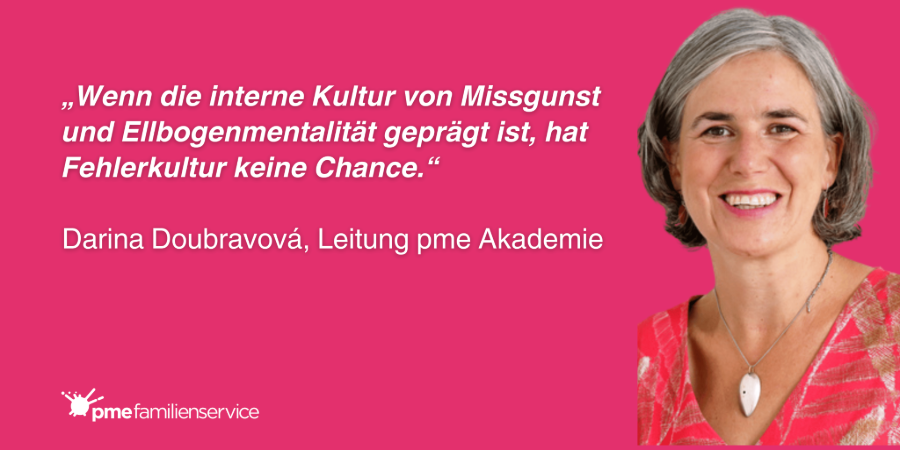
"If the internal culture is characterized by resentment and a cutthroat mentality, a culture of learning from mistakes doesn't stand a chance."
Darina Doubravová, Director of pme Academy
4. Build Trust in a Culture of Error Tolerance
Anyone who gets “grilled” by their manager will not develop trust and will be wary of admitting mistakes in the future. Instead of asking who is “to blame,” try to find out how the mistake happened and what the team member in question—or the team as a whole—can learn from it.It’s not important who made the mistake, but rather what led to it.
Encourage the team member to try again. Retrospectives or regular team meetings where the group reviews what’s going well and what’s holding them back are invaluable for building trust and fostering a constructive culture of learning from mistakes. An open culture of learning from mistakes is especially beneficial during high-friction phases of collaboration—such as those described by Tuckman’s team development model.
Instead of asking, "Who's to blame?", ask:
- How did this error occur?
- What can the person or team learn from this?
- How can we encourage someone to try again?
5. Reward Creativity
Praise team members who are brave, even if they make mistakes along the way. Creativity should always be rewarded. Where would we be without thinkers, dreamers, and visionaries! Crazy ideas often lead to mistakes, so don’t let yourself be blinded by the pursuit of a perfect end result.
6. Say Goodbye to Perfectionism
When everything is new and there’s no prior experience to draw on, it’s impossible to get everything right. This is especially true right now when it comes to working with artificial intelligence. Not everything works out as hoped the first time around.
To gradually achieve better results, you need curiosity and a willingness to learn, the courage to try out different models and tools, and the ability to learn from your mistakes. There’s no room for frustration here, because mistakes help you find the right path.
The following applies especially when dealing with artificial intelligence:
- Be curious and eager to learn
- Try out different models and tools
- Accept mistakes as part of the learning process, not as a setback
7. Lead by example
As a leader, set an example of how to deal with mistakes constructively. Take a moment to reflect: What goes through your mind when you’ve made a preventable mistake? What if someone else has made one? Also, observe how others communicate their mistakes. Do they do so objectively, or are they full of excuses and justifications?
In practice, I consistently observe that when a company has a weak culture of error tolerance, employees resort to making excuses out of fear. If you model a positive attitude toward failure, team members will feel secure and be able to focus on the positive aspects and lessons learned after making a mistake.
Reflection Questions for Leaders:
- How do I react when I make a mistake that could have been avoided?
- How should I react if it happens to someone else?
- Do team members communicate their mistakes objectively—or do they make excuses out of fear?
8. Establish a culture of feedback
The sooner a mistake comes to light, the sooner we can learn from it. Feedback from colleagues and supervisors, as well as critically examining our own actions, are the foundations for successfully dealing with setbacks. A proven method for this is the “5-Finger Feedback” approach, which facilitates respectful and specific feedback within the team.
In this context, it’s helpful to focus equally on both successes and mistakes. Unfortunately, mistakes often carry a very negative connotation—but focusing on the negative makes us feel unwell and stifles our creativity.
Fundamentals of an Effective Feedback Culture:
- Address mistakes early on, rather than letting them drag on
- Actively seek feedback from colleagues and supervisors
- Focus on both successes and mistakes (not just the negative ones)
9. Expect Setbacks
As with any change process, implementing a culture of error won’t always be smooth sailing. Be prepared for setbacks. Read our article to learn how you, as a leader, can strengthen your team’s resilience and remain capable of taking action even during difficult times.
Establishing a culture of learning from mistakes means changing one’s own attitude and behavior. To do this, learned and ingrained behavioral patterns and reactions must change. That takes time and patience. Not everyone adapts equally well to a culture of learning from mistakes—even if it makes sense to them on a rational level. It’s important to be prepared for this and not let it discourage you.
Conclusion: A culture of learning from mistakes starts with you as a leader
A positive culture of error doesn’t happen overnight—it’s the result of many small decisions made in everyday life: how you react to a mistake, how openly you deal with your own setbacks, and how much your team feels it can be honest. The nine tips in this article aren’t a rigid program, but rather a guide that you can integrate step by step into your day-to-day leadership practice.
The most important step is often the first one: Start small, be patient with yourself and your team—and celebrate when a mistake leads to a good solution. After all, true leadership isn’t about never allowing mistakes—it’s about how constructively a team deals with them.
FAQ: What is a positive error culture?
1. What is meant by a positive culture of error?
A positive culture of error refers to an open, constructive approach to handling mistakes within a company. Instead of punishing or covering up mistakes, they are viewed as opportunities for learning. The goal is to create psychological safety so that employees can openly address mistakes, learn from them, and grow—without fear of negative consequences.
2. Why is a positive culture of error important for companies?
A positive culture of error takes the pressure off managers and teams, fosters trust, and strengthens the ability to innovate. Especially in times when the ability to adapt quickly is essential—such as when dealing with new technologies like artificial intelligence—a “zero-error” mindset can hold companies back because employees are afraid to try new approaches out of fear of making mistakes.
3. How do you foster a positive culture of learning from mistakes within a team?
Key elements include: creating psychological safety, communicating transparently and fairly, fostering trust rather than assigning blame, rewarding creativity, and leading by example as a manager. Retrospectives and regular feedback sessions help to permanently embed the approach to handling mistakes within the team.
4. What is the difference between a positive error culture and a zero-error culture?
In a zero-error culture, mistakes are penalized and avoided whenever possible—which often leads to mistakes being covered up rather than addressed. A positive error culture, on the other hand, views mistakes as a natural part of learning and change processes and actively uses them to improve processes and collaboration.
5. What role does a manager play in fostering a culture of learning from mistakes?
Managers have a significant influence on the culture of error through their own behavior. Those who are open about their own mistakes, respond objectively rather than accusingly, and focus on “What can we learn from this?” rather than “Who is to blame?” lay the foundation of trust for a culture of error that is actively practiced throughout the entire team.
The Work:Life Academy at pme Familienservice offers a wide range of seminars and training programs for companies focused on leadership development and employee development.
Whether in-person, online, or as blended learning or blended coaching—we flexibly tailor our seminars and training sessions to the needs of your teams and leaders.
Systemic, solution-oriented, and practical: Work:Life Academy