


Pyramid Communication: How to Communicate Clearly as a Woman
Communicate clearly and concisely so that your message resonates with stakeholders and colleagues: The pyramid communication method helps you, as a woman in leadership, make your voice heard effectively. It includes practical, real-world tips for your day-to-day work.
Expert: Darina Doubravova, executive coach, Director of pme Academy | Editor: Isabel Hempel
Clarity, confidence, and impact are achieved when the most important message is stated first. The pyramid communication method helps women in leadership roles organize their thoughts, present themselves persuasively, and be heard more effectively in their day-to-day work. Practical tips, examples, and micro-habits demonstrate how this principle can be applied directly.
Read more in this article:
- Why isn't my message getting through?
- What is pyramid communication?
- The Three Principles of Pyramidal Communication
- Here's how to apply pyramidal communication in practice
- Structure using the example: “Meeting-Free Friday”
- Pyramid Communication in 3 Steps
- Limitations and Pitfalls of the Method
- Tip: How to turn pyramid communication into a micro-habit
- FAQs – Quick & Easy
Why isn't my message getting through?
Many women in leadership roles are familiar with this: they know exactly what they want to convey, but at the crucial moment, the message doesn’t come across as intended—whether in a meeting, during a project update, or in important emails. Yet, in addition to the right mindset, effective communication is crucial for a woman’s success in the workplace.
Prejudice and Stereotypes in the Workplace
There are many reasons for this: attention is a scarce resource, prejudices and stereotypes often operate beneath the surface, and sometimes we get in our own way.
"Women often have trouble getting to the point without going on and on. They back up their message with lots of details to demonstrate their expertise, instead of simply stating, 'I'm the best.'"
Darina Doubravova, Director of pme Academy
Social insecurity leads to repetition. The problem is: the audience tunes out!
That’s why every presentation should start with a brief introduction, followed immediately by the key message. “My advice: Let the audience decide when to tune out!” recommends Doubravova.
What is pyramid communication?
Pyramid communication was developed byBarbara Minto, one of the first consultants at the renowned management consulting firm McKinsey & Company. Her method arose from the need to quickly and accurately summarize complex analyses for busy decision-makers.
Want to project confidence at work? Listen to our podcast: Confident as a Woman in the Workplace
What is the Minto Principle?
The key to her teaching is to put yourself in the audience’s shoes: it’s not primarily about what you personally consider to be the core message, but rather about what the target audience already knows and what specific problem they need a solution for.
This analytical process is what Minto describes in her book *The Minto Pyramid Principle* (1978) with the famous maxim: “You think your way through it from the bottom up, but present it from the top down”(Barbara Minto, *The Minto Pyramid Principle*, 1978).
The goal of this top-down presentation is tostate thecore message right at the beginning, followed by two to five supporting key points.
Each of these arguments can be expanded upon as needed—like the blocks of a pyramid that together form the foundation for the central message.
The Three Principles of Pyramidal Communication
- Results-oriented: State your main point right at the beginning.
- Audience-focused: Seeing things from your target audience’s perspective.
- Structured:Present two to five key arguments, group them logically, and support them with facts
"A pyramid has the advantage that at least two stones always support the one above them. That is exactly how your arguments should support your main message. The number of key arguments should be limited. More isn’t always better—quite the opposite."
Darina Doubravova, Director of pme Academy
Here's how to apply pyramidal communication in practice
In a pyramid-shaped communication structure, the most important information is placed at the top.
The structure is simple: you start with the main point and then support it step by step with logically organized arguments. This way, the audience grasps the message immediately and can delve into the details if needed.
Structure of Pyramidal Communication: The Example of “Meeting-Free Friday”
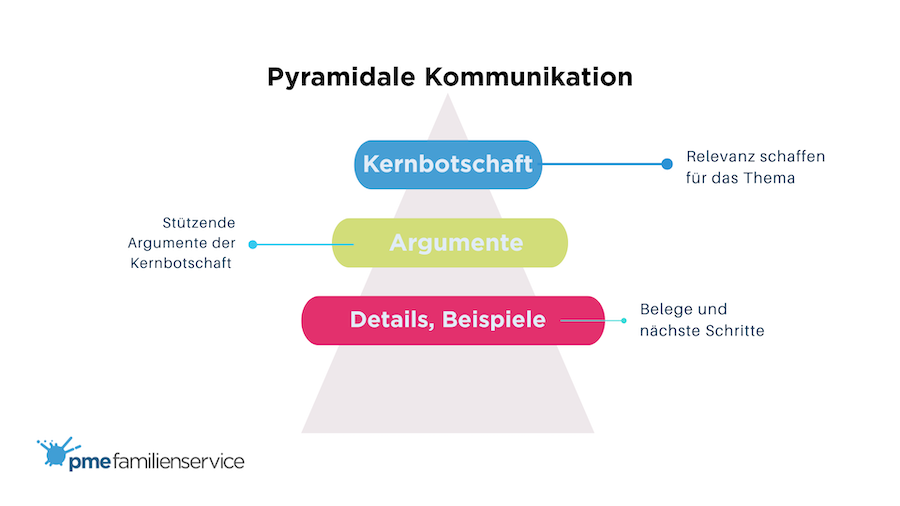
1. Introduction (Situation → Problem → Question)
Set the context and make it relevant:
"In recent months, the number of online meetings has risen sharply (situation), which is leading to fatigue and taking up time that could be spent on focused work (problem). How can we regain our focus?" (question).
2. Key Message (The Top of the Pyramid)
The direct answer to the question, the main plot point or piece of information.
"Starting immediately, Fridays will be meeting-free for the entire team."
Three supporting arguments (grouped logically):
List two to five clear, distinct reasons that convey the core message:
- Argument 1: "Everyone has more uninterrupted time for focused work."
- Argument 2: "There are fewer interruptions, which leads to less fatigue and better concentration."
- Argument 3: "Friday can be used as a set day for finishing up unfinished tasks and planning the week."
- Argument 4: "The policy contributes to a better work-life balance and increased motivation."
3. Evidence & Implementation ( The Foundation)
Details, facts, data, or next steps will be added here only as needed:
“The pilot will begin on [date]; exceptions will be made only by prior arrangement. An evaluation will be conducted after 3 months via a short survey.”
Tips for use in 3 steps
- Key message first: What is the most important point?
- Organize your reasons: Identify two to five clear, non-overlapping arguments.
- Details at the end: Briefly add supporting documents and next steps only if necessary.

What are the limitations and pitfalls of this method?
The pyramid structure is invaluable for reports, presentations, or decision-making frameworks. However, it isn’t ideal if you’re relying heavily on emotions or trying to overcome resistance—for example, in the context of complex change processes or when it comes to motivating your team members.
3 Tips: How to Turn Pyramidal Communication into a Micro-Habit
Before sending an email, giving a presentation, or attending a meeting, ask yourself:
1. Is my key message right at the beginning?
The next time you write an email or give a presentation, check to see if your key message is really right at the beginning.
2. What are my two to five main reasons?
Before you speak at a meeting, think through your clear key message in advance, along with two to five main reasons.
3. Have I presented my arguments logically and limited them to a maximum of five main points?
This is especially important during presentations.
Conclusion: Pyramidal communication makes women in leadership visible and heard
Whether in meetings, reports, presentations, or emails, pyramidal communication gives your voice power and structure. Give it a try, and you’ll notice how your messages come across as clearer, more precise, and more memorable.

Pyramid Communication – Frequently Asked Questions
When should I use the pyramid model of communication?
Use pyramid-style communication primarily for reports, dealing with facts and figures, and decision-making presentations. When it comes to motivation or dealing with resistance, more empathy and emotional appeal are needed.
How many main points should I make?
Research shows that two to five points is the upper limit of what the human short-term memory can effectively retain.
Can I use the pyramid communication method in emails?
Yes, and it’s actually very effective. Put the key message first, followed by no more than five points or pieces of information—short, clear, and easy to understand.
Can I use templates for pyramid communication?
Yes! Just search for “pyramid communication PowerPoint template”—you’ll find some handy templates there.
The Work:life Academy of pme Familienservice a wide range of seminars and training programs for companies focused on leadership development and employee development.
Whether in-person, online, or as blended learning or blended coaching—we flexibly tailor our in-house seminars to your needs.
Systemic, solution-oriented, and practical – Work:Life Academy





.jpg/9f3dd9a0-7339-c48e-0b82-367d29acc24c/9f3dd9a0-7339-c48e-0b82-367d29acc24c?imageThumbnail=2)