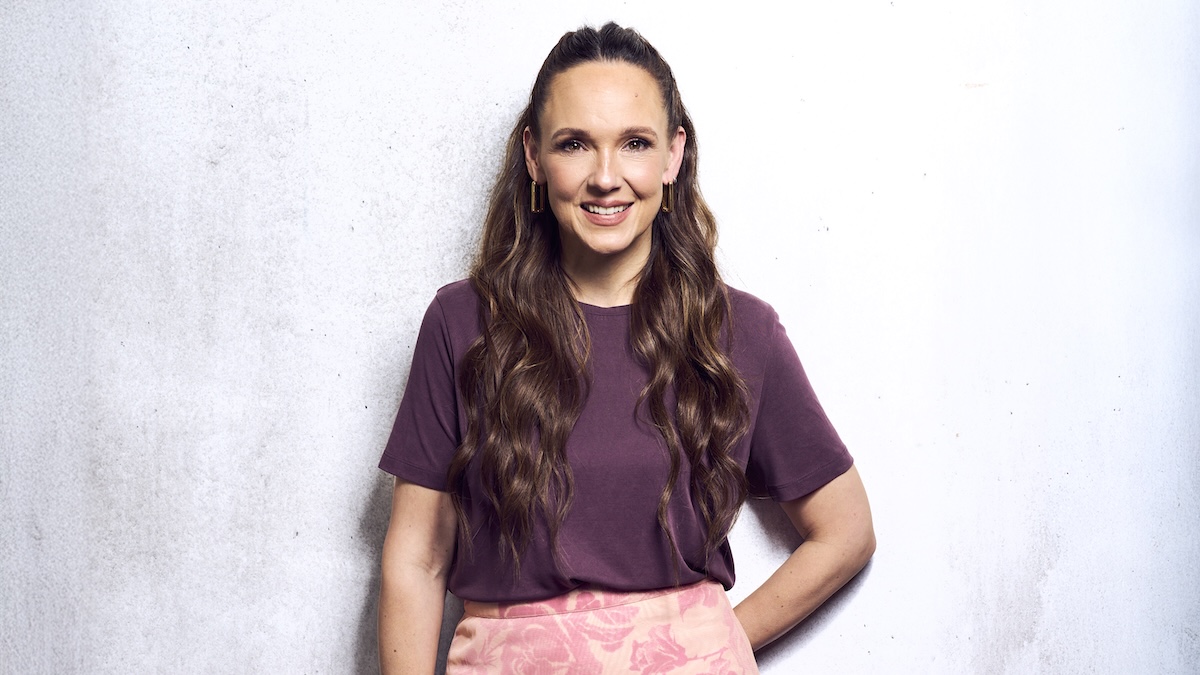


Carolin Kebekus: “Motherhood is in a league of its own”
"I think our entire society is based on women taking on the bulk of care work—without complaining."
If anyone knows what it feels like to be a mother—navigating the highs of joy, the lows of sleep deprivation, and a career in the spotlight—it’s Carolin Kebekus. The comedian and host, who usually makes a splash with sharp one-liners about politics, the church, and sexism, turns her attention to something very personal in her bestseller “8,000 Ways to Fail as a Mother”: her life as a mother.
In an interview with pme, she explains why reality “caught her off guard” after giving birth, why mothers are much quicker to be labeled “bad” while fathers are labeled “good”—and why humor, for her, isn’t just a way to smile things away, but a survival strategy. Carolin Kebekus will be a speaker at Health Day 2026 in October.
Interview: Sarah Raupach, Editor: Christin Müller, Photo: Ben Knabe
Your book is called *8,000 Ways to Fail as a Mother*. When did you realize you wanted to write a book about this?
Carolin Kebekus: While writing my new stage show, I realized I had an insane amount of material—pregnancy, childbirth, the postpartum period, everything. It would easily have been enough for a four- or five-hour show, but you can never fit all of that onto the stage.
Even during my pregnancy, I realized just how many rules you suddenly have to follow—as a pregnant woman, as a mother, and as a woman in general. And how incredibly quickly you’re labeled a “bad mother.” And how incredibly quickly you’re labeled a “good father.” That really surprised me.
The idea for the book came to me pretty quickly. I called the publisher, and they immediately got the vibe and were on board right away.
How much of Carolin Kebekus is in this book—and where did you exaggerate?
When I perform my routine about the postpartum period on stage, I always say at the end: “For everyone who’s currently pregnant—this is comedy; I’m exaggerating.” And afterwards, all the moms are rolling with laughter because they know exactly: That’s not exaggerated at all; I just put it out there exactly as it is. Maybe I’ve exaggerated a little here and there—it is comedy, after all—but every point is true. And it’s also true that breastfeeding is backbreaking work.
I think I’ve worked through a lot in this book. I had to somehow come to terms with the person I’ve become: sleep deprivation, constant overstimulation, always being touched, always on call, not a single second to myself anymore.
Until then, I was a different person. Whenever I wanted to accomplish something, I would ask myself: How do I do this? Where can I learn it? Where can I buy it? What do I need to do? And suddenly, my only option was to ask for help. It was incredibly hard for me to say, “I can’t do this anymore.” But that’s exactly what isn’t expected of mothers. A mother can always do it. A mother doesn’t say, “I can’t do this anymore.”
I think our entire society is based on the fact that women take on the bulk of care work—without complaining and without getting paid for it.
Many fathers see themselves as “modern fathers,” yet at the same time, many mothers complain about the invisible work that goes on behind the scenes. Where do you see this tension?
The classic scenario is: You drop the kid off, and your partner says, “Why don’t you just lie down for half an hour?” That could drive me up the wall. Yes, I could lie down—but then who’s going to unload the dishwasher, who’s going to do the laundry? Who’s going to schedule the U7 appointment, who’s going to buy new rain boots? When else am I supposed to do that if not now, when the child is asleep or out somewhere else?
There is just an incredible amount that goes unnoticed.
But I know I’m partly to blame, too. I often try to do everything myself to make sure it’s “done right.” Then I find it hard to say, “Why don’t you pack the kid’s bag, and I’ll just relax while you do it.” And at the same time, I think, “Are you really packing everything?”
Many modern fathers are different from what they were when I was growing up. Back then, spending time with Dad—going to the hardware store, for example—was considered quality time. Today, I know many wonderful fathers who are very involved with their children. But the logistics—who keeps track of appointments and birthdays, and who maintains the social network?—often still fall to the mothers.
When did you realize: This isn't just a lot; it's a structural problem?
Anyone who has been thinking about gender equality and feminism for a while knows this: there is a fundamental injustice—in care work, in pay, everywhere. I’ve been doing comedy about women’s issues, misogyny, and women’s rights for years, and at some point I thought, “I’ve already covered everything.”
Then I became a mother and realized: That was just the tip of the iceberg. Motherhood is in a league of its own.
I know how privileged I am. I have money; I can buy my child clothes, toys, educational resources, and childcare. I have a childcare center where my child eats breakfast and lunch—I used to underestimate how much of a burden that takes off my shoulders.
How does this constant pressure affect your mental health and that of those around you?
That's not healthy. And it's hard to put into words. It's okay among women, but there's still a sense of shame in admitting that you can't do it.
When I say, “I have a childcare center, I have a nanny, I work—and I’m still completely exhausted,” I immediately think of my friend with four kids, who might not be working. Do I have the right to complain if she manages to get by “somehow”—or at least makes it look that way?
We’ve internalized the idea that women can endure anything. We saw this in our mothers and grandmothers. The whole of society is built on women enduring things without complaining.
And when a woman does say, “I can’t take it anymore” or gets angry, that female anger is perceived very differently. Then you quickly think: “Am I too weak? Shouldn’t I be able to handle this?”
When you think about everything you’ve done in a day and how much sleep you’ve actually gotten, it’s clear that you’re overwhelmed. But the image I have of myself is: “I can handle all of this. I’m the person everyone says, ‘Caro, how do you actually manage to do all that?’” And sometimes I think: I don’t.
What can humor achieve when it comes to “mental load and psychological stress” that a purely serious statement cannot?
When you tackle a serious topic with humor, you always have to get right to the heart of the matter: What is the issue here? What is so absurd about the situation?
When it comes to misogyny, for example, there are many absurd moments. When people laugh at the right moments, you can tell they’ve understood what it’s all about—it’s boiled down to the essentials.
At my last show, there were many mothers in the audience who felt a strong connection to so many of the topics discussed. And everyone else in the room was moved by our shared laughter. Humor eases tension, breaks down barriers, and relieves frustration.
During my postpartum period, I exchanged photos every day with a friend who had also just had a baby—of everything that went wrong. We sent each other the ugliest baby photos and laughed ourselves silly—C-section scars and all. Humor really helped.
What would you say to someone who’s currently overwhelmed by mental load and feels completely alone with their “8,000 mistakes”?
Maybe I need to lower my expectations a bit. At first, I had a very clear picture of myself as a mother—who I am and everything I can accomplish. At some point, I let go of that image.
Sometimes it’s okay to just let things be. The best days are the ones when you don’t have any plans, don’t have to be anywhere, and can just spend time with your child. Without feeling like you have to serve lunch on time or cook it yourself. Then you can just go to the zoo and eat french fries.
And then I’d say: reach out for help. Build a network with other moms or family members. Sometimes you have to directly ask the people you’d like to have a closer relationship with your child: “Would you be interested in spending a day with the kids once a week?” Often, support comes from a source you least expect.
And then you should definitely let your partner know how you feel. I don’t think most fathers would say, “Don’t be such a baby!” If you sit down together and figure out what you can handle and what you can’t, you can divide up the tasks more effectively. But then you actually have to hand them over—that’s often the hardest part.