

The successful "Health Day" program is being expanded to include "Health Week"
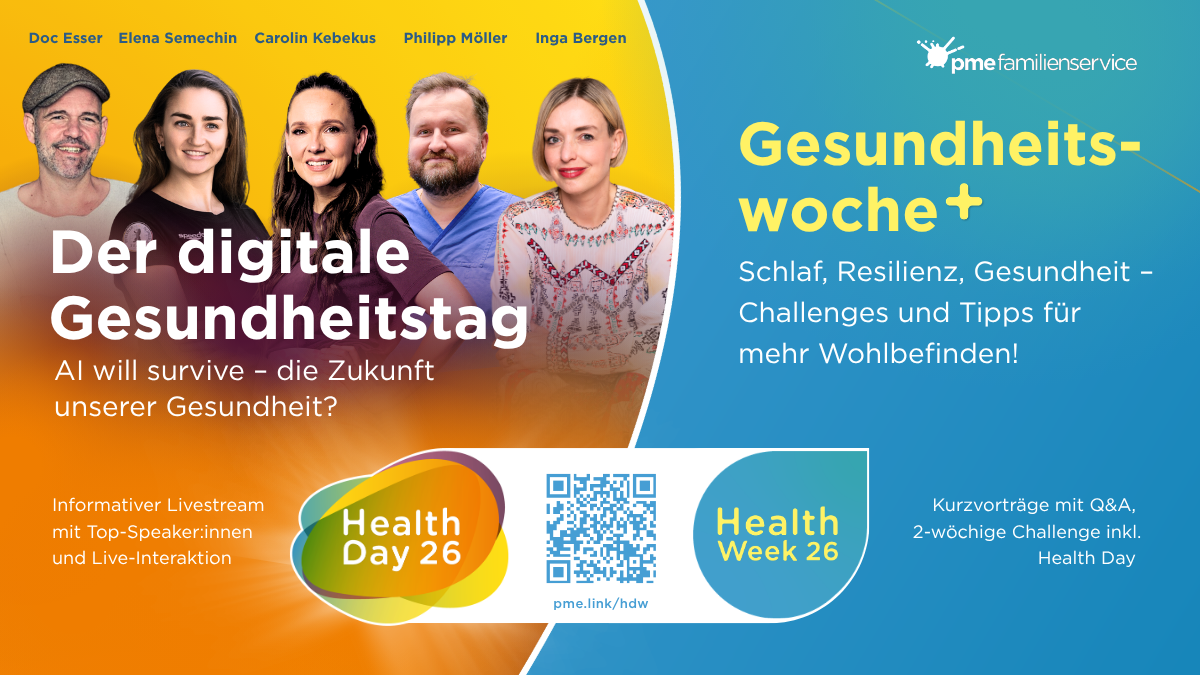
(Berlin, April 24, 2026) Health Day is back—and bigger than ever this year! Because one day isn’t enough, the pme Familienservice is expanding its successful digital health event into Health Week in 2026. A whole week full of inspiration, live challenges, and community—with Health Day on October 8 as the highlight.
This program is designed for all companies and organizations that wish to provide their employees with innovative ways to promote health and well-being—regardless of industry, role, or position.
New in 2026: Health Week
Health Week, taking place from October 5 to 9, 2026, brings fresh inspiration to the workplace every day: from a daily sleep challenge and power breaks to boost resilience, to yoga and relaxation, as well as lectures on longevity, nutrition, family health, and artificial intelligence. Interactive Q&A sessions, practical exercises, and a digital community ensure that these health initiatives have a lasting impact.
All sessions are available live and as recordings.
Michèle Penz, Head of Occupational Health Management at pme Familienservice:
"With Health Week, the pme Familienservice is setting an example for modern, practical health promotion—and turning health into a shared experience."
Highlight of the week: Health Day on October 8, 2026
More than 30,000 people have already benefited from Health Day. In 2026, this successful event will take place for the fifth time and once again offer an inspiring program. Under the theme "AI will survive?", the four-hour livestream will explore how people can stay healthy, clear-headed, and confident in a world where algorithms never tire.
Health Day highlights ways to boost physical and mental health as well as resilience. Viewers will learn how to listen to their inner selves, better manage stress, and use artificial intelligence in ways that support their health rather than creating additional stress—even amid the demands of daily life, balancing work, family, and career.
Here are the speakers for 2026:
Carolin Kebekus (comedian, host, and author) speaks with humor and honesty about mental health as she balances her career and family life.
Dr. Esser explainshow artificial intelligence can help us get and stay healthy in our daily lives.
Elena Semechin (Paralympic champion and entrepreneur) explains how, as a top athlete with a visual impairment, she makes decisions based on perception and intuition, and how AI supports her in her daily life.
Inga Bergen (healthcare entrepreneur and AI expert) explains how Gen Z is transforming the healthcare sector with its tech-savvy mindset and what older generations can learn from this.
Philipp Möller (forensic pathologist)demonstrates how our lifestyle leaves its mark on the body and speaks openly about how he copes with the psychological stresses of his profession.
For more information on the topics and how to register, please visit the Health Day & Health Week landing page.
About Health Day & Health Week
The pme Health Day will take place for the fifth time as a livestream in 2026 (in 2021 it was still known as “Digital Health Day”). Over the past few years, it has established itself as a major event in the field of workplace health promotion. More than 30,000 viewers have benefited from the inspiring insights of renowned speakers and industry professionals.
These speakers have previously appeared at our Health Days: Dr. Eckart von Hirschhausen, Prof. Dr. Dietrich Grönemeyer, Samuel Koch, Dr. Johannes Wimmer, Dr. Leon Windscheid, Miriam Höller, Steffi Jones, Dr. Pop, Patricia Cammarata, Nathalie Stüben, Bastienne Neumann, and many more.
In 2026, Health Day will be expanded for the first time into a full week of health initiatives—Health Week. It will offer concise tips, live challenges, and a community for sharing ideas and staying motivated.
Companies across the country can sign up for this interactive program for their employees to provide them with valuable insights into their health.
About the pme Familienservice – Provider of EAP and work-life balance services since 1992
On behalf of more than 1,400 employers, the pme Familienservice helps employees successfully balance their professional and personal lives so they can work with peace of mind.
The pme Familienservice has a presence in more than 70 locations across Germany, Austria, Switzerland, and the Czech Republic and employs over 2,000 staff members as well as numerous experts from various fields. Learn more about the pme Familienservice here:familienservice